AI-Based Forklift Safety Monitoring
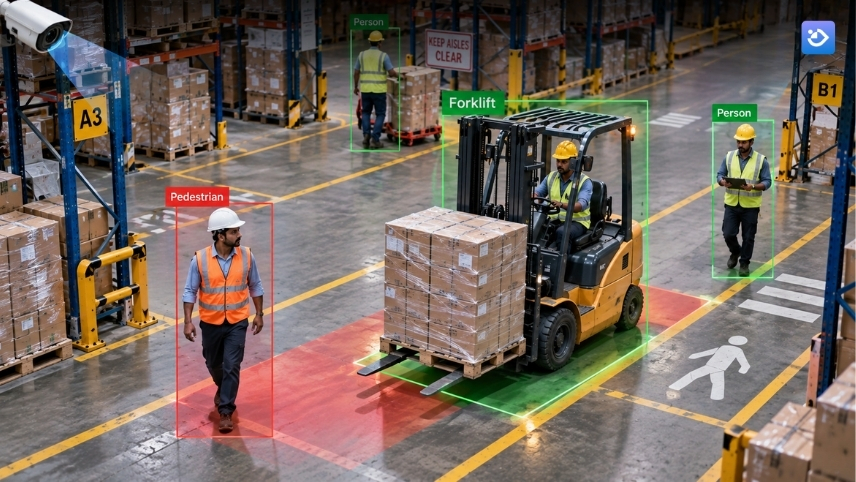
A forklift takes a blind corner two seconds faster than usual. Nobody notices. It happens again the next shift, and the one after that, until the day a pedestrian is standing exactly where the corner opens up. This is how most warehouse incidents actually happen: not as one dramatic failure, but as a small deviation nobody was watching closely enough to catch.
Painted lanes and posted speed limits assume the floor looks the same every day. It never does. Pallet stacks shift, shifts rotate, temporary staff arrive during peak season, and the blind corner that mattered yesterday is not the one that matters today.
Forklift Safety AI exists for exactly this gap. It does not replace training or signage. It replaces the assumption that a rule, once written, keeps working forever.
The Gap Between Written Policy and Floor Reality
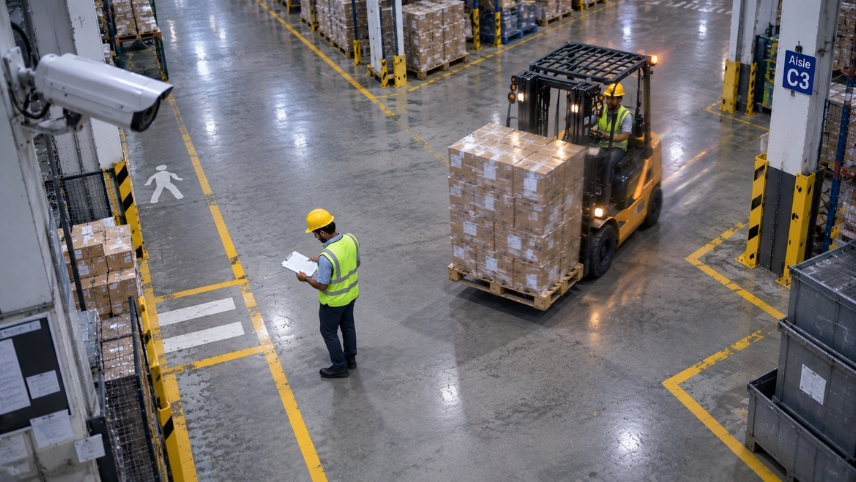
Every warehouse has a safety policy. Very few have a way to know, in the moment, whether that policy is being followed on the third shift when supervision is thinnest.
The pattern behind forklift accidents is consistent: it is rarely one dramatic failure. It is a slow accumulation of small deviations nobody caught in time.
- Blind corners taken too fast. A forklift clears a corner two seconds faster than policy allows, week after week, until a pedestrian is also stepping around it.
- Loads stacked past the rated height. The alternative was a second trip, so the shortcut became habit rather than exception.
- Restricted areas treated as shortcuts. A busy shift turns a barrier into a suggestion because the barrier is a sign, not a system.
According to OSHA, 70% of forklift accidents could be prevented through consistent training and adherence to standard safety measures. The gap is not knowledge. It is visibility into whether the known standard is being followed at the moment it matters.
Why Cameras Alone Were Never the Answer
Most facilities already run CCTV. Very few run a system that watches the footage in real time and warns someone before something goes wrong. A camera that only produces a recording for after-the-fact review is a documentation tool, not a safety tool.
AI CCTV Software changes what the camera is for. Instead of storing footage a human reviews after an incident, computer vision models process the live feed continuously and flag the specific behaviors that precede accidents.
- Speed and proximity detection: flags a forklift approaching an intersection or a pedestrian faster than the safe threshold, before contact occurs.
- Restricted Area Monitoring: identifies when a forklift or a person enters a zone that should be off-limits during specific operations, such as near racking under load or a loading dock edge.
- Load and stability recognition: flags a visibly unstable or overloaded pallet before it is moved.
- Worker Safety AI: distinguishes people from equipment and triggers a real-time alert the moment the two paths intersect.
This is the foundational shift. Industrial AI Software does not ask your team to change how they work. It asks the environment itself to start noticing what a human supervisor cannot watch across every aisle, every shift, every day.
Still relying on cameras that only record?
Mikshi AI alerts you before the incident happens.
Book a demoWarehouse Monitoring Was Built for Inventory. It Needs to Also Be Built for People
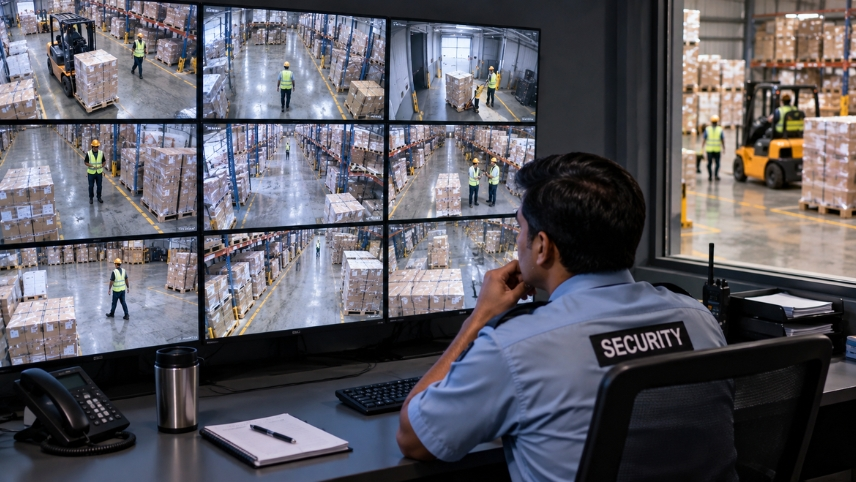
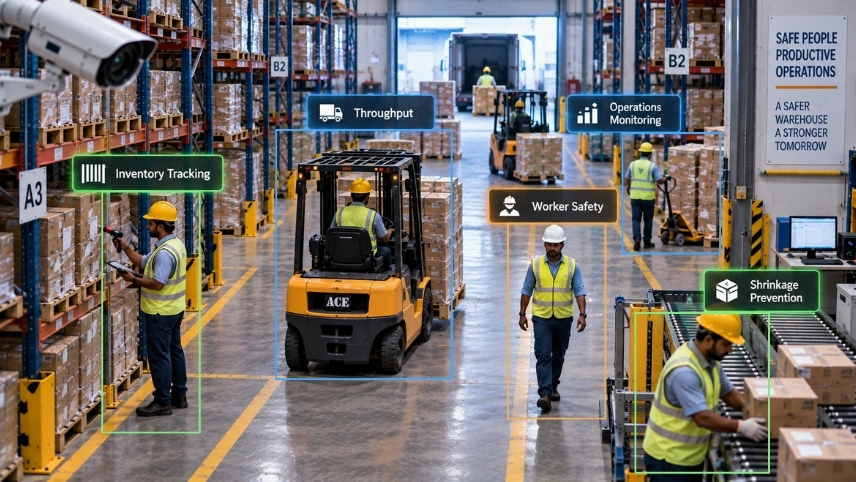
Most Warehouse Monitoring investments over the last decade were justified by inventory accuracy, throughput, and shrinkage reduction. Safety was a secondary benefit, if it was mentioned at all. That framing is changing.
Gartner survey data from December 2023 found that 20% of supply chain professionals had already adopted AI-enabled vision systems, with adoption expected to reach half of all warehouse operators by 2027. The same analysts noted that these systems identify safety issues and ergonomic risks for workers in real time, not just inventory discrepancies.
- Shared infrastructure: Warehouse Safety AI now runs on the same camera network that already supports cycle counting and dock scheduling, so incremental hardware cost is minimal.
- One platform, three stakeholders: a single warehouse monitoring layer can serve operations, compliance, and safety teams at once instead of requiring three separate systems.
- Searchable history: incident and near-miss data becomes a searchable record instead of hours of un-indexed footage nobody has time to review.
Treating forklift and worker safety as a by-product of an inventory camera network was always a missed opportunity. The cameras were already watching. The question was whether anything was watching back.
The Accountability Test for Any Safety AI Vendor
Before committing budget to any Factory Safety Monitoring or Warehouse Safety AI vendor, there is a fast way to separate a genuine safety system from a rebranded surveillance product. Ask three questions.
- Does it act before the incident, or only document it after? A system that generates a report the next morning is a records tool. A system that alerts a floor supervisor while the forklift is still moving is a safety tool.
- Does it distinguish context, or only detect motion? A restricted area monitoring system that cannot tell a scheduled maintenance crew from an unauthorized entry will generate so many false alerts that your team starts ignoring it within a month.
- Does it integrate with what your team already uses? and worker safety alerts are only useful if they reach a phone, a radio, or a dashboard someone is actually watching, not a separate portal nobody logs into.
Any vendor claiming to offer Manufacturing Safety AI or Forklift Safety AI should answer all three without hedging. If they cannot, you are buying a camera upgrade, not a safety program.
Computer Vision Manufacturing Applications Extend Beyond the Forklift Itself
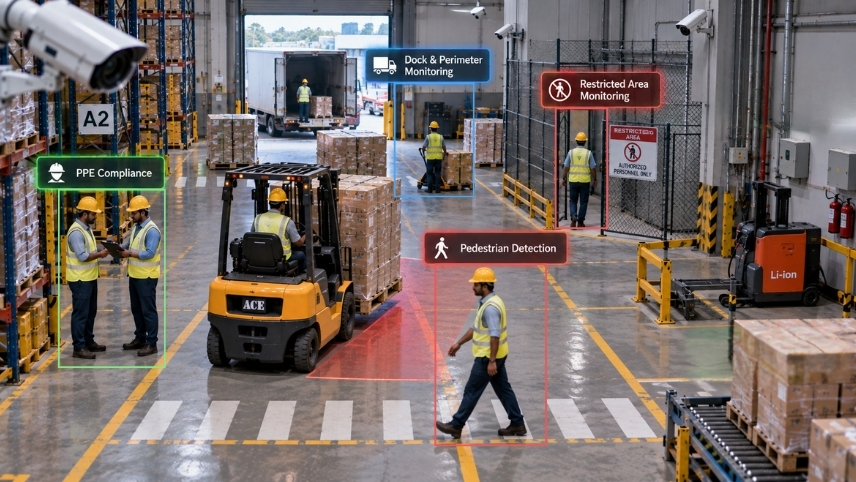
Forklifts rarely operate in isolation. In most facilities, the same aisles handling material movement also see foot traffic, Fire Detection AI coverage near charging stations, and access points that need to stay restricted to authorized personnel only.
- PPE coverage beyond the operator: Computer Vision Manufacturing deployments increasingly monitor PPE compliance for anyone entering a forklift operating zone, since pedestrian injury severity during forklift incidents consistently exceeds operator injury severity.
- AI Perimeter Monitoring: extends the same detection logic to loading docks and yard areas, where forklifts transition between indoor and outdoor operation and visibility drops.
- One vision layer, many use cases: Vision AI Manufacturing systems already monitoring PPE and restricted zones can be extended to forklift-specific detection without standing up a separate platform.
The efficient path is not five disconnected point solutions bolted onto a facility over five years. It is one vision AI layer, built to expand as new use cases emerge on the same floor.
Logistics Solutions Where Safety and Throughput Are the Same Metric
Facilities that treat safety and productivity as competing priorities usually get less of both. A forklift forced to move cautiously because the environment gives it no real-time information is slower and still not meaningfully safer.
- Fewer near-miss stoppages: Logistics Solutions built around real-time vision AI reduce the frequency of near-miss stoppages, a hidden throughput cost most facilities never formally track.
- Lower claims exposure: insurance and workers' compensation exposure drops measurably as incident frequency drops, a connection increasingly visible in facility-level safety AI case data.
- Faster verified-clear movement: confident forklift movement through verified-clear zones directly supports the same dock-to-stock cycle time targets that warehouse monitoring investments already aim to improve.
Safety AI is not a tax on operational speed. In a well-instrumented facility, it is one of the inputs to operational speed.
What Changes in the First Ninety Days
Facilities that install Forklift Safety AI typically see the value curve in two phases. The first thirty days surface behaviors nobody knew were happening. The next sixty show whether those behaviors actually change once operators know the system is watching and responding in real time.
- Weeks 1-4: Baseline data collection reveals actual speed patterns, near-miss frequency, and restricted area entries, providing a clearer picture of safety behaviors across the facility.
- Weeks 5-12: baseline data collection reveals actual speed patterns, near-miss frequency, and restricted area entries, often higher than leadership expected.
- Beyond 90 days: incident and near-miss trends become the baseline for continuous improvement conversations with operations, EHS, and insurance stakeholders together.
This is the moment a facility stops treating safety monitoring as a compliance requirement and starts treating it as an operating system input, the same way throughput and downtime already are.
What would ninety days of real-time alerts change?
Facilities that try it stop reacting and start preventing.
Get Started With Mikshi AI, Without Overhauling Your Facility
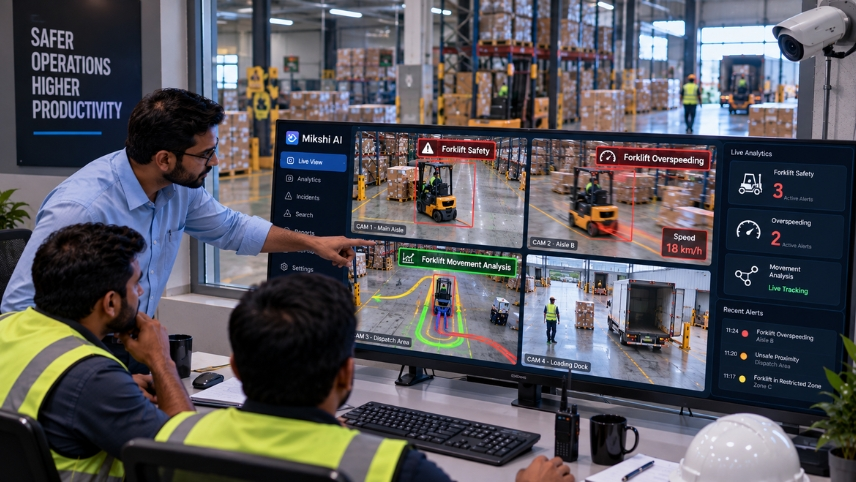
The instinct to wait for a full facility redesign before adopting Forklift Safety AI is understandable, and it is also the reason most facilities delay adoption by years longer than necessary. Mikshi AI is built for the narrower, faster starting point.
- Start with the highest-risk zones: pilot deployments typically cover blind intersections, loading docks, and restricted areas rather than attempting full-floor coverage on day one.
- Upgrade, don't replace: existing CCTV infrastructure can often be upgraded with AI CCTV Software rather than replaced, which materially lowers the initial investment.
- Weeks, not quarters: integration timelines for a focused pilot are measured in weeks, not the multi-quarter roll-outs associated with full warehouse management system overhauls.
The facilities furthest ahead on forklift safety AI did not start with a company-wide mandate. They started with the one intersection where the safety officer already knew, before any data confirmed it, that something was going to happen eventually. Mikshi AI is where that first pilot begins.
Still checking safety with a quarterly walk-through?
The facilities that move first set the standard that the competitors chase.
Book a demoIn this article
- AI-Based Forklift Safety Monitoring
- The Gap Between Written Policy and Floor Reality
- Why Cameras Alone Were Never the Answer
- Warehouse Monitoring Was Built for Inventory. It Needs to Also Be Built for People.
- The Accountability Test for Any Safety AI Vendor
- Computer Vision Manufacturing Applications Extend Beyond the Forklift Itself
- Logistics Solutions Where Safety and Throughput Are the Same Metric
- What Changes in the First Ninety Days
- Get Started With Mikshi AI, Without Overhauling Your Facility


