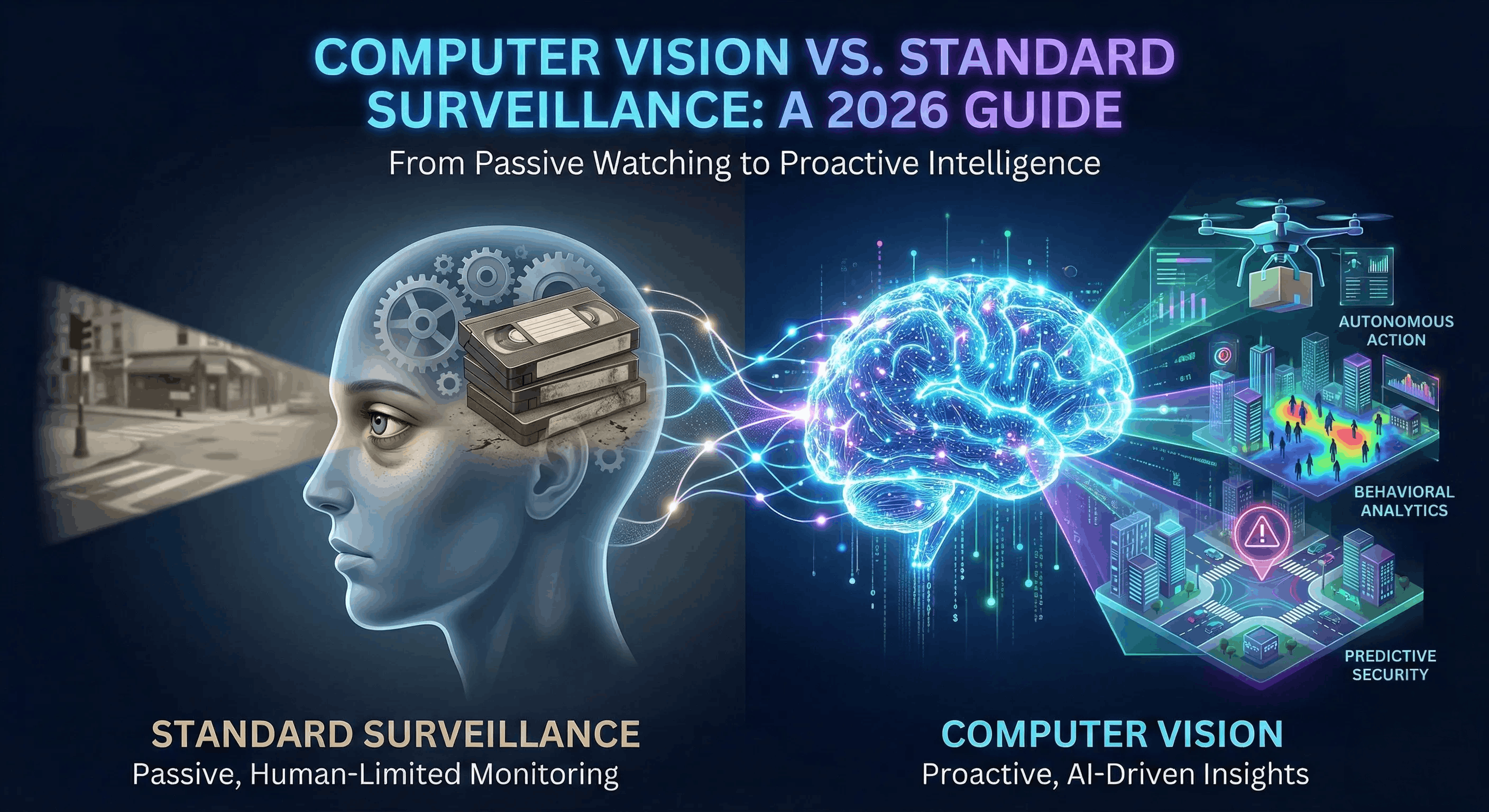
Computer Vision vs Standard Surveillance
Why This Conversation Matters Today
For decades, CCTV surveillance has been a passive tool, useful only after an incident occurs. But business environments are faster, riskier, and more complex than ever before.
From manufacturing floors to logistics hubs, from campuses to smart cities, leaders are asking a crucial question:
"How do we make our surveillance systems smarter, faster, and more proactive?"
The answer lies in computer vision, the same technology powering autonomous vehicles, robotics, and advanced security systems.
With platforms like Mikshi AI, computer vision is no longer futuristic, it's a practical, scalable solution for organizations of all sizes.
This blog breaks down the difference between computer vision and standard surveillance, and what business leaders must understand before deciding their future security strategy.
What Is Standard Surveillance?
Standard surveillance refers to traditional CCTV systems that record video footage for manual review without real-time analytics or automated decision-making.
These systems:
- Capture video continuously
- Store footage locally or on the cloud
- Require manual monitoring or post-incident review
- Do not interpret objects, people, or events
In short: They record, but they don't understand.
What Is Computer Vision?
Computer vision is a form of artificial intelligence that enables machines to interpret video content in real time, identifying objects, people, actions, and anomalies automatically.
If you're looking for a broader overview, our guide on AI video analytics and its use cases across industries explains how computer vision powers modern surveillance systems in manufacturing, healthcare, logistics, retail, and more.
Computer vision systems:
- Detect and classify objects
- Recognize patterns and faces
- Send real-time alerts
- Track behaviors and anomalies
- Analyze past footage for insights
In simple terms: Computer vision makes cameras think.
Computer Vision vs. Standard Surveillance: The Core Differences
1. Passive Recording vs. Active Intelligence
Standard Surveillance:
- Records everything
- Detects nothing
- Requires human review and often misses critical moments.
Computer Vision:
- Detects events in real time
- Sends alerts automatically
- Enables predictive insights
Platforms like Mikshi AI turn CCTV cameras into autonomous guards.
2. Human Monitoring vs. Autonomous Detection
In traditional setups, a single operator might monitor 50–200 screens, an impossible task.
Computer vision eliminates human fatigue by scanning every frame instantly.
Example events Mikshi AI detects:
- Face & People
- Intrusions
- Unauthorized access
- Smoking
- Vehicle & License Plate
- PPE compliance monitoring
- Man-down incidents
- Machine down-times
- Safety zone breaches
3. Evidence Collection vs. Threat Prevention
Standard CCTV provides context after damage is done.
Computer vision provides prevention before damage begins.
For business leaders, this shift is invaluable for:
- Reducing theft
- Preventing accidents
- Improving emergency response
- Ensuring compliance
- Avoiding costly downtime
4. Single Purpose vs. Multi-Purpose Intelligence
Standard CCTV = Security only.
Computer vision = Security + Safety + Productivity.
Mikshi AI's enterprise-grade analytics cover:
- Security: Face recognition, intrusion alerts
- Safety: PPE detection, hazardous zone monitoring
- Productivity: Assembly line bottlenecks, idle-time insights
This 3-pillar approach delivers higher ROI from the same camera network.
Why Computer Vision is Becoming a Global Business Priority
The reasons are clear: Businesses want automation, accuracy, and cost savings.
Real-world use cases of Mikshi AI:
Manufacturing Plant
Before: PPE violations unnoticed manufacturing plants → accidents, penalties
After: AI detects missing helmets instantly → alerts supervisors
Warehouse
Before: Forklift collisions due to blind spots
After: Hazardous zone detection → real-time warnings
Corporate Campus
Before: Unauthorized entry detected only during audit in corporate campuses
After: Facial recognition → instant blocking & notifications
Production Line
Before: Bottlenecks found through monthly reports
After: AI identifies delays live → saves hours of downtime
Why Business Leaders Are Choosing Mikshi AI Over Standard Surveillance
1. No hardware overhaul required
Works with existing CCTV infrastructure.
2. Enterprise-grade scalability
Deployable across multiple locations, floors, or regions.
3. Built with Mantra Softech's legacy
- 16+ years
- 2000+ workforce
- Presence in 40+ countries*
- Aadhaar-scale reliability
4. Securiyt + Safety + Productivity, all on one platform
Most providers solve one problem. Mikshi AI solves three.
5. High ROI from operational improvements
- Accidents prevented → cost savings
- Thefts avoided → asset protection
- Workflow optimization → increased output
Why Should You Move from Standard CCTV to Computer Vision?
Businesses should upgrade because they:
- Need real-time alerts
- Face repeated safety violations
- Run 24/7 operations
- Have large facilities with blind spots
- Depends on manual monitoring
- Wanted to reduce downtime
- Must meet compliance standards
If any of these apply, computer vision is no longer optional; it's essential.
Conclusion: The Future of Surveillance Is Intelligent, Not Passive
Standard surveillance shows you what happened. Computer vision shows you what's happening and what will happen next.
This shift is part of a broader transformation outlined in our guide to AI video surveillance trends shaping 2026, where surveillance evolves from passive monitoring to intelligent decision-making.
Platforms like Mikshi AI ensure that your cameras are not just watching, they're thinking, analyzing, and protecting your business every second.
Transform Your Surveillance with Mikshi AI
Your cameras are already installed. Now it's time to make them intelligent.
Ready to Upgrade? Book Your Free Demo of Mikshi AI


