What is AI Video Analytics? Complete Guide to Use Cases & Industries in India
Go to any factory, warehouse, hospital, or bank branch in India, and you will find cameras. Pointed at entrances, shop floors, loading docks, corridors. The hardware investment has been made, usually years ago, usually significant.
But here is the thing that very few people understand: recording is not the same as understanding.
Most of that footage never gets watched. It sits on a hard drive until something goes wrong, and someone needs to dig through six hours to find the 90 seconds that matter. By that point, the accident had happened. The inventory has walked out. The compliance violation has repeated itself for the third quarter running.
The gap between capturing video and actually doing something with it is where most operational risk quietly lives.
AI video analytics is what closes that gap. Not by adding more cameras. By making the ones already installed actually earn their place.
In this post, we cover what AI video analytics is, why Indian businesses are moving on it in 2026, where it is being deployed, and how to evaluate whether it makes sense for your setup.
What is AI Video Analytics?
Short answer: it is artificial intelligence that watches your camera feeds so your team does not have to.
Longer answer: AI video analytics uses computer vision models to analyze live video in real time, detect specific events and patterns, and push alerts to the right people the moment something happens.
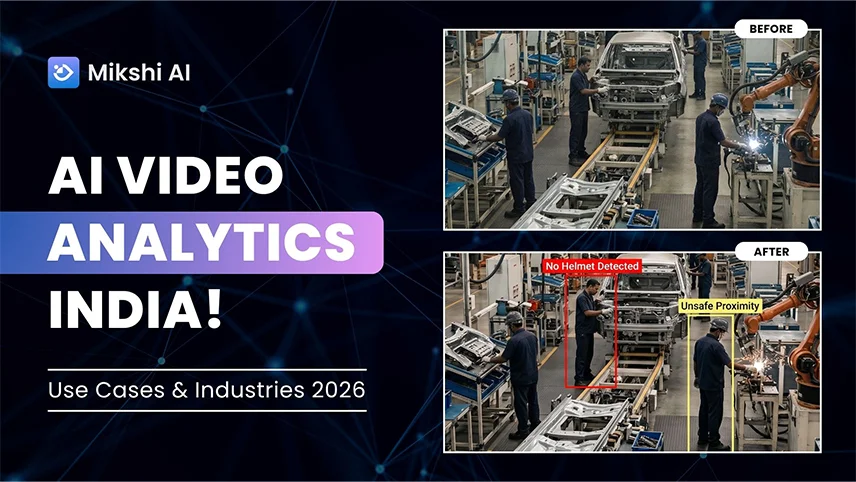
The system is not scanning for motion like a basic detector. It is trained to understand context. A worker without a helmet on a shop floor. A person who has been standing near a restricted zone for longer than makes sense.
Smoke forming near machinery. A queue that has crossed the threshold for acceptable wait time.
Traditional CCTV captures all of this. AI video analytics actually reads it.
The practical difference:
- CCTV alone: Passive recording. Reviewed manually. Useful only after something has gone wrong.
- AI video analytics: Continuous analysis. Event-based detection. Real-time alerts pushed to whoever needs to act.
- What actually changes: Surveillance shifts from a documentation layer to an operational one.
Also, critically, for most Indian businesses, this does not require replacing existing hardware. The AI software connects to the IP cameras already in place.Your CCTV Isn't Obsolete, It's Just Waiting for a Brain.
Why is AI video analytics Growing Rapidly in India?
The technology has existed in various forms for years. So why is adoption accelerating specifically now?
A few things are converging at the same time.
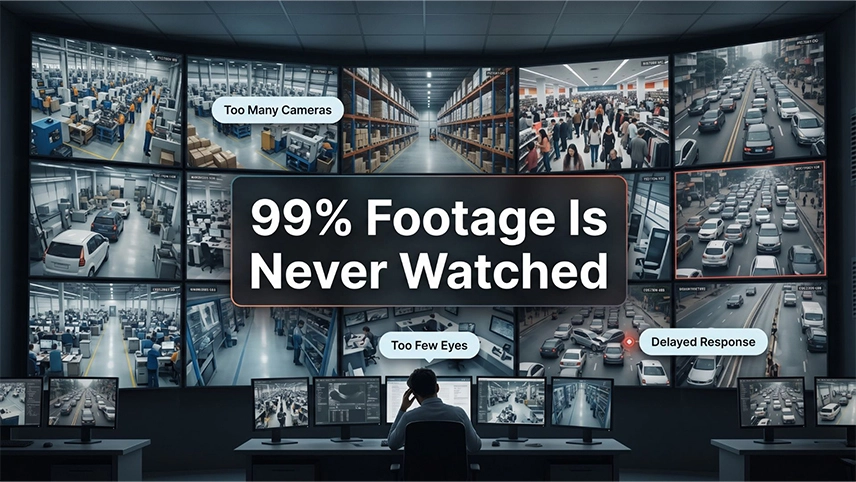
The scale problem has become impossible to ignore. Most large Indian facilities have hundreds of cameras. A pharma plant, a logistics hub near an industrial corridor, and a large retail chain with 40 stores across three cities. No security team can actively monitor that volume. Research states that less than 1% of recorded video surveillance is monitored live. Not 30%. Not 50%. 99% is not monitored. That is not a technology problem anymore. That is an operational liability.
Compliance expectations have also shifted significantly. Regulators and auditors are no longer satisfied with "we have cameras and we record everything."
The question now is: can you prove that your processes were followed consistently, across every shift, with a documented and verifiable record? That is a completely different bar, and passive CCTV does not clear it.
A few more factors pushing this in India specifically:
- The global video analytics market is projected to reach $65 billion by 2034. That level of investment means the technology is getting meaningfully better and more affordable every year. With its rising population and rising growth of industrial belts, a significant portion of this expected growth will be driven by India.
- The Smart Cities Mission has pushed over 100 Indian cities to invest in intelligent surveillance infrastructure. The ecosystem around AI video surveillance solutions is maturing fast
- Edge AI deployment models now make the technology viable in facilities with unreliable internet, which was a genuine technical blocker for many Indian industrial sites until recently.
The conversation in most Indian enterprises has moved from 'we should monitor this space' to 'which AI video analytics company in India is the right fit for our setup.
If you want context on where the technology is heading, our blog on the top AI video surveillance trends in 2026 is worth a read.
Do You Actually Need AI video analytics?
Not every business is at the tipping point yet. But the ones that need it most are usually already absorbing costs they have not fully traced back to the monitoring gap.
Here are the patterns that tend to show up just before a business makes the move towards AI video analytics.
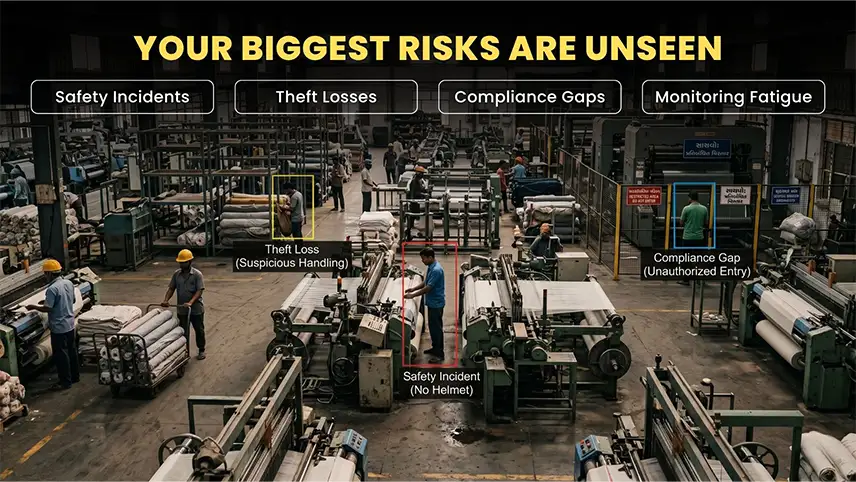
Rising safety incidents and near misses.
When small safety issues start piling up, the usual response is awareness campaigns. More posters. More toolbox talks. And the violations continue anyway, especially on night shifts and weekends when no senior person is on the floor.
- Repeated PPE violations despite documented warnings
- Near misses between workers and moving machinery
- Delayed response to falls or unsafe behavior because nobody was watching that feed
These are not discipline problems. They are a monitoring gap problem.
Increasing theft, losses, or security breaches.
Losses are rarely cinematic. They tend to be small and frequent: inventory shrinkage that does not trace to a single event, material discrepancies at month-end, after-hours access that nobody can explain clearly.
- Inventory shrinkage in warehouses or stores with no clean trail
- Unauthorized movement in restricted or high-value areas
- After-hours access that shows up in logs but cannot be connected to footage
If your investigations consistently start with "let us pull the footage and see," you already know the gap.
Compliance pressure and audit failures.
Auditors are asking harder questions now. Not just whether you have documentation but whether you can prove consistent adherence across every shift, every day.
- Recurring SOP deviation observations across consecutive audits
- No visual proof for compliance checks beyond manually signed logbooks
- Difficulty validating process adherence on shifts where supervisors were not present
Too many cameras, no real visibility (monitoring fatigue).
More cameras do not solve this. A team managing 200 feeds is not actually watching 200 feeds.
They are watching twelve and hoping nothing critical happens on the other 188.
- Security teams stretched across hundreds of camera feeds with no automation
- Missed events buried inside days of footage
- Alerts that get ignored because there are too many of them and most are noise
Expansion across multiple locations without central control.
As businesses add sites, visibility gets thinner at every location.
- Facilities running independently with no centralized oversight
- Inconsistent safety and security practices across branches
- Incident reports from remote sites arriving days after they occurred
Benefits of AI video analytics for Indian Enterprises
Businesses do not deploy AI video analytics because they want better monitoring in the abstract. They do it because specific, ground-level problems keep not getting solved any other way.
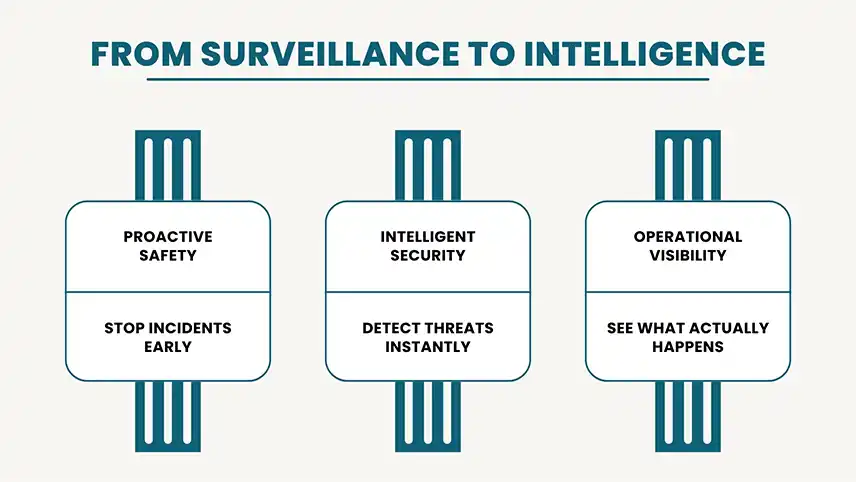
Proactive safety and incident prevention.
The shift from reacting to preventing is the most immediate change.
- PPE violations caught in real time, before someone enters a hazard zone
- Restricted area breaches detected the moment they happen
- Falls and fire risks trigger instant alerts to the right response team
Real-time security intelligence.
With AI video surveillance solutions, security teams stop being dependent on reviewing footage after damage is already done
- Instant alerts for intrusions, suspicious movement, and unauthorized access
- No need for anyone to stare at a bank of screens all shift
- Faster coordinated response across multiple locations simultaneously
Operational visibility and productivity gains.
This is usually where the surprise value shows up. The same infrastructure that handles security starts generating operational insight.
- Identify where workflow bottlenecks are actually occurring, not where you assumed they were
- Understand which spaces are used and which sit empty during peak hours
- Track queue lengths and act before customer frustration peaks
Cost versus savings: manpower, theft, compliance penalties.
The financial case is not just about system costs. It is about the cost of doing nothing.
- Reduced dependency on large security monitoring teams
- Lower losses from theft, shrinkage, and unauthorized access
- Fewer penalties from missed compliance and safety requirements
Most businesses, once they run the numbers, find they are not adding a cost. They are surfacing and removing hidden ones that were already there.
Key Components of AI video analytics Systems
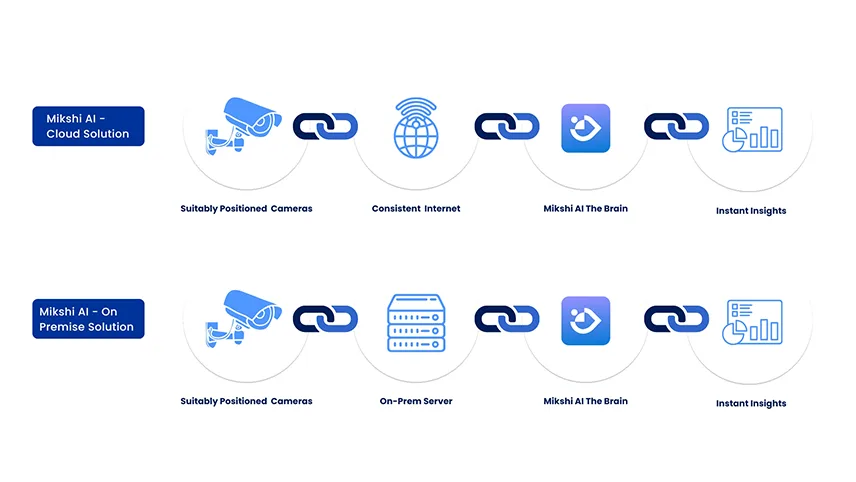
AI video analytics is not one product. It is several layers working together to convert raw video into something a business can act on.
Camera infrastructure and video input.
Most businesses already have this. The AI layer connects to what exists.
- Existing CCTV cameras serve as the data source
- No full hardware replacement required in most deployments
- Coverage spans entry points, shop floors, perimeters, and critical zones
AI models and computer vision engines.
This is where the actual intelligence sits. Models are trained on thousands of labeled examples of specific events.
- Detects PPE violations, intrusions, unsafe behavior, fire, crowd density
- Identifies patterns and anomalies as they happen, not in a batch overnight
- Improves with more data over time, especially with industry-specific training
Edge AI, cloud, and hybrid deployment.
Where processing happens matters more than most buyers initially realize.
- Edge AI runs locally, which means near-zero latency. Critical for safety applications where even two seconds of delay is not acceptable.
- Cloud handles storage, historical analytics, and multi-site dashboards.
- Hybrid is increasingly the default for Indian enterprise deployments.
Dashboard, alerts, and integration systems.
Detection only creates value when it reaches the right person fast enough to act.
- Central dashboards showing real-time activity across all locations
- Automated alerts via WhatsApp, SMS, or email
- Integrations with access control, alarms, ERP, HRMS, and IoT systems
Types of AI video analytics Deployment Models
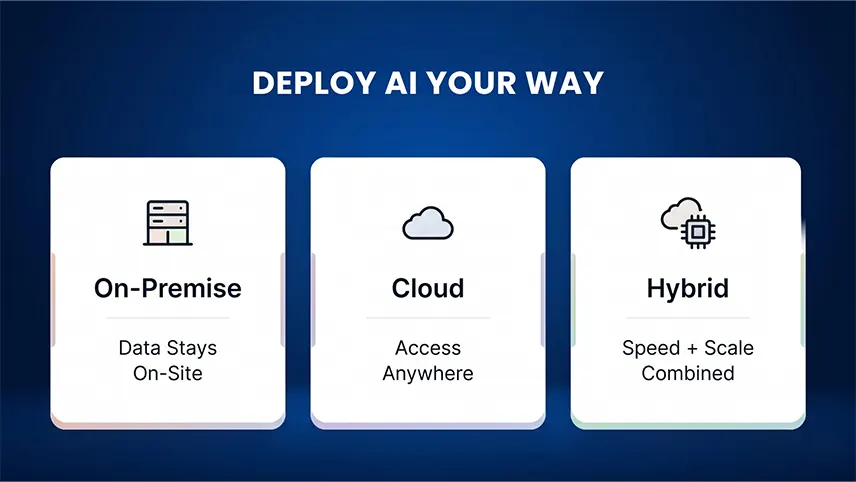
The right AI video surveillance solutions deployment model depends on data sensitivity, connectivity reliability, scale, and how quickly alerts need to reach the right person.
On-premise video analytics.
Everything runs within your own infrastructure.
- Video processing stays on-site, nothing leaves the building
- Maximum control over data and access
- Preferred by pharma, defense, banking, and other sectors with strict data residency requirements
Cloud-based video analytics.
Processing happens on remote servers.
- Easier to scale across many locations without heavy on-site infrastructure
- Lower upfront cost, accessible from anywhere
- Dependent on reliable internet, which is a real constraint in some Indian industrial locations
Hybrid and edge AI deployments.
This is where most serious Indian deployments are landing right now.
- Edge handles real-time detection and alerting with no latency dependency
- Cloud manages storage, analytics, and centralized multi-site visibility
- Gets you speed where it matters and scale where you need it, without choosing between them
Core Use Cases of AI video analytics
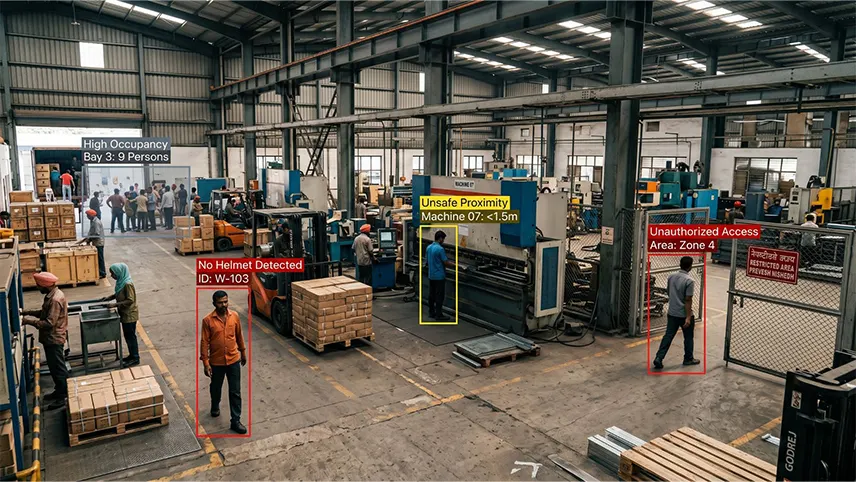
This is not about smart cameras. It is about replacing a monitoring system that depends entirely on human attention, which is finite, fatigable, and expensive, with one that actually understands what it is looking at.
Safety monitoring: PPE, fire, fall detection.
A safety officer on a large shop floor or construction site cannot be in five places at once. AI can.
- PPE compliance: The system flags a missing helmet or vest in real time, before the worker enters the hazard zone. Not in the incident report filed afterward.
- Fire and smoke detection: Large open warehouses are difficult environments for traditional detectors. AI catches the first visual signs of smoke and triggers an alarm immediately.
- Fall detection: When a worker goes down in a high-risk environment, an alert reaches the medical response team within seconds. Those first minutes matter enormously.
- Unsafe behavior detection: The system can flag risky actions like workers getting too close to heavy machinery or using mobile phones in critical zones where distraction can lead to serious accidents.
Security and surveillance: intrusion, theft, access control.
Traditional security is reactive. AI video surveillance makes it anticipatory.
- Smart perimeter protection: Virtual fences around your property mean a human breach at 3 AM generates an alert. The stray dog does not.
- Theft and loitering detection: Suspicious behavior in a restricted area, or someone tailgating through a secure door, gets flagged before it becomes a loss.
- Blacklist integration: If a known offender or a former employee with a grudge walks in, face recognition alerts management before they reach anything sensitive.
- Weapon detection: The system can identify visible weapons in real time and trigger alerts before a situation escalates.
Operational intelligence: people counting, workflow insights.
The same cameras watching for safety violations are also telling you how your operation actually runs day to day.
- Crowd and occupancy management: Know which areas are overcrowded or understaffed in real time and respond before it affects output or compliance.
- Workflow optimization: Analyzing worker movement patterns can reveal layout inefficiencies that are costing hours of productivity per shift without anyone noticing.
- Queue management: The system alerts a manager when wait time crosses a threshold, so the counter opens before customers start walking out.
- Object counting: Track movement of goods, vehicles, or assets across zones to improve inventory visibility and process control.
Compliance and audit automation.
Manual compliance documentation is slow, inconsistent, and easy to challenge.
- Automated logbooks: AI generates a timestamped daily record of what actually happened on every shift. No manual sign-offs, no memory gaps.
- SOP adherence: Hygiene protocols in food processing or pharma get monitored continuously, not just during scheduled checks.
- Digital evidence trail: When a regulator asks for proof, you pull a report in minutes instead of spending three days reconstructing events.
- Attendance monitoring: Automatically track workforce presence and shift adherence without manual logs.
Access Control & Identity Monitoring
- Tailgating detection: Identifies when unauthorized individuals follow authorized personnel through secure entry points.
- Blacklist / watchlist alerts: Flags known individuals in real time before they access sensitive areas.
- ANPR (Automatic Number Plate Recognition): Automatically captures and verifies vehicle number plates for access control, tracking, and security monitoring.
Industry-Wise Use Cases of AI video analytics in India
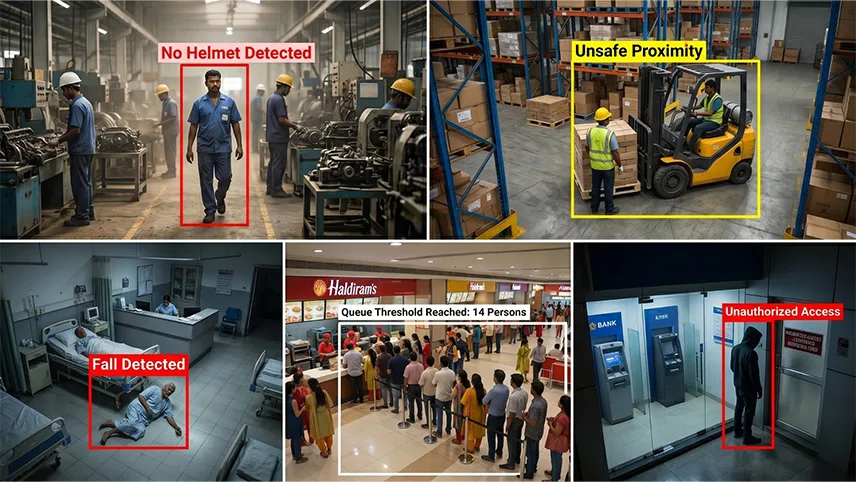
The technology is broadly consistent. What changes is the problem it is solving and what good outcomes look like in each environment.
Manufacturing and heavy industry.
Industrial environments carry the highest consequences for missed monitoring. One unreported incident can trigger a line shutdown, a regulatory investigation, and significant legal exposure.
- PPE compliance detection across assembly lines and designated hazard zones
- Restricted zone monitoring for high-voltage areas, active machinery, chemical storage
- Behavioral anomaly detection for movement patterns that tend to precede accidents
Logistics and warehousing.
Indian distribution centers are under enormous pressure in the logistics sector. High throughput, mixed workforce, constant movement, and significant shrinkage risk.
- Forklift speed and proximity alerts to reduce pedestrian near-misses
- Theft prevention at loading docks and high-value inventory areas
- After-hours unauthorized access detection
Healthcare
Hospitals combine patient safety, hygiene compliance, and complex multi-stakeholder access in a way that manual supervision alone cannot reliably manage.
- Patient fall detection with immediate nursing station alerts
- Hygiene and PPE compliance in sterile zones and ICUs
- Access control monitoring for pharmacies and restricted clinical areas
Pharmaceutical Manufacturing
Pharmaceutical facilities operate under strict compliance, where even small deviations can lead to audit risks or batch rejection. Ensuring consistent execution across shifts is the real challenge.
- PPE compliance and SOP adherence monitoring in cleanrooms and production areas
- Restricted access tracking with audit-ready visual records for inspections
See how AI-driven GMP compliance monitoring helps pharmaceutical manufacturers maintain continuous visibility across clean-room operations.
BFSI.
The most damaging threats in banking are often the quietest ones.
- ATM skimmer detection and after-hours loitering alerts at kiosks
- Tailgating detection at secure branch entrances and server rooms
- Branch queue monitoring with real-time counter management alerts
Retail chains and shopping malls.
In the retail sector, the business case runs in two directions: stop losses and understand customers better.
- Behavioral detection for shoplifting intervention before the point of loss
- Footfall heatmaps for layout optimization and merchandising decisions
- Queue alerts for checkout staffing management
- Brand consumption patterns to understand customer preferences and buying behavior
Smart cities and public sector.
Scale is the defining challenge in Indian smart cities. AI addresses what no team-based system can.
- Automated traffic violation detection without a presence at every intersection
- Crowd density monitoring during festivals and rallies to flag dangerous concentrations early
Corporate offices and IT parks.
Post-pandemic real estate decisions in the corporate offices and IT parks sector have made space utilization data genuinely strategic.
- Face recognition access control replacing physical badge systems
- Tailgating detection at server rooms and secure floor entries
- Meeting room and desk utilization tracking for energy and real estate decisions
Education.
Campus safety expectations have shifted in the education sector, and administrators need systems that do more than record.
- Real-time detection of aggressive physical behavior between students
- Automated attendance through face recognition, though deployment decisions should involve staff, parents, and students given the privacy implications
How to Choose the Right AI video analytics Company in India
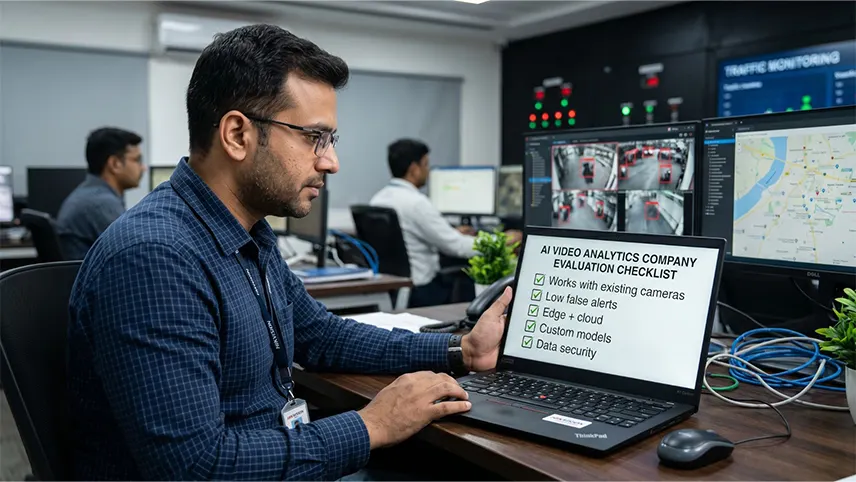
The vendor landscape has gotten crowded fast. There are enough polished demos and well-designed case studies out there that it is genuinely easy to make a decision that looks good in procurement and underperforms in production.
The real test is not how the system behaves in a controlled demo environment. It is how it performs when the internet drops, the lighting is bad, and your facility is three times larger than the reference site in the brochure.
Key features to look for in platforms.
Push past the demo before you sign anything.
- Accuracy in real-world conditions:Ask specifically how detection performs in low light, dust, rain, and heat haze. Get documented figures, not verbal assurances. Indian industrial environments are not laboratory conditions.
- Plug-and-play compatibility:Confirm the software works with your existing camera hardware. Replacing cameras changes the cost equation dramatically.
- Low false-alarm rate: A system that sends too many alerts will get ignored within weeks. Teams learn to tune out noise. Ask for false positive data by use case.
Scalability, integration, and customization.
What you need today and what you need in two years are different things. Your vendor needs to handle both.
- API flexibility:Can the platform talk to your HRMS, ERP, or access control systems? A surveillance tool that cannot integrate with anything else in your stack delivers a fraction of its potential value.
- Custom model training:Industries have specific requirements. If you need the system to recognize a particular machinery configuration or a non-standard safety uniform, the vendor should be able to train for that.
Data security and compliance considerations.
This part of the evaluation gets less attention than it deserves.
- Data residency:Does video data stay on your local infrastructure, or does it leave the facility and go to a cloud server, possibly outside India? For regulated sectors, this question has legal weight.
- Encryption and access logs:End-to-end encryption and a full audit trail of who accessed which footage and when are baseline requirements, not premium features.
- Alignment with Indian data protection norms:India's data protection landscape is tightening. Getting this right during deployment avoids expensive rework when regulations catch up.
When shortlisting AI video analytics companies in India, data residency and compliance alignment should be evaluated as seriously as detection accuracy.
From CCTV Monitoring to Intelligence with Mikshi AI
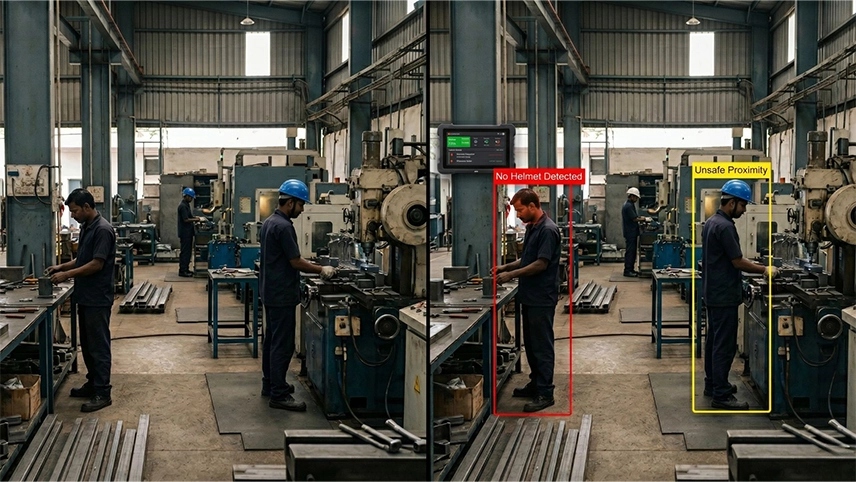
Mantra Softech has spent decades building identity and biometric security systems across global markets. Mikshi AI was built from that foundation, designed specifically for the camera infrastructure and operational realities of Indian enterprises rather than for ideal conditions that do not exist on most real shop floors.
The platform connects to what you already have and starts delivering value without a hardware overhaul.
Why Indian enterprises are switching to Mikshi AI:
- Seamless camera integrations:Works with your existing IP cameras regardless of brand. No rip-and-replace, no months of hardware procurement before deployment can begin.
- 40+ industry-specific use cases: From PPE compliance in manufacturing to footfall analytics in retail to forklift safety in logistics. Built for real-world Indian industrial conditions, not generic scenarios.
- Real-time alerts via WhatsApp, SMS, and email: Incidents get flagged the moment they happen, through the channels your team actually uses.
- Flexible and secure deployment: Edge for facilities where response speed is critical or connectivity is unreliable. Cloud for centralized multi-site visibility. Hybrid for organizations that need both. SOC 2 Type II compliant throughout.
Among AI video analytics companies in India, Mikshi AI stands out for one practical reason: it is built to work with the infrastructure Indian enterprises already have.
Most Indian organizations sitting on years of camera investment are holding a capability they are simply not using. The hardware is there. The coverage exists. What has been missing is an intelligence layer that turns continuous recording into continuous awareness.
Ready to see what that looks like for your environment?
Book a product tour with the Mikshi AI team todayIn this article
- What is AI Video Analytics?
- Why is Adoption Growing in India?
- Do You Actually Need It?
- Benefits of AI Video Analytics for Indian Enterprises
- Key Components of AI Video Analytics Systems
- Types of AI Video Analytics Deployment Models
- Core Use Cases of AI Video Analytics
- Industry-Wise Use Cases of AI Video Analytics in India
- How to Choose the Right AI Video Analytics Company in India
- From CCTV Monitoring to Intelligence with Mikshi AI


