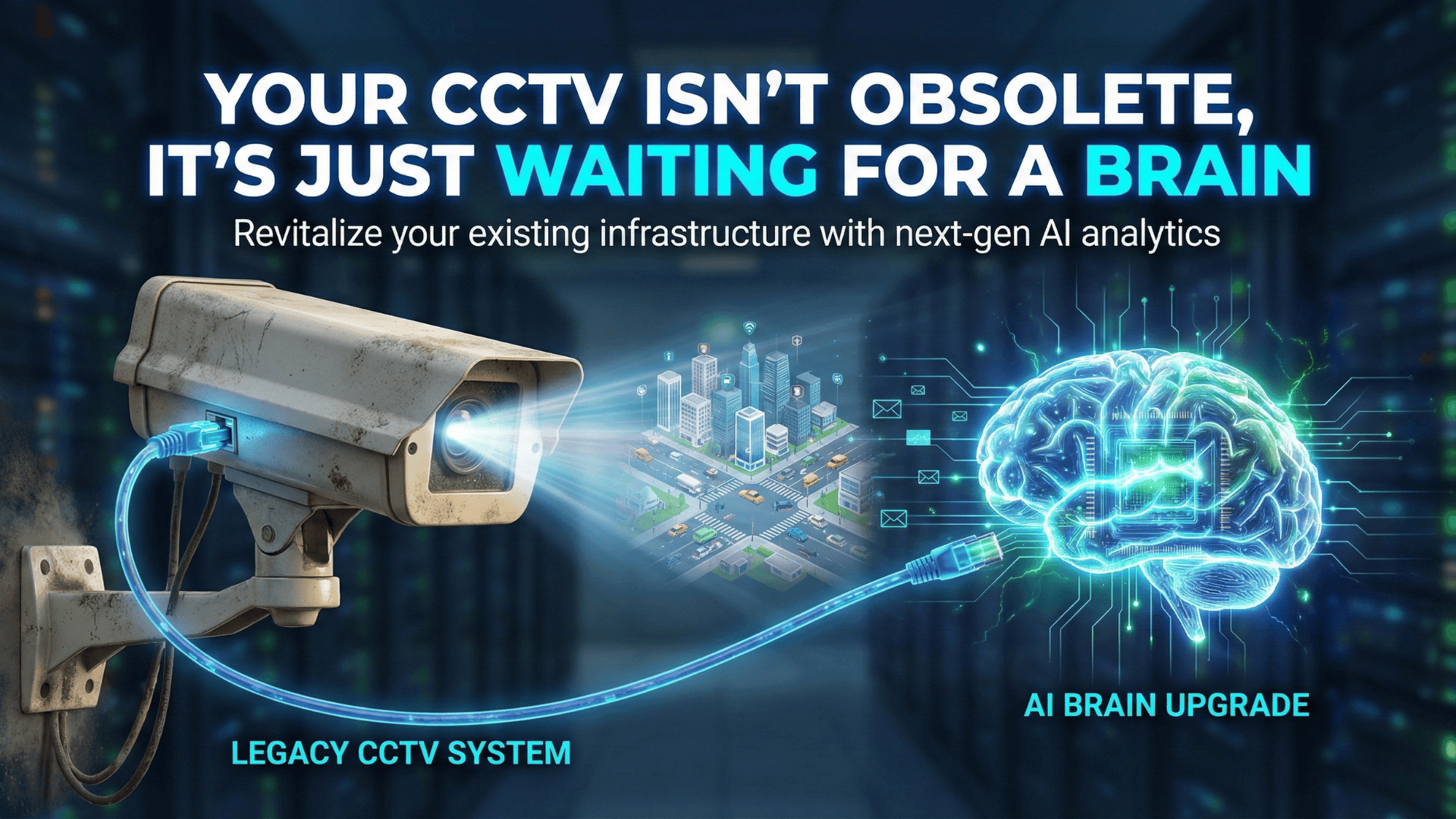
Your CCTV Isn't Obsolete. It's Just Waiting for a Brain
Most enterprises are sitting on millions of dollars of CCTV infrastructure they believe is obsolete. It isn't. The right AI video analytics software can transform any existing IP camera network into an intelligent security system without replacing a single camera.
Introduction: The Hardware Graveyard
Walk into any large enterprise, and you will likely find a "hardware graveyard" hidden in the server room: racks of expensive NVRs and boxes of legacy cameras that were state-of-the-art only five years ago.
Most companies have millions of dollars sunk into their existing CCTV infrastructure. When they want to move into the world of AI, whether for person detection, license plate recognition, or behavioral analytics, they are often told the same thing: "Rip it all out and start over."
Understanding how computer vision differs from traditional CCTV surveillance helps explain why intelligent video analytics can work with your existing camera infrastructure.
We disagree. At Mikshi, we believe software is the upgrade, not hardware. You shouldn't have to replace a perfectly functional camera just to make it smarter.
If you're exploring the technology for the first time, our guide on AI video analytics and its use cases across industries explains how AI transforms passive surveillance into real-time operational intelligence.
The Universal Language of Video
The biggest barrier to digital transformation in security is brand "lock-in." Historically, different manufacturers used proprietary languages, making it almost impossible to build a unified intelligent system.
We use industry-standard protocols to create a "universal translator" for your network:
- Camera Discovery and Control: Our software automatically discovers cameras on your network and understands their capabilities, regardless of brand or manufacturer, without any manual configuration.
- RTSP (Real-Time Streaming Protocol): This is the pipeline. It is the gold standard for pulling a live video feed from almost any IP camera (Hikvision, Dahua, Axis, etc.) and bringing it into our AI environment.
- Can AI video analytics work with existing CCTV cameras? Yes. Using RTSP, AI video analytics software like Mikshi can connect to and analyze streams from virtually any IP camera, regardless of brand, without hardware replacement.
The Challenge: The Codec Mess
Even with a universal protocol, the "language" inside the stream varies. Some older cameras use H.264, while newer ones use H.265 (HEVC). Our integration layer handles this complexity in the background, normalizing these chaotic streams so the AI receives a consistent, high-quality image every time.
Common question: Does AI video analytics support both H.264 and H.265 cameras?
Answer: Yes. Mikshi's integration layer automatically detects and normalizes H.264, H.265 (HEVC), and MJPEG streams, so your AI always receives a clean, consistent feed.
The Ingestion Pipeline (The AI Translator)
Connecting to a camera is only half the battle. The real magic happens inside Mikshi's Media Server, which acts as a high-performance bridge between your raw network traffic and our neural networks.
How the Pipeline Works:
- Packet Buffer and De-jittering: Network traffic can be "noisy." Our pipeline smooths out inconsistent bitrates to ensure the AI gets a continuous, frame-perfect stream.
- Hardware-Accelerated Decoding: Instead of taxing the CPU, we leverage GPU-accelerated decoding (NVDEC/QuickSync). This allows the system to unpack streams in milliseconds.
- Dynamic Rescaling AI models require specific input dimensions. Our pipeline performs real-time aspect-ratio correction, ensuring cameras of different brands are processed with equal precision.
| Feature | Supported Standards | AI Optimization |
|---|---|---|
| Video Codecs | H.264 (AVC), H.265 (HEVC), MJPEG | Auto-detected and hardware-decoded |
| Protocols | RTSP | Sub-300ms glass-to-glass latency |
| Resolutions | 480p up to 1440p | Real-time bi-linear down-scaling |
| Frame Rates | 5 FPS to 60 FPS | VFR stabilisation |
Scalability: Enterprise-Grade Performance
We avoid the "performance wall" through multi-threading. Every camera feed is isolated into its own execution thread. If one camera loses connection, it doesn't interrupt the rest. Our architecture allows for linear scaling, so as you grow, you simply add "worker nodes" to the cluster.
Can AI video analytics scale across hundreds of cameras in an enterprise?
Yes. Mikshi's multi-threaded, cluster-based architecture scales linearly. Each camera runs in an isolated thread, so adding capacity means simply adding worker nodes with no performance degradation.
This architecture also supports demanding applications like AI-powered restricted area monitoring, where multiple high-risk zones must be monitored simultaneously across large facilities.
The Honesty Check: What We Can't Fix
We believe in "AI realism." While our software provides a massive intelligence boost, it isn't magic.
If your existing camera is a decade-old 720p model with a smudged lens, we can still run AI on it, but we cannot "zoom and enhance" it into a 4K image. Our goal is to maximize the value of your current hardware, but the results will always be defined by the quality of the optical data we receive.
Your Infrastructure Needs a Brain, Not a Replacement
Healthcare providers are also implementing AI video analytics for hospitals and healthcare facilities to improve patient safety and operational monitoring without replacing existing camera systems.
Your current security infrastructure isn't a relic of the past. It's a massive data source that is currently underutilized. Manufacturers are already deploying AI video analytics for manufacturing plants to improve safety, productivity, and compliance using their existing CCTV infrastructure. By using Mikshi, you are turning "dumb" glass into an intelligent sensor network.
This shift reflects broader AI video surveillance trends shaping 2026, where organizations are moving beyond recording footage to making faster operational decisions.
Stop Guessing. Start Seeing. Don't let your existing hardware sit idle. See exactly how Mikshi can turn your current CCTV feeds into an intelligent security powerhouse.
Book a Live Demo with Our Engineers


