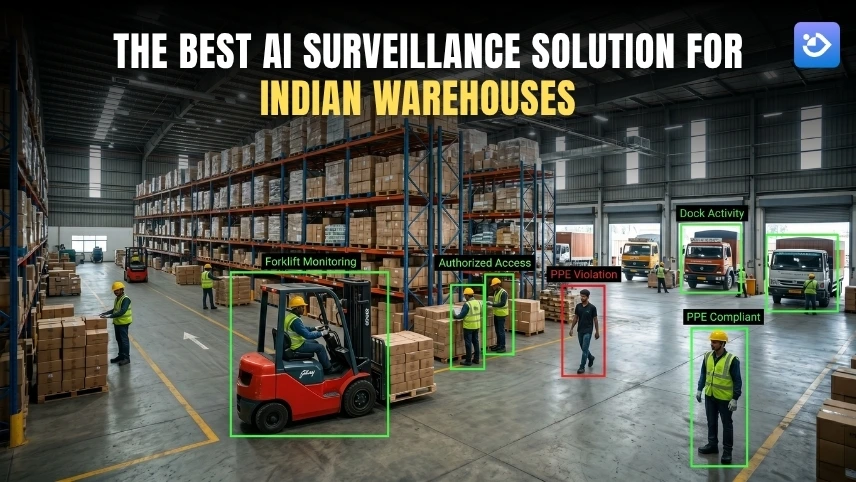
The Best AI Surveillance Solution for Indian Warehouses
Your warehouse has CCTV cameras. Probably a lot of them. They cover the dock, the floor, the entry gates, and the high-value storage zones. Your security team monitors a feed, or reviews footage after something goes wrong.
That is not AI surveillance. That is CCTV with a better resolution sensor.
Many warehouse operators are discovering that existing CCTV infrastructure can be upgraded with AI video analytics without replacing cameras or disrupting operations.
The question that most operations heads are not asking is:
What does your current system actually catch in real time, before the loss happens, before the worker gets hurt, before the compliance audit finds the gap?
Recording an event and preventing one are two completely different things. Most facilities are paying for the first while believing they have the second. And that gap is exactly where the conversation about AI surveillance solutions for warehouses India should start.
If you're evaluating intelligent surveillance for the first time, our guide on AI video analytics and its use cases across industries explains how modern systems move from recording incidents to preventing them.
The Cost of Getting This Decision Wrong
According to the ILO, the annual cost to the global economy from workplace deaths and work-related diseases is $3 trillion.
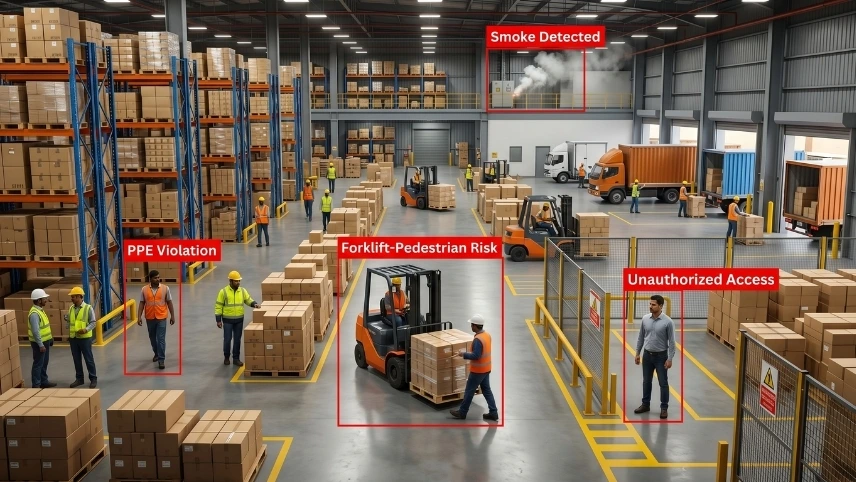
A single reportable forklift-pedestrian incident in an Indian warehouse carries direct costs: medical expenses, ESIC claims, temporary labor replacement, and the mandatory documentation cycle. In Indian operational terms, that is lakhs of rupees per incident, before you account for legal exposure or the reputational impact with enterprise clients who audit your facility.
Now look at PPE compliance monitoring across daily warehouse operations. If your facility runs three shifts with 80 workers per shift and 10% are non-compliant with zone-specific PPE requirements at any given time, that is 24 violations per day across 300 working days. Each unreported violation is a regulatory and insurance exposure event.
A proper AI surveillance solution built for warehouses in India does not just catch these events. It creates an audit trail that protects you during inspections and enterprise vendor assessments. That trail has real monetary value. The cost of the platform is rarely the number to focus on.
Your cameras are already watching.
See how Mikshi AI turns them into intelligence.
Book a DEMOWhat Warehouse-Grade AI Video Analytics Actually Looks Like
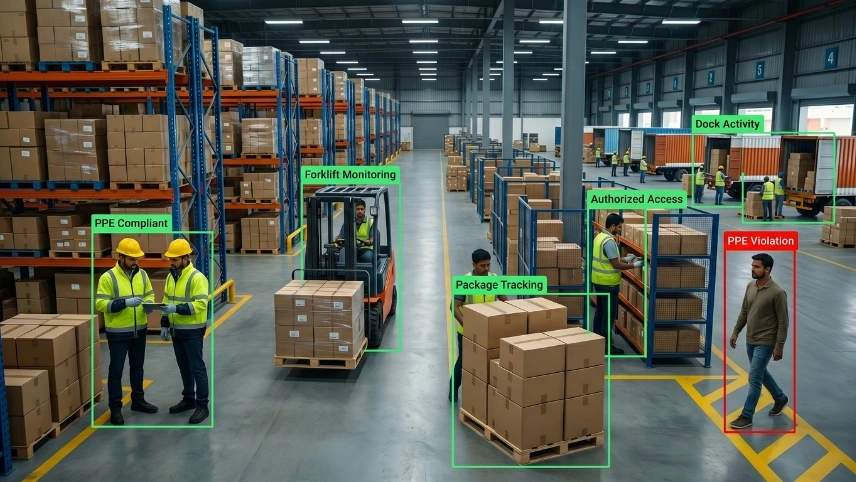
Not every AI video analytics warehouse logistics platform is built for warehouse operations. Some are security platforms that added a warehouse module. Some are manufacturing tools adapted for logistics. The underlying model training determines what the system can and cannot reliably detect. That distinction is not visible in a demo.
Warehouse-grade platforms share capabilities that general-purpose tools do not:
- Alert fatigue management: Systems that flag everything create a situation where operations staff stop responding within a week. Warehouse AI is tuned to flag actionable events, not every movement in a busy aisle.
- WMS and ERP integration: Surveillance data becomes operationally useful when dock dwell alerts connect to your dispatch scheduling, not sit in a separate security dashboard.
- Customizable zone logic: Your layout is not generic. The platform needs to let your team define restricted zones and high-alert corridors without requiring vendor intervention every time you reorganize.
The same configuration also supports perimeter intrusion detection for warehouses with large yards, loading docks, and outdoor storage areas.
latforms that lack these capabilities are not worth considering.
The India-Specific Deployment Reality Nobody Talks About
A platform built for a European distribution warehouse centre will face real friction in the Indian warehouse context. This is not a technology critique. It is a deployment reality most buyers only discover after they go-live.
Indian warehouses run a distinct operational profile:
- High contractor and temporary labor density: Many Indian logistics facilities run 30 to 50 percent of their workforce on contract, with high turnover. The platform needs to handle face-enrollment at scale and shift-level access changes without a significant IT overhead.
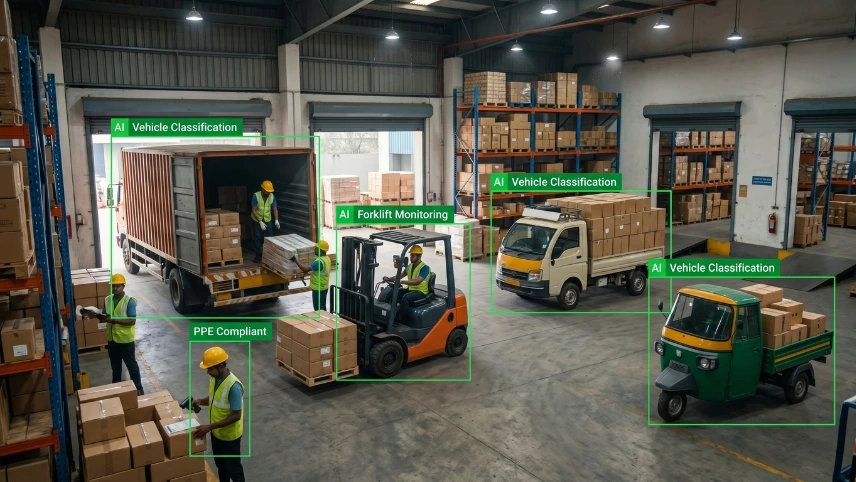
- Mixed vehicle types: Indian docks see trucks, tempos, three-wheelers, and occasionally two-wheelers. A platform trained on Western dock configurations can mis-classify these vehicle events.
- Low-bandwidth site conditions: Not every warehouse campus has enterprise-grade connectivity. The platform needs edge processing, not constant cloud round-trips for every detection event.
- Regulatory alignment: Compliance dashboards need to map to the Factories Act and state-level labor requirements, not OSHA or EU directives.
Many of these deployment challenges are similar to those faced by industrial facilities using AI video analytics for manufacturing plants in India, particularly around contractor management, safety monitoring, and edge deployments.
Indian warehouse capacity is projected to reach 300 million square feet by 2026. The facilities being built right now need AI CCTV analytics platforms that are designed for them, and not retrofitted for them.
Every warehouse has different safety, security, and operational challenges.
See Mikshi AI deployed in your warehouse.
Book a DEMOThree Questions to Ask Before You Shortlist Any Platform
Most procurement processes for warehouse AI surveillance start with the wrong inputs: vendor case studies shot in ideal lighting and feature checklists that every platform can tick. Run this accountability test instead.
Can you show me a live detection feed from an active facility, not a demo environment?
The gap between demo performance and live performance is where most buyer regret originates. Any credible platform arranges a reference site visit or live feed access.
What is the false positive rate for your top three detection categories?
In a high-throughput warehouse, a false alert every 20 minutes means your supervisor stops responding to the system within a week.
What does implementation require from my internal team?
Platforms that need extensive IT involvement create invisible costs. A mature platform deploys with minimal internal overhead and does not require vendor hand-holding every time your layout changes.
If a vendor cannot answer all three without redirecting to a brochure, that tells you something.
Mikshi AI: A Solution Built for Indian Warehouses
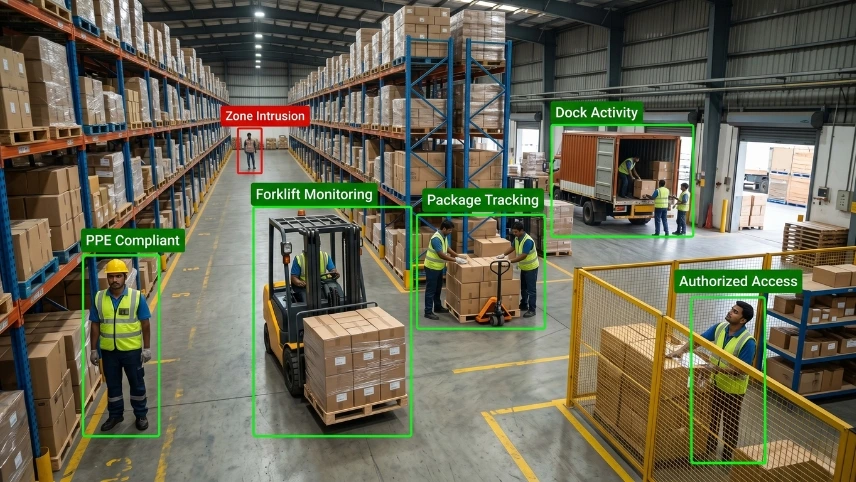
The Indian warehousing sector does not need a security upgrade. It needs operational intelligence that happens to come through cameras. That distinction matters when you are evaluating platforms because it determines whether the system helps your operations team or just your security team.
Mikshi AI is a purpose-built AI video analytics solution for logistics and warehouse operations designed for industrial environments. It delivers real-time PPE compliance monitoring, dock activity analytics, forklift-pedestrian conflict detection, zone-based access control, and perimeter anomaly alerts, all configured for the Indian facility context. The platform runs on edge hardware, so real-time detection works regardless of cloud connectivity. The compliance audit trail is structured around Indian regulatory requirements, not adapted from a Western template.
For operations leaders evaluating AI surveillance solutions for warehouses in India, Mikshi AI closes the gap between what your cameras see and what your team can act on.
AI video analytics warehouse logistics is not a future investment. Facilities that have moved to warehouse-grade AI surveillance are not just reducing incidents. They are building an audit-ready operational record that protects them with clients, regulators, and insurers. The question is not whether your facility needs this. It is how much the delay is costing you.
In this article
- The Best AI Surveillance Solution for Indian Warehouses
- The Cost of Getting This Decision Wrong
- What Warehouse-Grade AI Video Analytics Actually Looks Like
- The India-Specific Deployment Reality Nobody Talks About
- Three Questions to Ask Before You Shortlist Any Platform
- Mikshi AI: A Solution Built for Indian Warehouses


