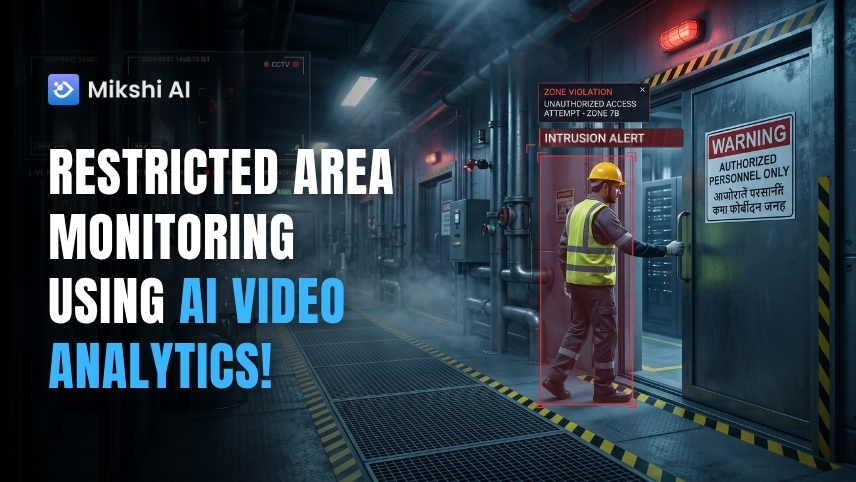
Monitor gowning compliance, clean-room access, and operator behavior in real time using AI video analytics built for pharmaceutical manufacturing environments.
Every industrial facility has restricted zones. High-voltage switch rooms. Chemical storage bays. Boiler rooms. Server rooms. Confined spaces with permit-to-work requirements. And every one of those zones has a sign on the door that says "Authorized Personnel Only."
The thing is that this sign is not a monitoring system.
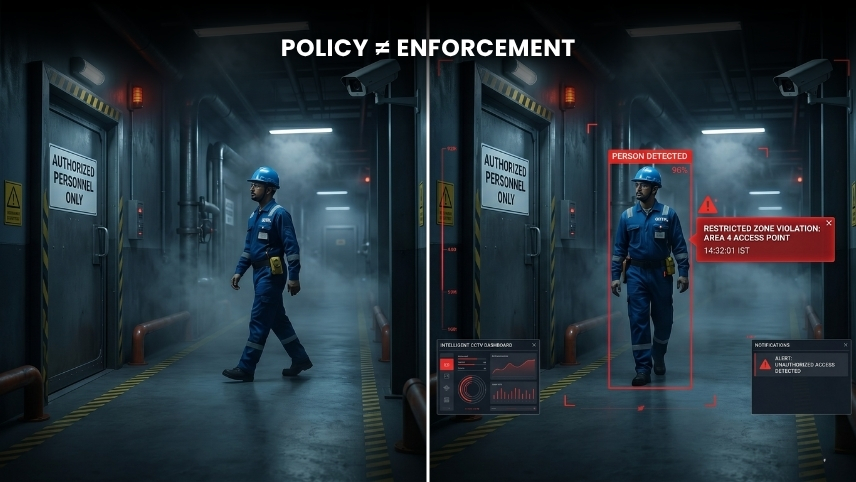
Most Indian manufacturing facilities rely on a combination of physical locks, access badges, and periodic security rounds to manage restricted zone entry. Each of these has a documented failure mode: locks get propped open, badges get shared, security rounds have gaps. None of them generate a real-time alert when unauthorized entry actually happens.
An AI restricted area monitoring system built for industrial facilities is the layer that closes the gap between access control policy and access control enforcement.Manufacturers implementing AI video analytics for manufacturing plants are increasingly using restricted-area monitoring as part of broader safety, security, and compliance initiatives. This post covers what that gap looks like in practice, what AI actually detects, and what responsible deployment requires.
The Access Control Gap That Existing Systems Cannot Close
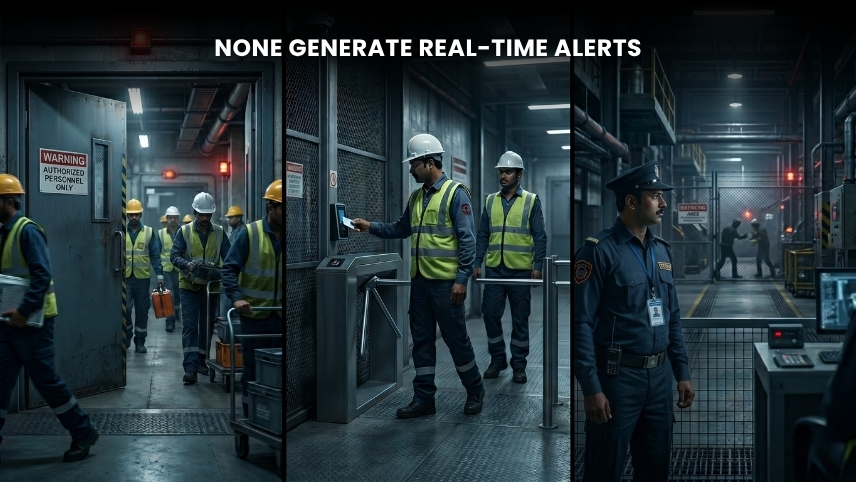
Standard access control in industrial facilities runs on three mechanisms. All three have a structural ceiling.
Physical locks are effective when doors are closed. Meaningless when propped open during shift changes or equipment movement, which happens multiple times per shift in most industrial facilities.
Access badge systems record who was granted authorized entry. They do not record who tailgated through behind an authorized person, who used a colleague's badge, or who entered a zone at the wrong time of day.
Security rounds provide periodic coverage. A round every 90 minutes leaves 89 minutes of unmonitored time per zone. Across a three-shift operation, that is a significant exposure window in every restricted area.
An AI intrusion detection system for manufacturing floors does not replace these systems. Instead, it fills the gap that all of the above three systems leave: a real-time alert when unauthorized entry actually occurs, regardless of whether the door was locked, the badge was valid, or the last round was clean.
What AI Restricted Area Monitoring Actually Detects
In an industrial restricted zone context, an AI access control video analytics system is configured to detect specific behaviors:
Unauthorized personnel entry: A contractor in a chemical storage area, an unauthorized visitor in a high-voltage room, or a worker crossing into a zone outside their shift-authorized perimeter, all generate immediate alerts.-
Tailgating detection: Two people pass through a single badge swipe. The badge logs one authorized entry. The AI system logs two bodies crossing the threshold and alerts on the second. After-hours zone access: A zone that should be empty between 10 PM and 6 AM shows movement. Alert reaches the control room immediately rather than appearing in a morning review.-
Loitering near restricted perimeters: Abnormal dwell time near restricted zone boundaries is a documented precursor to intentional access violations. AI flags it before entry occurs. Contractor and visitor movement: Third parties moving through a facility with limited zone discipline are covered on the same system without additional deployment.
According to DGFASLI data cited by the British Safety Council India, three people were killed and eleven injured every day on average in India's registered factories between 2017 and 2020. Unauthorized access to restricted zones is a causal factor in a significant number of those incidents.
Why Industrial Environments Create Specific Monitoring Challenges
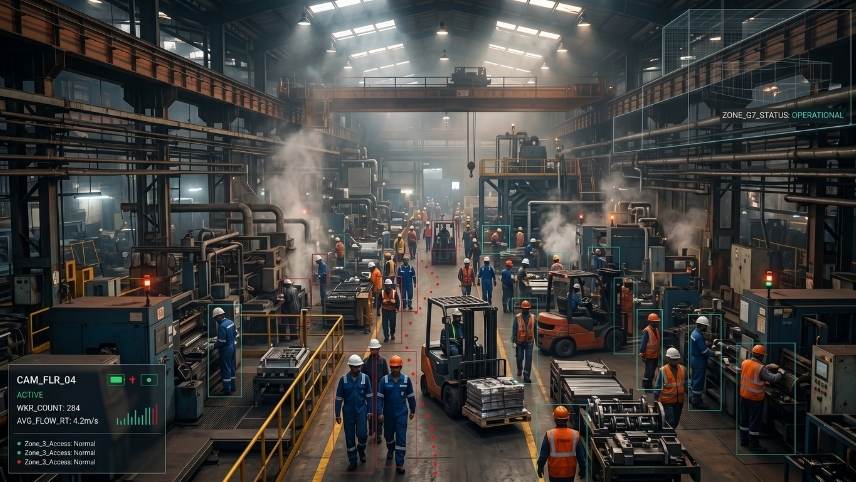
Generic surveillance platforms under-perform in industrial restricted zone monitoring for reasons specific to the environment.
High workforce density during shift changes
This creates a detection environment that AI models not trained on Indian industrial conditions handle poorly. False positives during transitions undermine trust and lead to alert fatigue that renders the system useless within weeks.
Contractor and temporary worker complexity
Indian manufacturing facilities routinely operate with a significant proportion of contract labor whose zone permissions change by day, project, and shift. In regulated sectors such as pharmaceutical manufacturing and life sciences, restricted-area monitoring also plays a critical role in maintaining compliance across clean-rooms, production areas, and controlled-access zones. Badge systems lag permission changes. AI restricted area monitoring for industrial environments configured against current zone permissions in real time does not.
Environmental conditions inside restricted zones
Chemical plants, boiler rooms, and confined spaces operate in low light, steam, dust, and heat. Detection accuracy in these conditions is a configuration and training question that any vendor evaluation should test directly before sign-off.
Multiple zone types with different rules
A chemical facility has different access requirements for storage zones, mixing areas, confined spaces, and high-voltage rooms. AI access control video analytics must be configurable at zone level, not as a single facility-wide rule.
The sign says Authorized Personnel Only.
CCTV camera only records who ignored it.
AI tells you while it is happening so you can stop it.
Book a Free Demo with Mikshi AIFactories Act and OSH Code: Why Monitoring Evidence Matters
The Factories Act 1948 places explicit duties on employers to prevent unauthorized access to hazardous areas. Many facilities combine restricted-area monitoring with PPE compliance monitoring to create a stronger safety and compliance framework across hazardous work environments. Section 36 covers confined spaces. Section 21 addresses the fencing and guarding of dangerous machinery. The OSH Code 2020, when fully operationalized, extends these obligations across a broader range of facilities.
The compliance gap in India is structural. According to DGFASLI data obtained via RTI and reported by IndiaSpend, only 69% of sanctioned factory inspector posts were filled as of 2020, thus amounting to approximately one factory inspector for every 412 working factories. Factory inspection coverage cannot be relied upon as a compliance backstop.
When an incident occurs in a restricted zone and the investigation finds no monitoring evidence, the liability falls entirely on the facility. "We had a policy" is not a defense in a Factories Act inquiry or a civil negligence proceeding. "We have timestamped, camera-referenced evidence of continuous restricted zone monitoring" is.
AI intrusion detection system for manufacturing creates that evidence trail automatically, on every shift, without a human having to remember to log it.
One unauthorized entry into a confined space is one investigation away from a fatality finding.
Evidence of active monitoring is the difference between a policy and a defense.
Book a Free Demo with Mikshi AIHow Mikshi AI Handles Restricted Area Monitoring in Industrial Facilities
The AI restricted area monitoring system for industrial environments is built for Indian manufacturing, chemical, pharma, and heavy industry facilities.
- Zone-by-zone configuration: Every restricted area has different access rules, shift permissions, and risk profiles. Mikshi AI configures each zone independently. Zones like chemical storage, high-voltage rooms, confined spaces, and server rooms are configured independently rather than applying a single facility-wide rule.
- Works on existing cameras: No hardware replacement required. The AI layer deploys on existing IP cameras as it has ONVIF-compliant CCTV infrastructure.
- Tailgating and multi-person detection: Mikshi AI detects the difference between one authorized swipe and two bodies crossing the threshold simultaneously.
- After-hours and shift-transition monitoring: The highest-risk windows for unauthorized access are covered continuously without a headcount dependency.
- On-premise or cloud deployment: Fully on-premise deployment keeps restricted zone footage within your facility's own infrastructure for facilities with data residency requirements.
- Alert routing to the right people: Alerts go to the security control room and the relevant zone supervisor simultaneously, not into a generic dashboard queue.
- India-based support: Implementation and ongoing support runs in Indian time zones by a team that understands Indian industrial facility layouts, contract workforce dynamics, and Factories Act compliance context.
Deployment goes live on existing cameras in days. No construction, no production downtime.
Access Control Policy and Enforcement Are Not the Same Thing
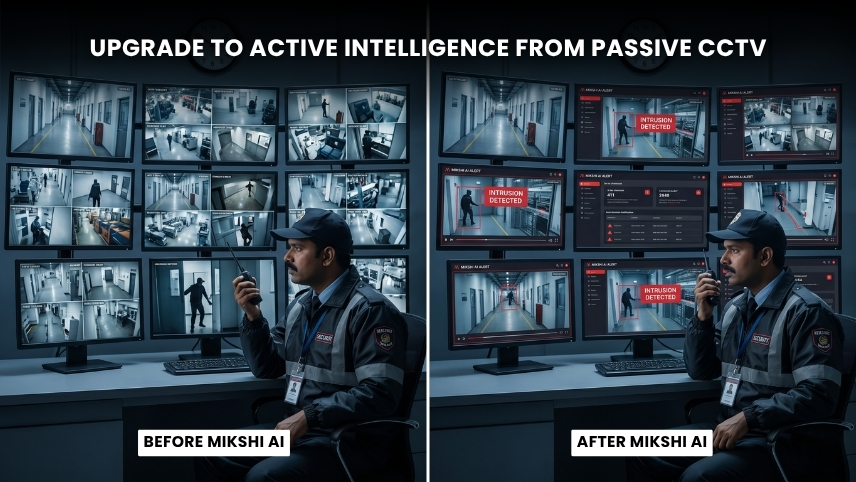
An AI restricted area monitoring system for industrial facilities closes the gap that every badge system, every physical lock, and every security round leaves open: the real-time, documented record of what actually happened in every restricted zone, on every shift, regardless of whether a supervisor was present.
An AI intrusion detection system for manufacturing does not replace your access control infrastructure. It makes it enforceable in practice rather than on paper. And in a regulatory environment where factory inspector coverage runs to one inspector per 412 factories and the duty of care rests entirely with the facility, that distinction is the difference between a policy and a defense.
One unauthorized entry can become one major investigation.
See Restricted Zone Breaches As They Happen.
Book a Free Demo with Mikshi AIIn this article
- The Access Control Gap That Existing Systems Cannot Close
- What AI Restricted Area Monitoring Actually Detects
- Why Industrial Environments Create Specific Monitoring Challenges
- Factories Act and OSH Code: Why Monitoring Evidence Matters
- How Mikshi AI Handles Restricted Area Monitoring in Industrial Facilities
- Access Control Policy and Enforcement Are Not the Same Thing


