Top 9 Safety Challenges in Steel Manufacturing and How AI Solves Them
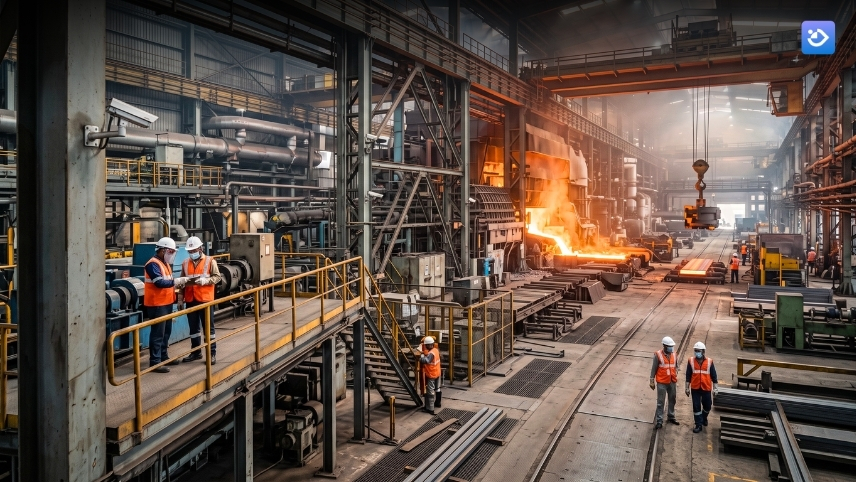
The safety officer at a steel plant does the same walk every shift. Furnace bay first, because that is where a bad day starts fastest. Then the casting floor, then the crane runway, then the yard where ladles move on rail. He checks fifteen things in twenty minutes and trusts that the cameras mounted on every pillar are catching the other twenty three hours he cannot personally stand there. They are not. The footage is being recorded, not watched, and it sits on a server until someone needs it after something has already gone wrong.
Here is what nobody on that floor is asking out loud: if the cameras are already running, why does anyone still find out about a violation after the fact instead of during it. The plant has already paid for the infrastructure. What it has not solved is the gap between a camera capturing a moment and a person acting on it in time to matter. That gap is where molten metal burns, crushed limbs, and furnace bay explosions actually happen, not in the footage nobody reviewed until the incident report needed it.
That is why steel manufacturing safety in 2026 is a different conversation than it was five years ago. It is no longer about adding more inspectors or more posters. It is about making the CCTV cameras a plant already owns actually think, so that the fifteen things a safety officer checks in twenty minutes become the thousand things a system checks every second, across every shift, without needing anyone to be standing there. This list covers nine of those checks in detail, spanning heat exposure, PPE, restricted zones, crane movement, fire risk, night shifts, vehicle traffic, perimeter security, and theft, and a companion piece on AI use cases for steel plants walks through how several of them actually get configured on a live floor plan.
1. Blind Spots Around Molten Metal and High-Heat Zones
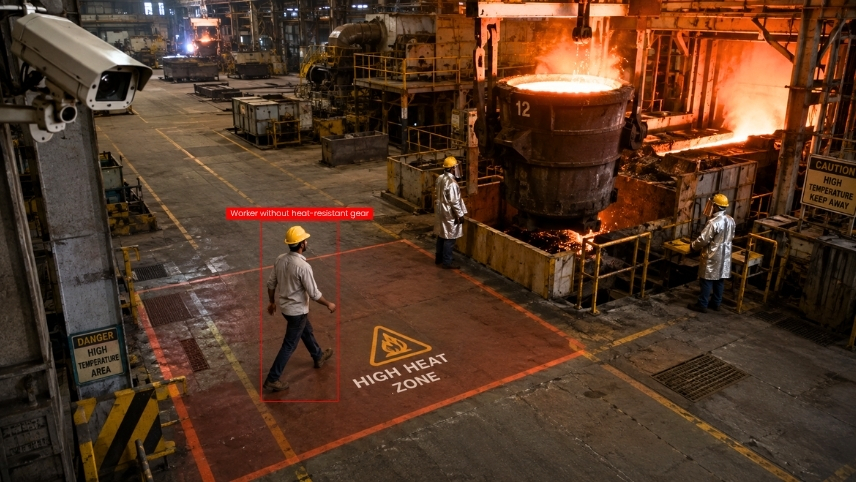
Furnace bays, ladle handling areas, and casting floors are where a steel plant's worst accidents concentrate, and they are also the areas where human supervision naturally thins out. Nobody wants to stand near a 1,600 degree pour longer than the job requires, which means the zone with the highest consequence for a lapse often gets the least continuous human attention. A supervisor doing rounds every twenty minutes is, by definition, absent from that zone for most of the shift, and the absence is longest in exactly the spot where a lapse costs the most. That is not a training gap or a discipline problem. It is a structural limit on how much of a shift one person can physically cover.
Regionally, this risk is not shrinking. Across Asia and the Pacific, 74.7 per cent of the workforce is exposed to excessive workplace heat, well above the global average.
- A worker crossing into a marked heat zone without heat-resistant gear should trigger an alert before the pour happens, not after a burn report is filed.
- Dwell time near active furnaces and ladles can be tracked automatically, flagging anyone who lingers past a safe exposure window.
- Zone breaches during a scheduled pour or tap can be detected the moment they happen, not reconstructed later from footage.
The point is not to add another sign near the furnace. It is to make the zone itself watch for the crossing that a sign cannot stop.
2. PPE Non-Compliance in Zones Where a Lapse Is Fatal
Nobody enjoys wearing a heat-resistant suit for eight hours straight. By the third hour of a night shift, gloves come off, face shields get pushed up, and the slip happens exactly in the zone where it costs the most. A supervisor walking through catches whatever he happens to see in that pass, and nothing that happens between rounds.
Furnace bays need a stricter PPE standard than a general walkway does, and steel industry PPE compliance can be checked against that exact standard, zone by zone, all the time.
- A worker enters a marked area without a face shield. The system does not wait for the next round to notice.
- Compliance stops being whatever a supervisor remembers from his walk-through and becomes a logged record, tied to shift and zone.
A PPE rule enforced only when someone happens to be watching is not really a rule. It is a suggestion that got written. A separate piece on PPE compliance monitoring with AI CCTV cameras goes deeper into how that logged record turns into an audit-ready report.
3. Unauthorized Entry Into Restricted High-Risk Areas
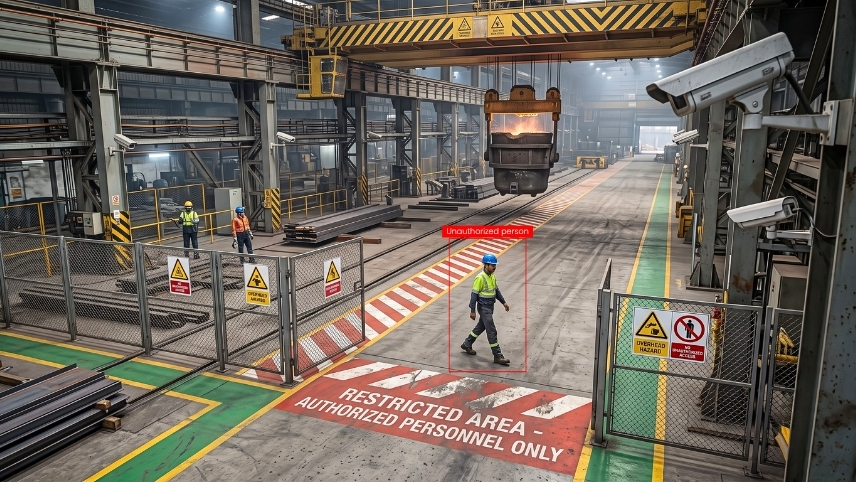
Crane runways, coke oven batteries, and gas pipeline sections get marked restricted for good reason. Contractors still cut through them. New hires still cut through them. Even veterans in a hurry take the shortcut they know is off-limits. A sign works on someone who chooses to respect it. It does nothing for someone who does not.
- Camera feeds can define these zones virtually, so any entry outside authorized hours or without clearance gets flagged as it happens.
- The same person crossing the same line twice in a week is a pattern, and it should surface as one before it becomes an incident.
- A contractor wandering outside their scope of work gets caught the moment it happens, not weeks later when a permit is finally audited.
A boundary only matters if something is actually watching it. A camera that recognizes where the line sits does not have that problem, and AI restricted area monitoring for manufacturing facilities covers exactly how those virtual boundaries get set up.
Your cameras saw it. Nobody watched, and the incident happened.
Book a demo with Mikshi AI to plug this gap4. Crane and Heavy Machinery Movement Near Workers
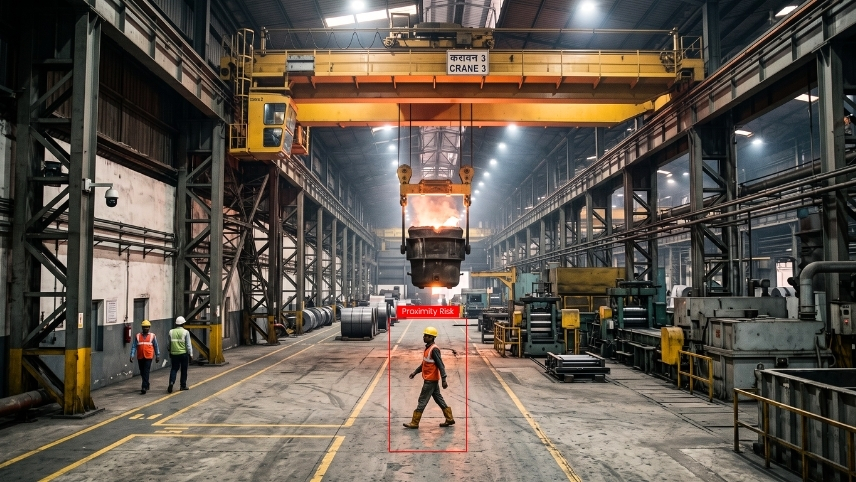
Overhead cranes moving molten ladles, rolling mills, and heavy material handlers share floor space with workers on foot, and the margin for a struck-by accident is thin. A crane operator's line of sight is not always complete, and ground personnel do not always hear a machine approaching over plant noise.
- Proximity between moving machinery and workers on foot can be tracked continuously, with alerts fired before a collision path develops.
- Crane load zones can be monitored for unauthorized personnel standing underneath or too close during a lift.
- Speed and movement patterns of material handlers inside pedestrian-heavy areas can be flagged when they exceed a safe threshold.
Workers already know the danger zone exists. What is missing is a system that watches the zone as continuously as the machine operates in it.
5. Fire and Smoke Detection Lag
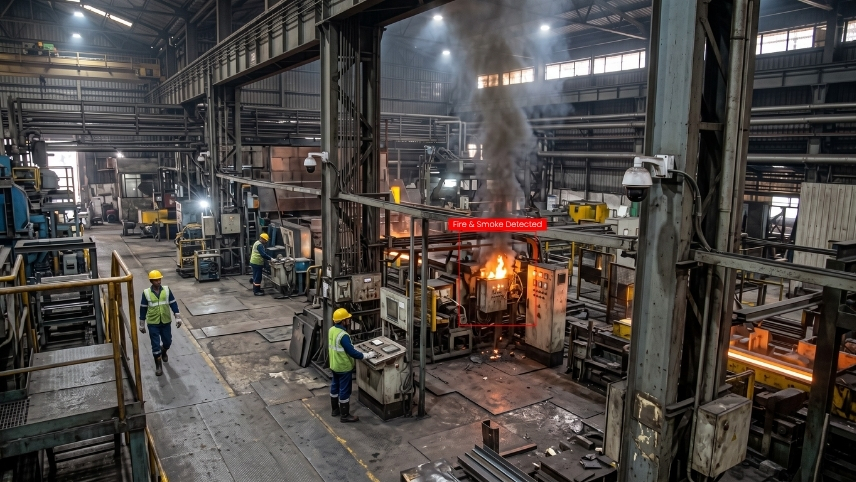
Furnace bay fires and localized flare-ups escalate fast, and the earliest visual signs, a flicker at a hot spot, a plume of smoke rising off equipment, are exactly the signs a human patrol is most likely to miss because nobody is standing in that exact spot at that exact minute. India's registered factories recorded a fatal injury rate of 5.46 per lakh workers in 2023, and fire incidents remain a disproportionate share of the worst outcomes. The rate has barely moved over the past decade even as overall injury reporting has improved, which points to fire and heat-related incidents as the harder category to bring down through inspection alone.
- Smoke and flame can be detected visually within seconds of appearing, often faster than a fixed-point sensor covering a large bay.
- Unusual visual patterns near hot equipment and material stacking areas can be flagged for inspection before a spark becomes a fire.
- Alerts can route directly to the nearest response team instead of waiting for a control room operator to notice a feed.
Ask any inspector how fast a furnace bay fire escalates. The window to catch it early is measured in seconds, not in the length of a patrol route, and closing that window is the entire premise behind continuous visual monitoring rather than periodic checks. A dedicated piece on fire and smoke detection for manufacturing plants covers how that seconds-level detection actually works on camera.
6. Night Shift and Fatigue-Driven Monitoring Gaps
The night shift runs the same plant with fewer eyes on it. Fewer supervisors, longer intervals between rounds, and workers whose own vigilance has naturally dipped by hour six. This is the shift where DGFASLI's data on Indian factories consistently shows a disproportionate share of incidents concentrating, and it is also the shift where camera footage is most likely to sit unreviewed until morning.
- A zone violation at 3 a.m. gets flagged the same way it would at 3 p.m. The system does not get tired, even if the two people covering the shift are.
- Fewer people on the floor at night does not have to mean weaker coverage. Continuous monitoring does not scale down with the headcount.
- An alert can reach whoever is on call immediately instead of sitting in footage until someone gets around to a control room screen.
Staffing drops at night. Risk does not. That mismatch is exactly what continuous monitoring is meant to close.
Danger doesn't wait for the morning shift.
Book a demo with Mikshi AI7. Vehicle and Material Handling Movement Inside the Plant
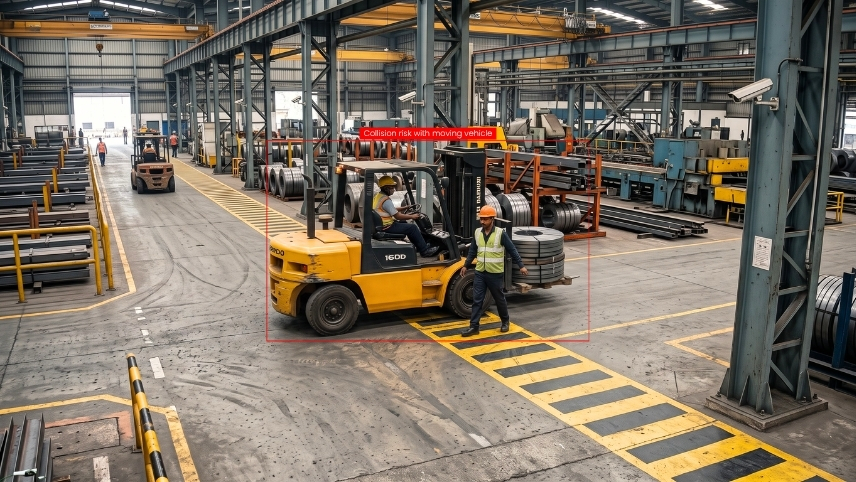
Forklifts, ladle cars on rail, and material transport vehicles move constantly through areas where workers are also walking, and the combination of blind corners, reversing vehicles, and foot traffic is a recurring source of injury that rarely makes it into a formal incident count until someone is hurt.
- Vehicle movement in pedestrian zones can be tracked, with alerts for vehicles entering walkways or moving faster than the zone allows.
- Reversing vehicles without a spotter present can be flagged automatically, closing a gap that depends entirely on procedure being followed.
- Near-miss patterns, not just actual collisions, can be logged over time to identify which junctions inside the plant need redesign.
Most vehicle incidents on a plant floor were preventable in hindsight. The value of continuous monitoring is catching the pattern before hindsight is the only tool available.
8. Perimeter Intrusion Detection
A steel plant's perimeter is long, and a fence line is only as strong as the number of people watching it. Trespassers, scrap pickers, and unauthorized visitors find the gap in coverage soon enough, usually after dark, at the stretch of boundary furthest from the guard post.
- Perimeter breaches can be flagged the moment someone crosses the fence line or an unmanned gate, not on the next patrol round.
- Loitering near boundary walls, loading docks, and gate areas outside operating hours can be detected automatically.
- Steel plant safety monitoring at the perimeter can run continuously across every stretch of boundary at once, something a limited guard headcount cannot match.
A fence stops the person who respects it. It does nothing for the one testing where nobody is looking, which is exactly the gap continuous monitoring closes.
9. Material and Scrap Theft
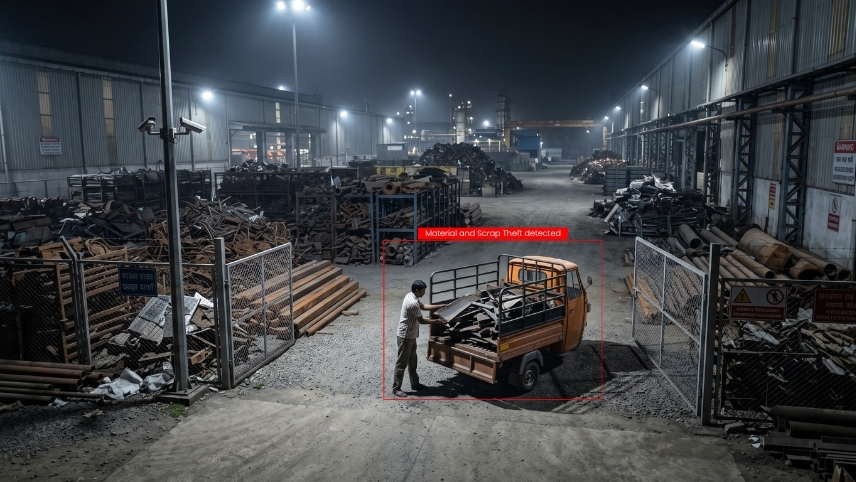
Coils, billets, and scrap metal move through a plant in large volumes, and a piece going missing during loading, unloading, or yard storage often is not noticed until the next stock reconciliation, days after the fact. By then, there is no footage anyone thought to pull and no way to say when or how it left.
- Material movement in and out of storage yards can be tracked against expected loading schedules, flagging activity outside those windows.
- Vehicles loading or leaving without a matching dispatch record can be flagged in real time rather than caught in a monthly audit.
- Repeated yard access by the same vehicle or individual outside their assigned task can be logged and surfaced as a pattern.
Stock reconciliation finds a theft weeks late. A camera watching the yard in real time finds it while the vehicle is still at the gate.
How Mikshi AI Closes the Gaps Named Above
Trace every challenge above back far enough and it lands on the same root cause. The cameras on a steel plant floor were already capturing the moment. Nobody was watching in real time. Mikshi AI connects to the CCTV infrastructure a plant already has and adds the piece that was missing: continuous, automated attention across every zone, every shift, with no new camera hardware to install. For a closer look at what that gap actually is, CCTV vs AI video analytics: what's the real difference breaks down the distinction this entire list is built on.
- A PPE lapse, a crane proximity risk, a restricted zone breach. None of it waits for a review any more. It gets flagged the moment it happens.
- Night shifts and high-risk zones like furnace bays and coke oven areas get the same coverage a fully staffed day shift would have.
- Incident timelines and compliance records build themselves automatically, so a safety team has an actual record instead of a reconstruction pieced together after the fact.
AI video analytics for steel plants is not about replacing the safety officer's walk-through. It is about making sure the twenty three hours he is not standing there get the same attention as the twenty minutes he is. None of the nine gaps above needs a different tool. They need the same feed watched continuously instead of occasionally reviewed, which is the entire shift in thinking this list has been building toward. The Mikshi AI manufacturing solution page covers how these same zone definitions apply across a full manufacturing floor plan, steel or otherwise.
Stop reviewing footage after the damage and prevent the incident.
Book a demo with Mikshi AIIn this article
- Blind Spots Around Molten Metal and High-Heat Zones
- PPE Non-Compliance in Zones Where a Lapse Is Fatal
- Unauthorized Entry Into Restricted High-Risk Areas
- Crane and Heavy Machinery Movement Near Workers
- Fire and Smoke Detection Lag
- Night Shift and Fatigue-Driven Monitoring Gaps
- Vehicle and Material Handling Movement Inside the Plant
- Perimeter Intrusion Detection
- Material and Scrap Theft
- How Mikshi AI Closes the Gaps Named Above


