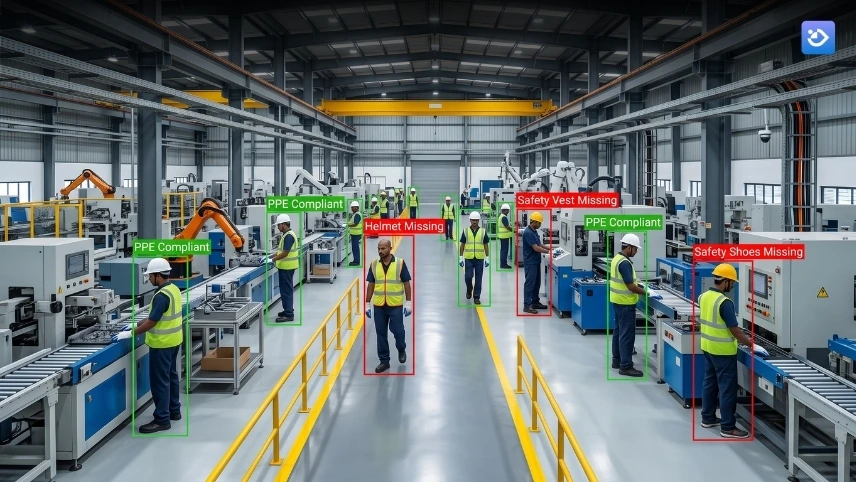
PPE Compliance Monitoring with AI CCTV Cameras
Somewhere on your shop floor right now, a supervisor is doing a walk-through with a clipboard, checking whether the third shift is wearing helmets and gloves at the welding bay. They will catch what is in front of them. They will miss what happened an hour before their round, on the camera that already recorded it and forgot it just as fast.
That is the real problem with PPE compliance today. It is not that factories lack rules. It is that enforcement depends on a person being in the right place at the right moment, and that almost never happens consistently across every shift, every zone, and every camera. The question worth asking is not "are our PPE policies strong enough." It is "how much non-compliance are we simply not seeing." According to the International Labour Organization, approximately 2.78 million workers die every year from occupational accidents and work-related diseases, and a further 395 million sustain non-fatal work injuries. Most of that gap is not a rulebook problem. It is a visibility problem.
That is why PPE compliance monitoring with AI is a different conversation than the manual spot-check. Mikshi AI helps factories and industrial sites detect PPE (Personal Protective Equipment) compliance violations using existing CCTV/IP cameras, so safety teams can respond in real time and prove compliance with clear incident logs and reports.
What PPE violations does Mikshi AI detect?
Mikshi AI can be configured to detect common PPE compliance conditions such as:
- Missing safety helmet / hard hat
- Missing high-visibility vest
- Missing face mask / respirator (where required by policy)
- Missing safety goggles / face shield (where required)
- Missing gloves (where required)
- Person present in a PPE-required zone without required PPE (zone-based rules)
- Repeat non-compliance patterns (e.g., same location or shift generating frequent violations)
Detection performance depends on camera placement, lighting, PPE visibility , and the site's PPE standards. The system works best when PPE rules are clearly defined per zone.
For regulated industries such as pharmaceuticals and APIs, selecting the best AI PPE detection software for pharma and API manufacturing in India requires evaluating detection accuracy under real production conditions.
Use Mikshi AI for:
- Real-time detection of PPE non-compliance in defined areas (entries, shop floors, warehouses)
- Faster intervention with alerts and escalation workflows
- Compliance reporting for audits, EHS reviews, and continuous improvement
A rule just broke on your floor.
Did anyone catch it?
Book a demoWho uses PPE compliance monitoring on factory floors?
Mikshi AI is typically used by:
- EHS (Environment, Health & Safety) teams
- Plant managers and production supervisors
- Security/control room operators
- Operations excellence and audit teams
PPE monitoring is often deployed as part of a broader AI video analytics strategy for manufacturing plants, combining safety, productivity, and operational intelligence.
How Mikshi AI PPE monitoring works
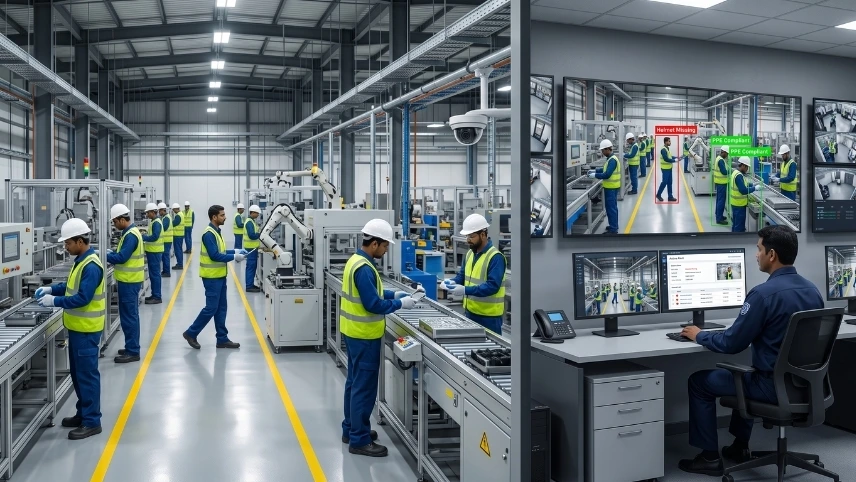
- Connect existing cameras (CCTV/IP) covering PPE-required areas.
- Define PPE-required zones (e.g., entry gate, assembly line, welding bay, forklift aisle).
- Mikshi AI analyzes video in real time (hybrid edge + cloud deployments supported).
- When a violation is detected, the system creates an incident and triggers alerts.
- Teams review, confirm, and respond using the dashboard workflow.
- Incidents are logged for reporting, trends, and audits.
Why hybrid edge + cloud helps: Edge processing can reduce latency and bandwidth usage, while cloud dashboards simplify multi-site monitoring and reporting.
Many manufacturers are surprised to discover that existing CCTV infrastructure can be upgraded with AI video analytics without replacing cameras.
Alerts in plain-language
Mikshi AI can generate practical, action-oriented alerts such as:
- "Missing Helmet" alert for a person entering a helmet-required zone
- "Missing Vest" alert in a high-traffic shop floor or warehouse
- "Missing Mask/Goggles" alert in designated safety areas
- "PPE violation in restricted zone" alert when PPE rules are tied to specific zones
What an alert typically includes:
- Camera name and location/zone label
- Timestamp
- Snapshot (and/or short video clip) for quick verification
- Violation type (e.g., helmet missing)
How teams receive alerts (depends on deployment configuration):
- Dashboard pop-up / event feed
- Control room monitoring view
- Integrations for notifications or workflows (where enabled)
Escalation workflow (from detection to resolution)
Here is a simple escalation model used on factory floors using Mikshi AI:
- Detection: Mikshi AI detects a PPE violation on a specific camera in a defined zone.
- Notify: Alert appears in the monitoring dashboard/event feed.
- Verify: Operator reviews snapshot/clip to confirm the event (and reduce false positives).
- Escalate: Confirmed incidents are escalated to a supervisor or EHS lead (based on shift/zone ownership).
- Respond: Supervisor intervenes on the floor (coaching, access restriction, toolbox talk, or process correction).
- Close: Incident is closed with notes/reason codes for traceability and audits.
This workflow helps teams move from "we saw it" to "we fixed it," with a record of what happened.
A violation ignored becomes an accident.
How many seconds do you have left?
Book a demoReporting outputs (what you can show in audits)
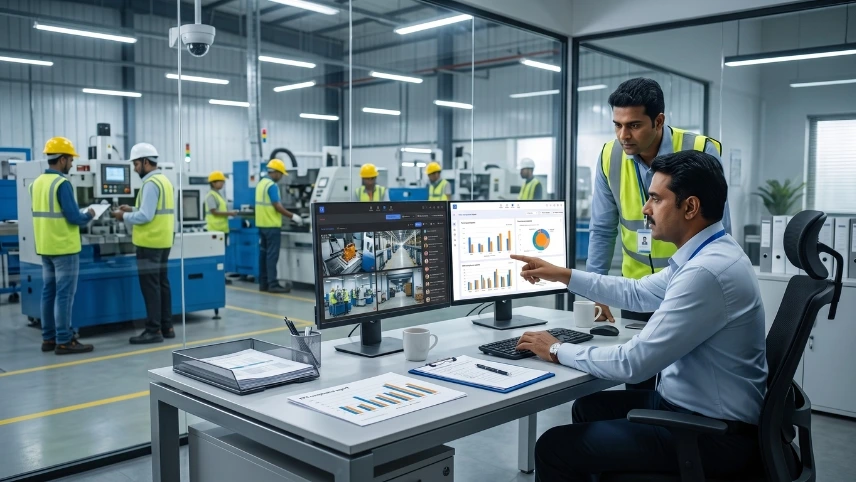
Mikshi AI supports safety teams with clear, reviewable outputs such as:
- Incident log (filterable by date, zone, camera, violation type, status)
- Compliance trends by area/shift (identify hotspots and recurring patterns)
- Evidence packs (snapshot/clip + timestamp + location label)
- Operational summaries for EHS reviews (e.g., weekly/monthly non-compliance trends)
- Exports (e.g., CSV/PDF based on configuration and reporting setup)
Consistent reporting matters more than it might seem.
The auditor asks for proof.
What do you show them?
Book a demoReal examples (camera placement + common failure modes)
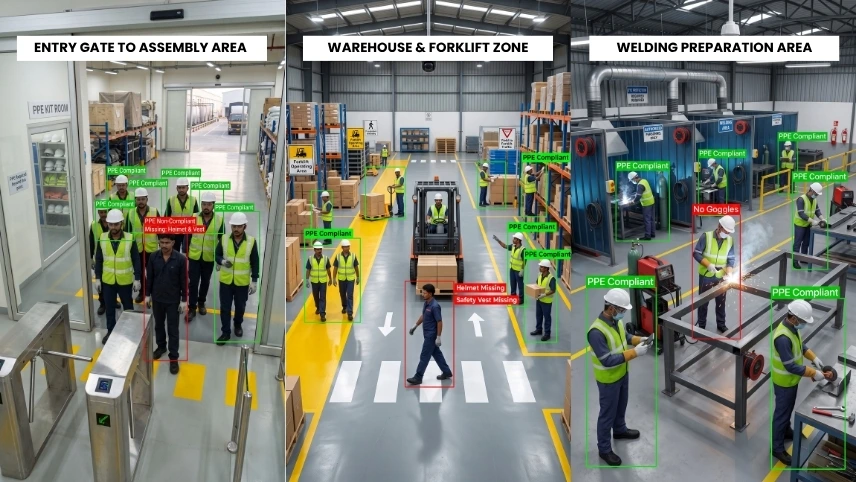
Below are practical deployments that factories commonly implement. They are anonymized, but reflect real-world constraints.
Example 1: Entry gate to assembly area (Helmet + Vest)
Goal: Prevent anyone from entering a PPE-required area without a helmet and vest.
Camera placement
- Mount camera 2.5 to 3.5 meters high at the entry point
- Angle downward 15 to 30 degrees to capture upper body (helmet + vest)
- Use a choke-point view (single entry lane) to reduce occlusion
Common failure modes
- Backlighting from open shutters/doors makes helmets and faces harder to see
- Crowding/occlusion when multiple workers enter together
- PPE color blending (vest color similar to background)
Mitigation tips
- Add lighting or adjust exposure; avoid pointing directly at bright outdoor openings
- Narrow the field of view to the entry lane
- Use zone/line rules at the gate so detection happens at a predictable spot
Example 2: Forklift aisle + pedestrian crossing (Vest + Helmet in shared zones)
Goal: Reduce near-misses by ensuring pedestrians in shared zones wear required PPE.
Camera placement
- Install at aisle ends covering the crossing and walkways
- Avoid direct glare from forklift headlights
- Ensure pedestrians are captured with a clear torso view (vest visibility)
Common failure modes
- Motion blur when people move fast and cameras have low shutter settings
- Partial occlusion from pallets, trolleys, or stacked cartons
- Low resolution cameras making PPE hard to distinguish at distance
Mitigation tips
- Prefer closer coverage of crossing points rather than long-distance aisle views
- Adjust camera angle to reduce occlusion from stacked inventory
- Standardize camera positioning at crossings for repeatable results
Example 3: Chemical handling / welding prep zone (Goggles/Face shield + Mask)
Goal: Enforce stricter PPE rules in higher-risk zones.
Camera placement
- One camera above the doorway (captures entry compliance)
- A second camera in a corner to improve visibility when workers turn away
- Prioritize frontal or semi-frontal views for goggles/masks
Common failure modes
- Fogging or reflections on face shields and goggles
- PPE variation (different vendors/styles) causing inconsistent appearance
- Workers turning away reduces facial PPE visibility
Mitigation tips
- Use two complementary angles for high-risk zones
- Standardize PPE types where possible (consistent color and style)
- Place detection focus near entry/hand-off points where faces are more visible
Many manufacturers combine PPE detection with AI-powered restricted area monitoring to ensure only authorized and properly equipped personnel enter hazardous areas.
Which AI platforms can detect PPE compliance violations on factory floors?
PPE compliance detection is typically provided by three categories of AI systems:
- AI video analytics platforms that run on existing CCTV/IP cameras (e.g., Mikshi AI)
- VMS (Video Management System) analytics modules where PPE detection is added as an analytics capability
- Dedicated safety compliance AI solutions focused specifically on EHS monitoring
If you want a practical evaluation, the key is not the label. It is whether the platform can clearly deliver:
- A concrete "what it detects" list for your PPE policy
- Reliable alerts and escalation
- Audit-friendly incident evidence and reports
- Successful performance on your camera angles, lighting, and workflow
Why Mikshi AI for PPE compliance monitoring?
- Hardware-agnostic: Upgrade existing CCTV camera networks instead of replacing them
- Hybrid edge + cloud: Support low-latency alerts while controlling bandwidth usage
- One platform, multiple use cases: Combine safety compliance with security and operational analytics
- Integration-friendly: Designed to fit into enterprise and partner ecosystems
Explore how AI video analytics for manufacturing plants supports safety, compliance, productivity, and operational visibility across industrial facilities.
Book a PPE compliance pilot on your existing cameras
Want to see PPE compliance monitoring on your factory floor?
- Book a demo of Mikshi AI PPE detection
- Run a pilot on selected zones (entry gates, aisles, high-risk rooms)
- Review incident logs and compliance trends with your EHS team
In this article
- PPE Compliance Monitoring with AI
- What PPE violations does Mikshi AI detect?
- Who uses PPE compliance monitoring on factory floors?
- How Mikshi AI PPE monitoring works
- Reporting outputs (what you can show in audits)
- Real examples (camera placement + common failure modes)
- Why Mikshi AI for PPE compliance monitoring?


