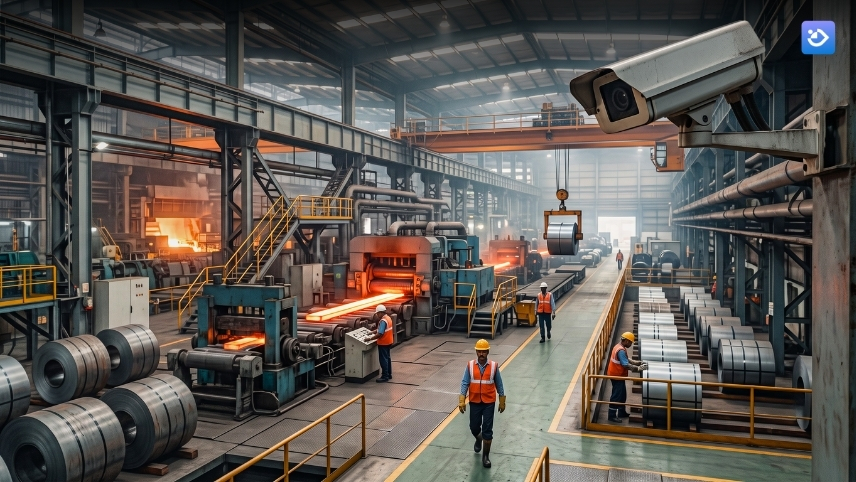
7 AI Use Cases Every Steel Plant Should Implement
It is 2 AM in the rolling mill. The safety officer on shift is one person covering three bays, a slag pit, and a crane yard. Right now, he's filling out a shift log in the control room. Forty meters away, a contract worker steps under a crane's swing radius to retrieve a dropped tool. No helmet. The one he was issued cracked last week, and nobody has replaced it yet. Nobody sees this happen. The camera above the bay sees it, technically, but the feed is being recorded, not watched, and it will only get pulled up if something goes wrong.
Here is what nobody in that control room is asking: why does a plant with forty cameras still depend on one pair of human eyes to catch a violation in real time? The cameras aren't the gap. Nobody is watching them continuously; that's the gap.
That is why you should consider the different AI CCTV use cases for steel plants and identify how your existing CCTVs can help you run your steel plant in a better manner.
Forget adding more cameras or more headcount. This is about making the footage you already have actually work for you, in the seconds that matter, not the hours after.
1. Real-Time PPE Compliance Detection
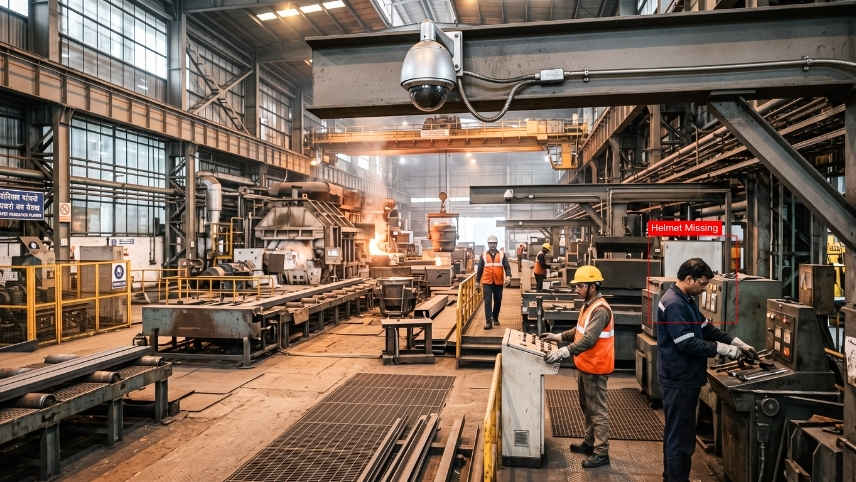
Nobody can watch every worker in every bay for twelve straight hours. And taking action after the incident doesn't do a thing for the worker who already got hurt. An AI-based PPE detection system flips that order around: it flags a missing helmet, glove, or face shield the moment someone walks into a zone that requires it, not three days later when an inspector finally gets to that footage.
- Spots missing or improperly worn helmets, safety glasses, gloves, and high-vis vests across multiple camera feeds at once, in real time
- Zone-aware, not blanket. A worker without ear protection gets flagged near a furnace; the same worker walking through an office corridor doesn't trip anything
- Logs every alert with a timestamp, so you get a searchable compliance record instead of a paper spot-check register nobody actually reviews
No supervisor can be in three bays at once. This system can.
2. Restricted Zone and Unauthorized Entry Monitoring
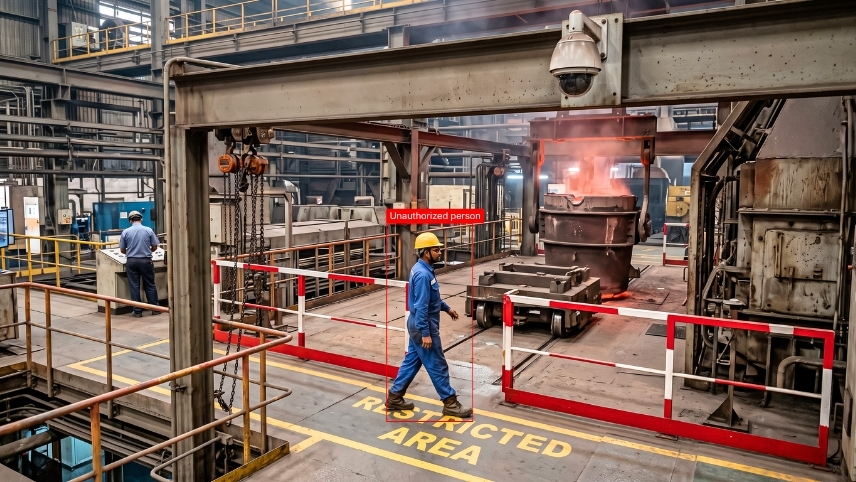
Ask any inspector what the common thread is across near-miss reports involving hot metal, moving cranes, or confined spaces. Nine times out of ten, it's someone who wasn't supposed to be there, at the moment when nobody happened to be looking at that particular spot. Steel plants have dozens of zones like this, where just being present is the hazard. It doesn't matter what the person is wearing.
- Draws virtual perimeters around blast furnace zones, ladle areas, crane swing radii, and confined spaces, and triggers the instant anyone crosses them
- Differentiates between authorized personnel with proper clearance and unregistered entry, cutting down false alarms from routine maintenance crews
- Runs around the clock, night shifts and thin weekend rotations included, which is exactly when supervision is weakest
- Creates an auditable record of every zone breach, useful both for internal safety reviews and for regulatory inspections
The rule being enforced here is presence, not behavior. Closer to how the actual risk plays out on your floor than any signage ever managed.
3. Fire, Smoke, and Spark Detection Near Furnaces and Casting Areas
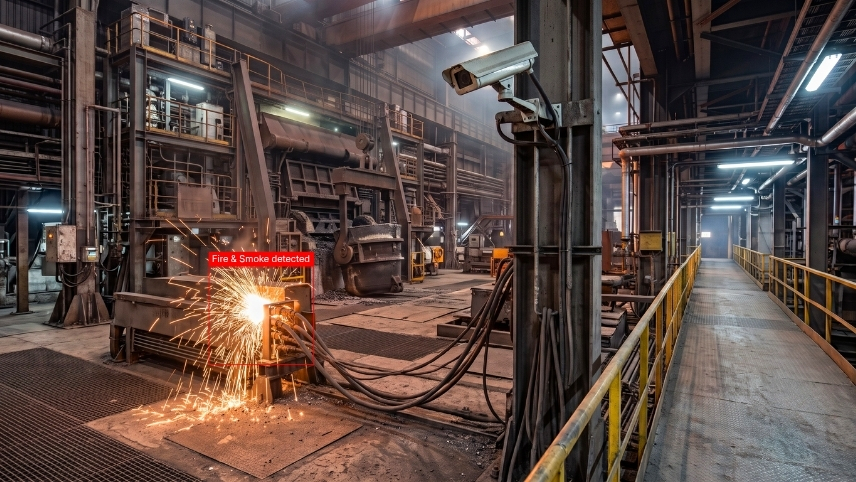
By the time a smoke detector actually triggers, the fire has usually already taken hold. In a steel plant, the window between a spark and an uncontrolled fire near coal stockyards, oil stores, or cable trays can be a matter of minutes, and point-sensor smoke detectors are frequently too far above from where the spark actually happened to catch it in time.
- Picks up smoke, flame, and abnormal sparking straight from the cameras already installed without waiting for smoke particles to drift over to a fixed sensor
- High ceilings are exactly where traditional smoke detectors struggle. A camera doesn't care how far away the ceiling is
- Alerts the nearest response team and the control room at the same moment, so there's no lag between spotting it and someone acting on it
- Runs as software on top of the CCTV you already have, not a new sensor installation project
4. Suspended Load Zone Monitoring
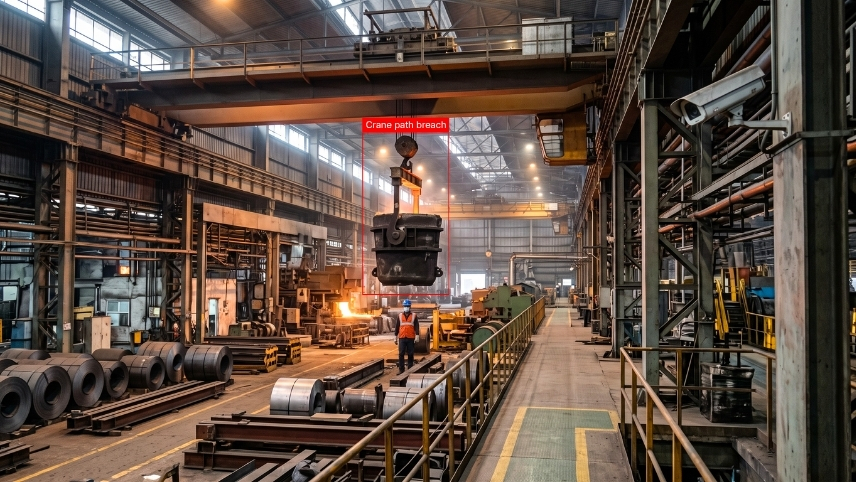
A crane lifting a ladle, a coil, or a scrap bundle creates a hazard that moves with it, not a fixed zone you can mark with paint on the floor. The crane operator's own sight-line is often blocked by the load itself, which is exactly the moment a worker walking underneath to reach a tool or a shortcut becomes invisible to the one person who's supposed to be watching for them.
- Tracks the crane hook and load position in real time and builds a moving exclusion zone around it, not a static marked area
- Flags any person detected under or entering the path of a live suspended load, whether it's a ladle, a coil, or a scrap bundle
- Distinguishes a load at rest from a load in motion, so the alert fires when the hazard is actually live, not every time a crane is simply parked overhead
- Works even when the operator's own view is blocked by the load, which is precisely when this kind of accident tends to happen
On average, India's registered factories recorded 1,109 deaths and more than 4,000 injuries a year between 2017 and 2020. A meaningful share of that risk sits exactly where a person and an overhead load occupy the same space without either one seeing the other coming.
5. Workforce Presence & Absentee Tracking
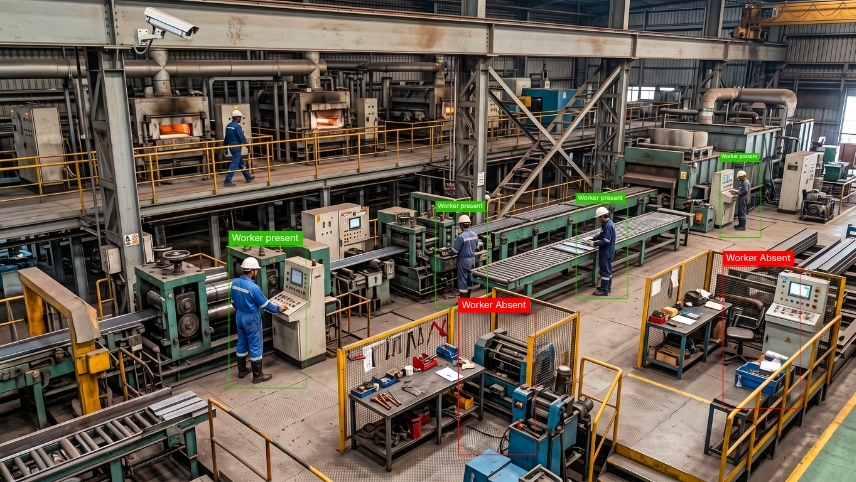
Steel plants operate across multiple shifts, production areas, and critical zones where adequate workforce coverage is essential. Supervisors may not always have visibility into whether the required personnel are present in designated areas, particularly during night shifts, shift changes, or periods of reduced supervision. AI video analytics can continuously monitor workforce presence across defined zones and provide visibility into coverage gaps.
- Monitors workforce presence across critical production areas, shop floors, operational zones, and designated workspaces during defined shifts.
- Detects missing personnel from critical zones where workforce presence is required, helping supervisors identify coverage gaps before they affect operations.
- Tracks workforce presence across shifts to identify recurring absenteeism, staffing gaps, or areas where required personnel are consistently unavailable.
- Provides time-stamped presence records that help plant teams review workforce coverage, improve accountability, and support shift-level operational monitoring.
Instead of depending entirely on manual attendance checks or supervisors physically verifying every zone, plant teams can maintain continuous visibility into workforce presence. This helps ensure that critical areas have the required personnel during the shifts and operating periods when their presence matters most.
6. Unsafe Worker Behavior Detection: Mobile Phone Usage and Other Violations
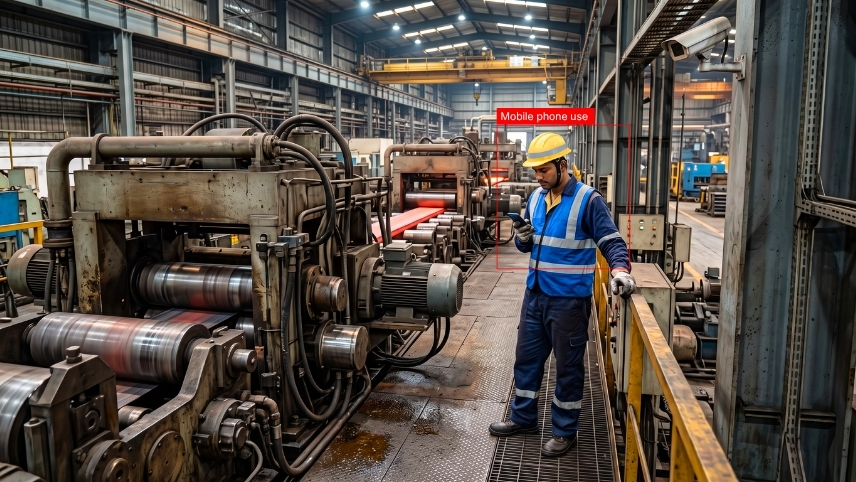
Rules and signage only work if a worker actually stops to think about them. In practice, most safety lapses aren't dramatic. They're small, repeated things: a worker checking a phone while operating machinery, someone lighting a cigarette near a no-smoking zone, a barrier propped open because walking around it is inconvenient. None of that shows up on a checklist until it causes an incident.
- Flags mobile phone usage in zones where it's prohibited, like near moving machinery, cranes, or furnace areas, where a distracted worker is a genuine hazard
- Detects smoking or open flame in designated no-smoking zones, close to flammable stock or gas lines
- Picks up on loitering near hazardous zones, skipped lockout-tagout procedures, or barriers being bypassed
- Gives supervisors trend data across shifts, so it's clear whether a particular shift, team, or time window is racking up more violations than the rest
- Backs up coaching conversations with specific, time-stamped footage instead of a supervisor's general sense that something's off
Used well, this points a safety manager toward where training is actually needed, before something happens, not after.
Can your cameras catch unsafe behavior in real time?
Book a demo with Mikshi AI7. Blocked Emergency Exit and Escape Route Monitoring
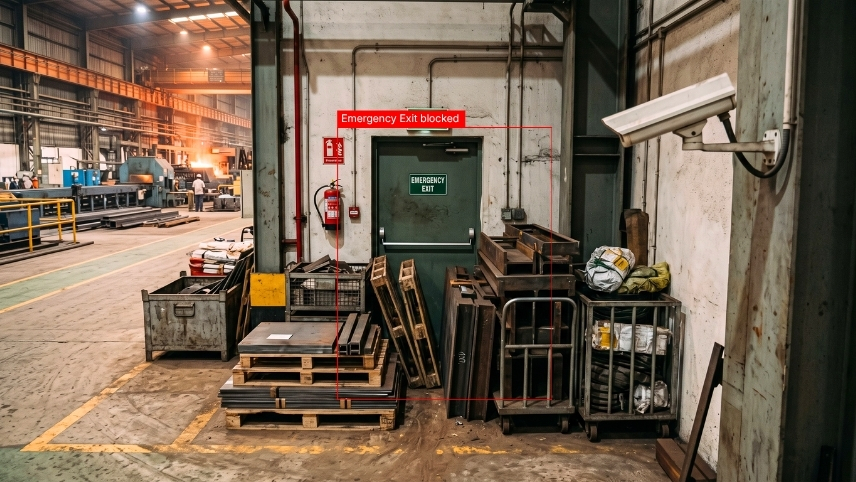
An emergency exit blocked by a stack of pallets doesn't matter until the day it matters, and by then it's too late to move the pallets. Fire escape routes, aisles, and access to firefighting equipment in a busy steel plant get encroached on gradually, a bit of material staged here, a trolley parked there, and nobody flags it because no single obstruction looks serious on its own.
- Watches designated fire exits, escape routes, and firefighting equipment access points for obstructions, and flags anything blocking a clear path
- Catches gradual encroachment, materials or equipment that build up over days rather than appearing all at once
- Sends an alert to the shift supervisor or EHS team the same day an obstruction shows up, instead of waiting for the next scheduled walk-through or fire drill
- Runs on the cameras already covering these corridors, so there's no new hardware to install specifically for this
Keeping escape routes clear is a basic, recurring line item in workplace safety compliance. A steel plant safety monitoring system that catches this automatically is the difference between finding out during a drill and finding out during an actual fire.
How Mikshi AI Closes the Gap Named Above
Go back to the scene at the start of this post: a safety officer covering three bays alone at 2 AM. Hiring another supervisor does not fix that. Giving the cameras already mounted above every bay the ability to actually watch does. That is the exact problem Mikshi AI was built to close. We turn the footage your plant already generates into a continuously watching system instead of a passive recording archive that only earns its keep after something has already gone wrong.
- Deploys on existing CCTV infrastructure across PPE detection, restricted zone monitoring, fire and smoke detection, and rule-violation flagging, without a rip-and-replace hardware project
- Delivers real-time alerts to the people who can act on them, not a report someone reads next week
- Covers the gaps that matter on a steel plant floor, from a missing helmet to a blocked fire exit, using cameras you've already paid for
AI use cases for steel plants are no longer a pilot-stage experiment reserved for the largest integrated mills. They are becoming table stakes for any plant that wants its safety data to reflect what actually happened on the floor, not just what someone happened to notice.
Want to prevent incidents and protect profits in your steel plant?
Book a demo with Mikshi AIIn this article
- Real-Time PPE Compliance Detection
- Restricted Zone and Unauthorized Entry Monitoring
- Fire, Smoke, and Spark Detection Near Furnaces and Casting Areas
- Suspended Load Zone Monitoring
- Workforce Presence & Absentee Tracking
- Unsafe Worker Behavior Detection: Mobile Phone Usage and Other Violations
- Blocked Emergency Exit and Escape Route Monitoring
- How Mikshi AI Closes the Gap Named Above


