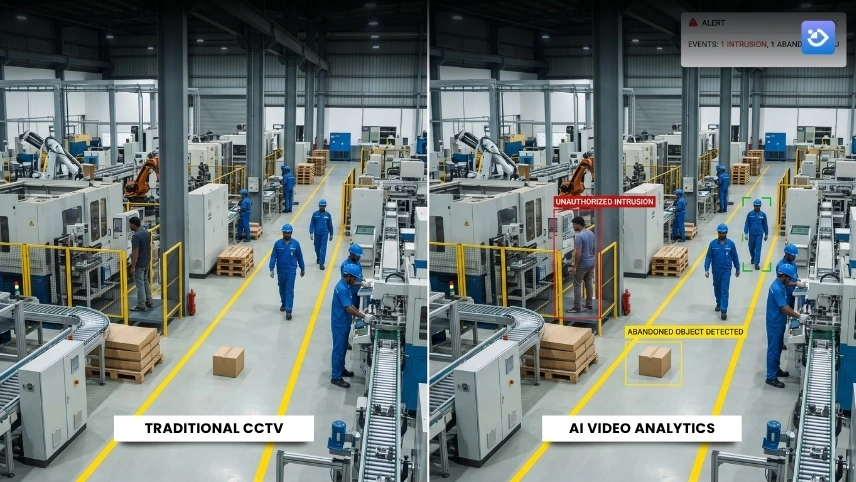
CCTV vs AI Video Analytics: What Is the Real Difference?
You've got cameras. Dozens of them, maybe more, bolted across the warehouse, the store floor, and the parking lot. They record all day, every day. And still, when something actually goes wrong, someone on your team ends up sitting there scrubbing through hours of footage trying to reconstruct what happened.
That gap is exactly why AI CCTV Software has stopped being a "someday" upgrade and started showing up in actual budget conversations. The camera on the wall was never really the problem. What it was (or wasn't) connected to on the back end, that's the part nobody looked at closely enough.
If you're still working out what this technology actually covers, our complete guide to AI video analytics walks through the use cases and industries where it's already running in India.
CCTV Records. It Doesn't Think
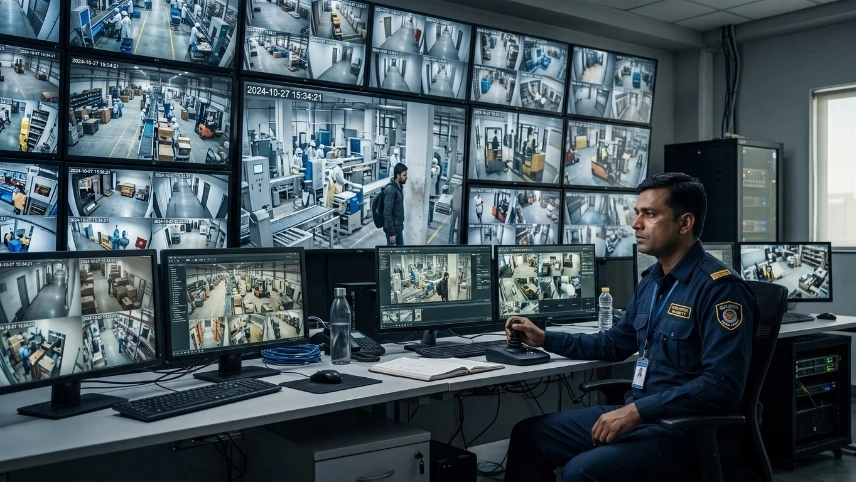
Old-school CCTV does one thing, and it does it fine: it captures video and keeps it somewhere for later. Twenty years ago, that felt like enough. It isn't any more.
- A person hanging around a restricted door at 2 a.m. looks exactly like an empty hallway to a camera that isn't set up to notice the difference. Someone has to physically be watching that one feed at that one moment.
- Footage only becomes useful once the damage is already done. By the time anyone pulls up the recording, the theft happened, the safety incident happened, the thing you wanted to prevent already happened.
- Somebody has to sit in front of the monitors, or the organization quietly accepts that most of what the cameras capture will never be seen by a human being.
- Try finding one specific moment across forty camera-hours with no real search function. It's slow, it's tedious, and half the time you're not even sure what you're looking for.
None of that makes traditional CCTV worthless. It just means it stops at step one. Recording is not the same thing as understanding, and that's precisely where incidents slip past unnoticed.
What AI Video Analytics Actually Adds
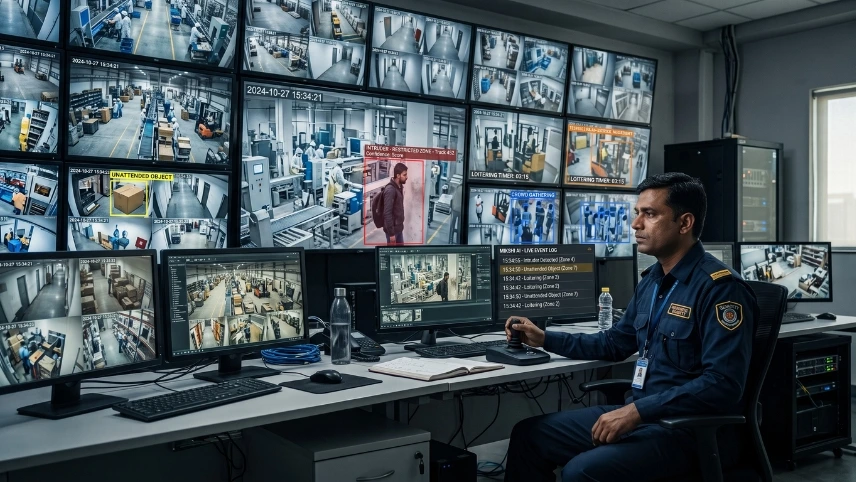
AI video analytics does something fundamentally different with the same raw footage. Instead of just storing pixels for a rainy day, it looks at what's happening as it happens and does something about it.
Real time detection is the obvious one. The system spots intrusion, loitering, an unattended bag, a crowd forming somewhere it shouldn't, and it spots it the moment it starts, not six hours later during a review nobody had time for.
Then there's the alerting piece. Instead of a guard staring at forty tiles hoping to catch the right one at the right second, the software does the catching and routes the alert to whoever needs to see it. That's the part that actually changes outcomes.
Video analytics software also gets better with repetition, in a way a human reviewer rarely has the patience for. The same vehicle circling a lot three times before a break-in? A tired night-shift guard might miss that pattern. Software built to flag it usually won't.
And then, obviously, there's a search. Instead of scrubbing a timeline blind, you type in what you're looking for, an object, an event type, a rough time window, and you're at the clip in seconds.
Instead of manually reviewing hours of CCTV footage, simply type a query such as:
"Show me restricted area breaches in the last 24 hours."
Mikshi AI instantly retrieves every matching event across your camera network, helping security teams investigate incidents in seconds instead of hours.
Watch the videoThis is essentially the same shift we broke down in our piece on how computer vision compares to standard surveillance, where the camera stops being a passive recorder and starts actively reading the scene.
Still leaning on your team to manually eyeball hours of footage every week? That's paid labor wasted in finding what software could've flagged instantly. Mikshi AI's platform does that catching automatically; worth a look before you schedule another monitoring shift.
Nobody Needs to Rip Out Their Cameras
Here's where most buyers talk themselves out of moving forward, and it's usually based on a wrong assumption. They think going from CCTV to something smarter means tearing out every camera and starting fresh. Rarely true.
A lot of IP cameras installed in the last five, six, and seven years already have plenty of resolution and processing headroom sitting unused. The camera itself isn't the constraint most of the time.
Swapping in a smarter interpretation layer is a much smaller lift than replacing hardware wall to wall, and most facility teams underestimate that.
If that sounds like wishful thinking, it's worth reading through why your CCTV isn't obsolete, it's just waiting for a brain, since it lays out exactly why existing hardware usually has more headroom than teams assume.
Some smart surveillance systems handle the processing right on the camera or a nearby edge box. Others push the stream to the cloud and do the heavy lifting centrally. Which one makes sense really comes down to bandwidth and how fast you need the alert to land.
There's a real cost question buried here too, and it's smaller than people expect. A 2025 policing industry survey found most agencies would need fairly modest retrofits, often a few hundred dollars per camera, to get modern analytics running. That's not nothing, but it's a lot less than the number most teams have in their heads before anyone actually checks.
Delay usually isn't about the tech being unready. It's about hardware and software getting lumped into one scary number when they should've been two separate, much smaller conversations.
Doing the Math on Doing Nothing
Picture a facility running fifty cameras with two people covering shifts. Nobody, and I mean nobody, can genuinely watch fifty live feeds at once. So most of what happens on those screens just... happens. Unwatched. Unless someone goes back and finds it later, if they even know to look.
Put a rough number on that. Say ten percent of camera-hours contain something worth flagging, shrinkage, a safety issue, an access breach, and nobody happened to be looking at that exact tile at that exact second. That's not an abstract risk any-more. It shows up later in shrinkage reports, in insurance claims, and in response times that get measured in hours instead of the seconds they should've taken.
The market's already reacting to that math, at scale. The AI-enabled video surveillance space was sitting around USD 6.51 billion in 2024, projected to hit USD 28.76 billion by 2030, growing north of 30 percent a year. That kind of growth doesn't happen because a technology is trendy. It happens because organizations finally ran the numbers on what unwatched footage was quietly costing them.
Speed Is Where This Shows Up First
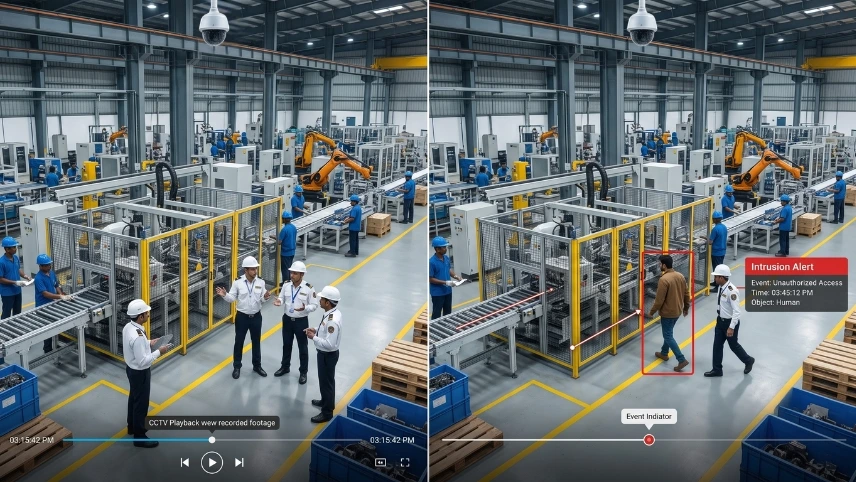
If you're looking for proof that any of this actually matters, don't look at accuracy specs. Look at how fast a threat gets caught.
Traditional CCTV, left on its own, catches nothing. A person has to be watching, and people get tired, get distracted, step away for coffee, and miss the one frame that mattered.
The TSA has real numbers here. After rolling out AI-driven threat detection at Category X airports, false alarms dropped 40 percent. That's not a marketing claim; that's an operational result at some of the busiest security checkpoints in the country.
Fewer false alarms means the humans on shift actually spend their attention on things that matter instead of chasing every shadow or lens flare across a bank of monitors. And on the back end, searchable AI video analytics turns what used to be an afternoon of scrubbing footage into a query that takes maybe thirty seconds.
Three seconds versus three hours. Same footage, completely different outcome, and that gap is really the whole pitch in one sentence.
Curious what your current cameras could already be catching if you just turned the software on? Most sites own more capability than anyone's actually using. Ask Mikshi AI before you budget for a hardware overhaul you might not need.
This Really Comes Down to Risk Tolerance
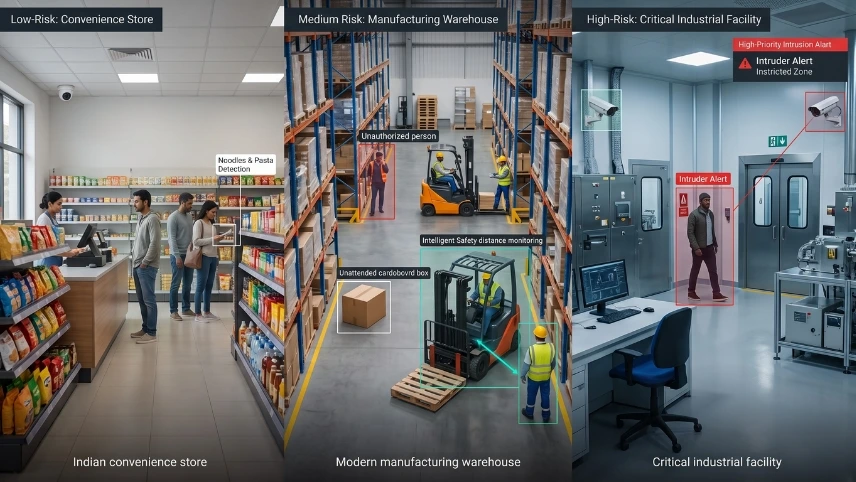
Strip away the feature comparisons, and this becomes a question about how much risk your organization is comfortable carrying between the moment something happens and the moment somebody notices.
Low foot traffic, low asset value, minimal exposure? Passive recording as a deterrent might genuinely be fine there. Nobody's arguing every corner store needs an AI stack.
Retail floors, warehouses, corporate campuses, moderate risk, moderate traffic, this is where AI CCTV Software tends to pay for itself fast because one missed incident routinely costs more than the software would have.
Warehousing carries its own version of this math; worth a look at how this plays out specifically for logistics and warehousing operations.
Critical infrastructure, hospitals, transit hubs? Passive review just isn't a realistic option any more given how quickly things need to be caught and escalated there.
On the hospital side, specifically, this is the exact ground covered on our healthcare and hospitals page, from patient safety risks to restricted area access.
For most mid-size and larger operations, the honest read is this:
Passive CCTV made sense a decade back.
Today, it's less of a cost saving and more of a liability.
The Cameras Were Never the Real Problem
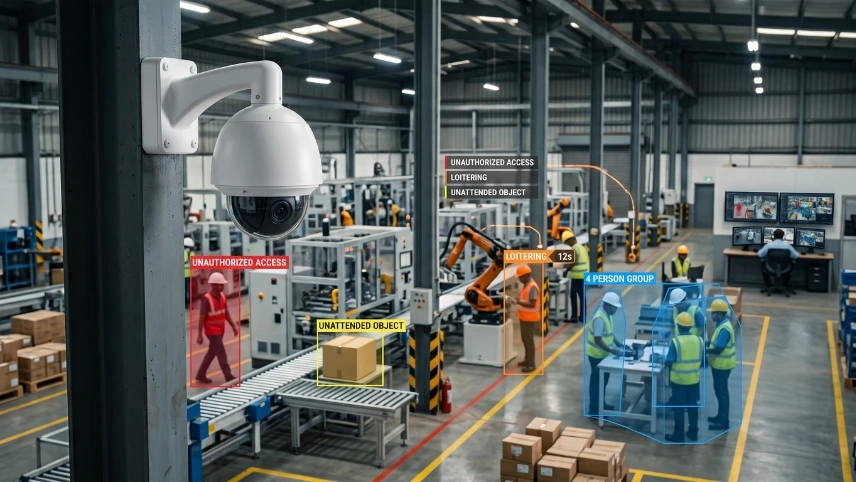
Every facility already has eyes on it. The question underneath this whole comparison is whether those eyes are hooked up to anything that thinks. Traditional CCTV hands you a recording. AI video analytics hands you a response.
The technology gap is smaller than most people assume walking in; plenty of existing camera infrastructure already supports an analytics layer without touching the hardware. The cost of doing nothing isn't neutral either; it shows up in shrinkage, in slow reaction times, in staff hours spent watching screens instead of acting on real threats. And the market itself keeps signalling where this is heading, with double-digit growth year after year, in AI-enabled surveillance adoption.
So the decision isn't really about replacing your cameras. It's about whether you finally put the ones you already own to work.
Ready to find out what your existing camera network could already be catching? The gap between recording footage and understanding it is closing faster than most security budgets have caught up to. Talk to Mikshi AI about turning the CCTV setup you already have into an active AI video analytics system.
In this article
- CCTV vs AI Video Analytics: What Is the Real Difference?
- CCTV Records. It Doesn't Think
- What AI Video Analytics Actually Adds
- Nobody Needs to Rip Out Their Cameras
- Doing the Math on Doing Nothing
- Speed Is Where This Shows Up First
- This Really Comes Down to Risk Tolerance
- The Cameras Were Never the Real Problem


