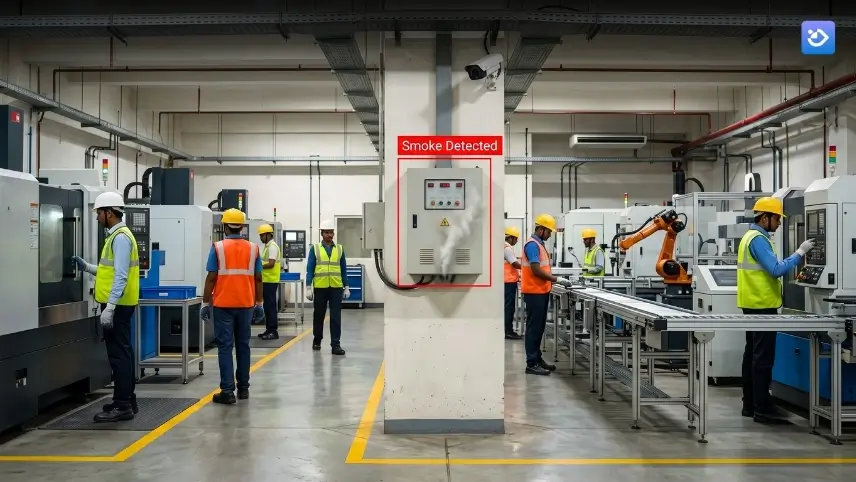
Fire & Smoke Detection for Manufacturing Plants: How Fire Detection AI Catches What Sensors Miss
By the time a traditional smoke detector on a factory ceiling triggers, smoke has already filled enough of the room to reach it. In a warehouse with 30-foot ceilings or an open shop floor with fans running, that can take several minutes, minutes where a small electrical fault near a cable tray is already turning into something much bigger.
Point sensors were built for a different kind of building. They work well in a small office room. They struggle in the wide-open, high-ceiling, dust-heavy spaces most manufacturing plants actually have. That gap is exactly what a fire detection AI system is built to close, by watching the same floor visually instead of waiting for particles to drift up and reach a sensor.
This is not a replacement for your fire alarm system. It is an earlier warning layer that sits on the CCTV cameras you already have, catching a wisp of smoke or the first flicker of flame while the point sensors are still waiting for enough particulate to build up.
What Counts As a Fire Detection AI Alert
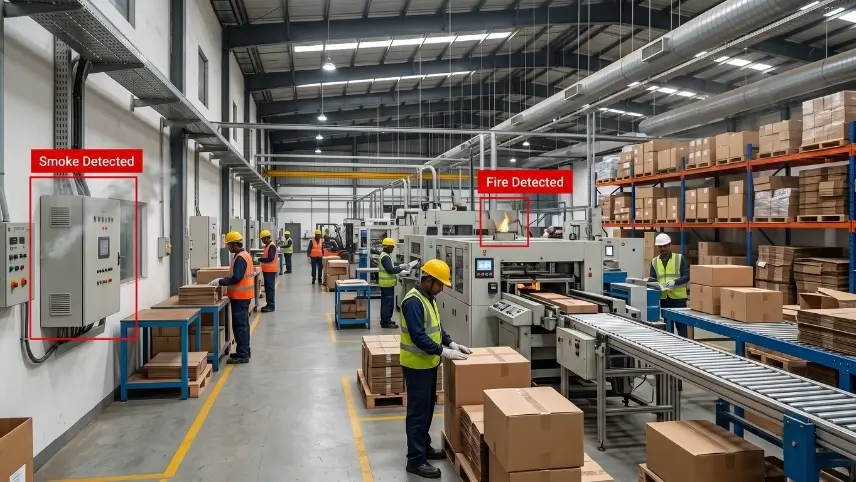
A Fire detection AI system is built to recognize visual signs of fire and smoke well before a conventional sensor would fire an alarm. On a plant floor, that typically means flagging:
- Visible flame at a machine, panel, or storage area, even a small one
- Smoke building up near ceilings, corners, or storage racks, before it thickens enough to reach a point detector
- Smoke or heat near electrical panels and cable trays is a common ignition point in older facilities
- Fire near flammable storage, packaging materials, or chemical handling zones
- Repeat smoke events in the same equipment or zone, which usually means a mechanical fault rather than a one-time accident
How well the system performs depends on camera coverage of high-risk areas, resolution, and lighting. A camera that only sees the front of a machine will miss a fire starting behind it, so zone coverage matters as much as the detection model itself.
Your Existing Cameras Are Enough
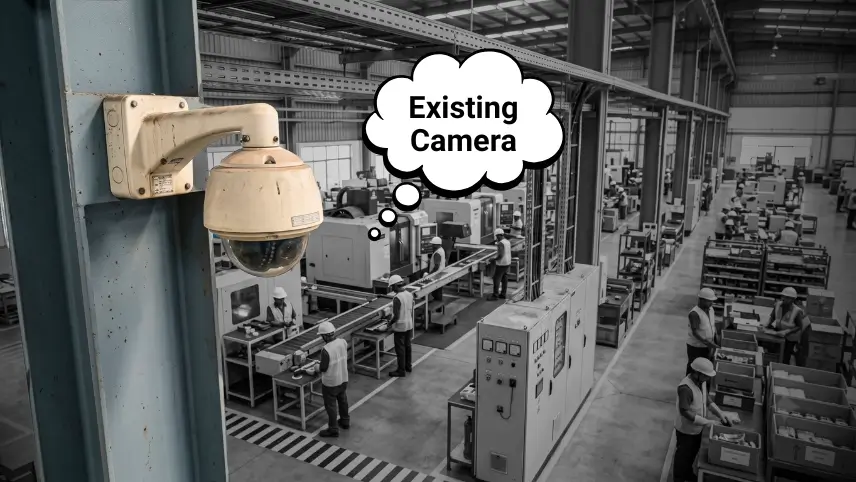
Most plants assume fire detection means a whole new sensor network with wiring runs across the ceiling. That is what point detectors need. Fire detection AI does not. As we've argued before, most CCTV infrastructure isn't obsolete, it's just waiting for a brain, and fire detection is one of the clearest examples of that. If your CCTV or IP cameras already cover the machines, storage racks, and electrical rooms that matter, the AI runs as a layer over that existing feed.
What actually decides whether a camera is good enough for this:
- A wide enough field of view to cover machines, storage racks, or panels, not just a doorway
- Resolution sufficient to pick up early smoke against the background, which is harder in dusty or hazy environments
- Coverage of high-risk zones, specifically, electrical rooms, compressors, welding bays, and combustible storage, rather than general floor views alone
- A reasonable frame rate, since fire and smoke both spread fast once they start
Fires don't wait for smoke to reach a ceiling sensor.
Your cameras can see it the moment it starts.
Book a DemoFrom First Spark to First Responder
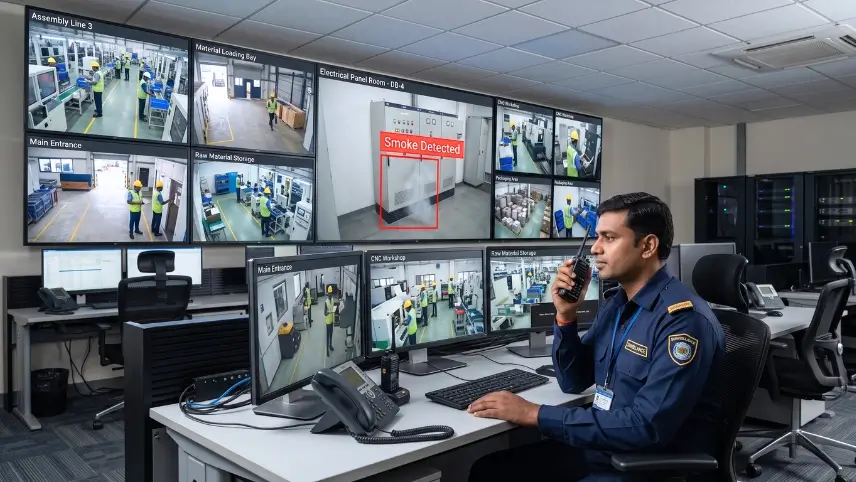
A flame on a screen means nothing if nobody sees it in time. On a manufacturing floor, the loop from detection to response typically runs like this:
- Cameras covering high-risk zones are connected and mapped
- The system continuously analyzes the live feed for flame and smoke signatures
- A detection triggers an incident with a timestamp, camera location, and a short clip
- The alert reaches the control room or safety team in seconds, not minutes
- An operator confirms the event and dispatches the nearest response team
- The incident is logged with notes for later review and reporting
Speed here is the entire point. Government data compiled from the National Crime Records Bureau shows India records roughly 1.6 lakh fire incidents a year, resulting in more than 27,000 deaths, with Gujarat, Maharashtra, Delhi, and Madhya Pradesh, all major manufacturing states, accounting for over half of those fatalities. A few extra minutes of warning before smoke reaches a ceiling sensor is often the difference between a small incident and an evacuation.
A fire caught in its first minute is a maintenance ticket.
The same fire caught ten minutes later is a shutdown.
Book a demo to avoid shutdownThe Real Culprit Behind Most Plant Fires
It is worth naming the actual source of most of these incidents. Electrical distribution and lighting equipment is the single leading cause of industrial fires, responsible for close to a quarter of all incidents at manufacturing and industrial facilities, ahead of heating equipment, machinery faults, and everything else combined. These are not dramatic, sudden events. They usually start small, a loose connection sparking, an overloaded panel running hot, and stay that way for a while before anyone notices.
That slow build is exactly the window fire detection AI is useful for. A camera watching an electrical room or a cable tray does not need to wait for enough smoke to trip a sensor across the room. It can flag the first faint haze near the panel while it is still a five-minute fix instead of an evacuation.
Proof for Insurers, Auditors, and Fire NOC Renewals
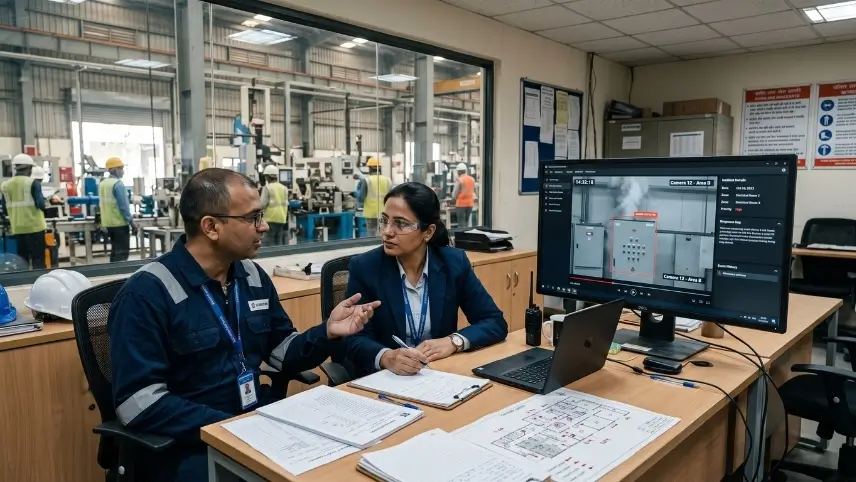
Fire safety audits, insurance reviews, and internal EHS reporting all want the same thing: proof of what happened and when. A properly configured setup should give safety teams:
- A timestamped incident log by camera, zone, and event type
- Video clips and snapshots attached to each detection for review
- Response time data, from detection to acknowledgment to dispatch
- Exportable reports for insurance audits, fire NOC renewals, and internal safety reviews
That response time figure matters more than people expect. Insurers and auditors increasingly ask not just whether a fire happened, but how fast it was caught and how the plant responded, and a system that logs both automatically saves a lot of reconstruction work after the fact.
Beyond a Single Camera Feed
Fire and smoke detection rarely runs alone for long. Most plants that deploy it end up pairing it with broader restricted zone monitoring, so the same cameras cover unauthorized access and fire risk together instead of running as separate systems. It fits into the same shift covered in how AI video analytics supports manufacturing plants on safety, attendance, and productivity, where the CCTV a plant already owns starts doing more than recording.
The cameras stay the same. The coverage just gets wider.
Why Mikshi AI for Fire Detection
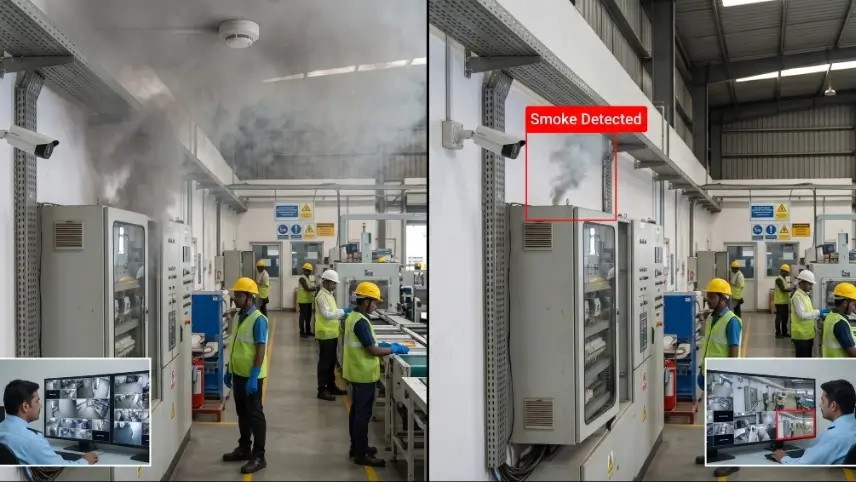
Mikshi AI's fire and smoke detection work sits on the CCTV or IP cameras a manufacturing operation already has, with hybrid edge and cloud processing that keeps alerts fast without hammering bandwidth. Apart from fire and smoke detection, it also provides PPE compliance detection, restricted zone monitoring, and unsafe behavior detection, so a plant isn't juggling five different vendors for five different risks.
A fire alarm tells you smoke reached the ceiling.
By then, how much has already burned?
Book a demoIn this article
- Fire & Smoke Detection for Manufacturing Plants
- What Counts As a Fire Detection AI Alert
- Your Existing Cameras Are Enough
- From First Spark to First Responder
- The Real Culprit Behind Most Plant Fires
- Proof for Insurers, Auditors, and Fire NOC Renewals
- Beyond a Single Camera Feed
- Why Mikshi AI for Fire Detection


