The 2026 FDA Crackdown on Restaurants in India: Can AI Video Analytics Help?
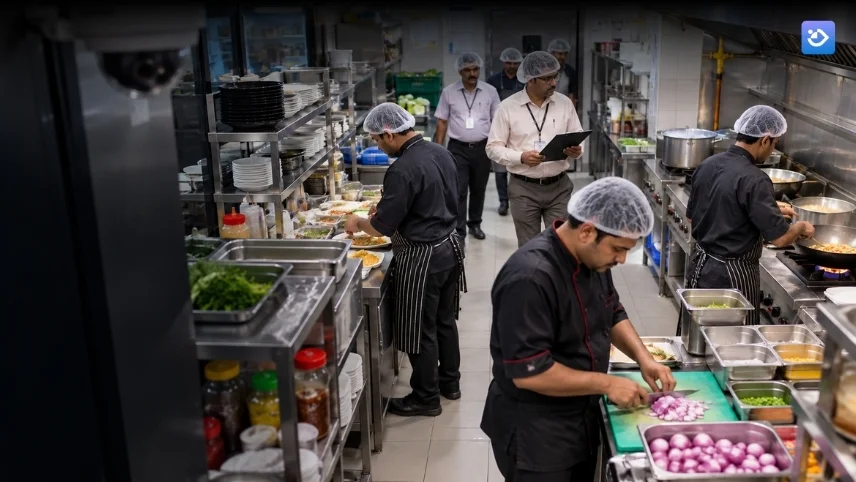
The Food Safety Officer walks in at 11:20 on a weekday morning, right when lunch prep is at its messiest. He does not stop at the reception desk where your FSSAI licence hangs in its frame. He goes straight through the swing door into the kitchen. A helper is chopping onions without a head covering. The storage room door has been propped open with a crate since breakfast, and there is a gap under it you have been meaning to get fixed for months. Forty minutes later, you are holding an improvement notice. On a worse day, you are holding a suspension order.
Here is the uncomfortable part. You were in the building the whole time, and you still did not know any of this was happening. Most owners and general managers spend service hours at the counter, on the floor, or on the phone with suppliers. The kitchen runs on trust and on whoever happens to be supervising that shift. The officer saw more of your kitchen in forty minutes than you see in a normal week.
That gap between what the owner sees and what the inspector finds is exactly what the 2026 enforcement drives across India keep exposing. It is also why the question of whether an AI video analytics system for restaurants can help deserves a straight answer, including the parts where the answer is no.
What the 2026 FDA Crackdown Actually Looks Like on the Ground
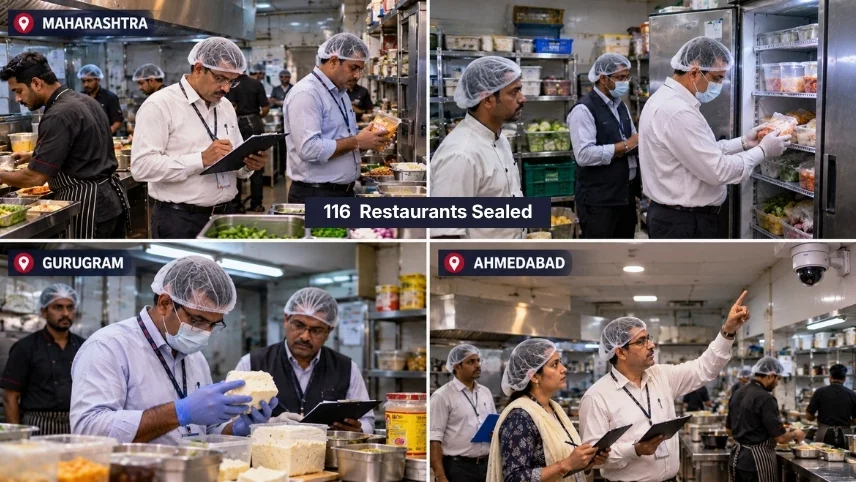
State Food and Drug Administrations have spent 2026 running inspection drives that look less like routine visits and more like sustained campaigns. Maharashtra has been the most aggressive, but it is not the only state moving.
- Between May 25 and July 31, the Maharashtra FDA inspected 890 hotels, restaurants, and eateries, issued 329 improvement notices, and suspended the licences of 116 establishments. That is roughly one in every eight kitchens the department walked into.
- The pace did not drop after the monsoon. In the third week of September, the Pune division ran a fresh drive across Pune, Satara, Sangli, Kolhapur and Solapur, took action against 41 establishments, and suspended the licences of 10 hotels, restaurants, bakeries and other food businesses for serious food safety violations.
- Gurugram's FDA raided outlets over fake analogue paneer, while in Pune, officials suspended licences after finding cockroaches and insects on the premises.
- Ahmedabad took a different route. The Ahmedabad Municipal Corporation issued an advisory asking 11,123 restaurants and food businesses to install CCTV covering their kitchens and display the live feed where diners can see it.
For a hotel group or a restaurant chain with outlets in several cities, an FDA inspection is no longer a once-in-a-licence-cycle event. The real question is which outlet gets the visit, and on which shift.
Most Violations Are Shift Behaviour, Not Infrastructure
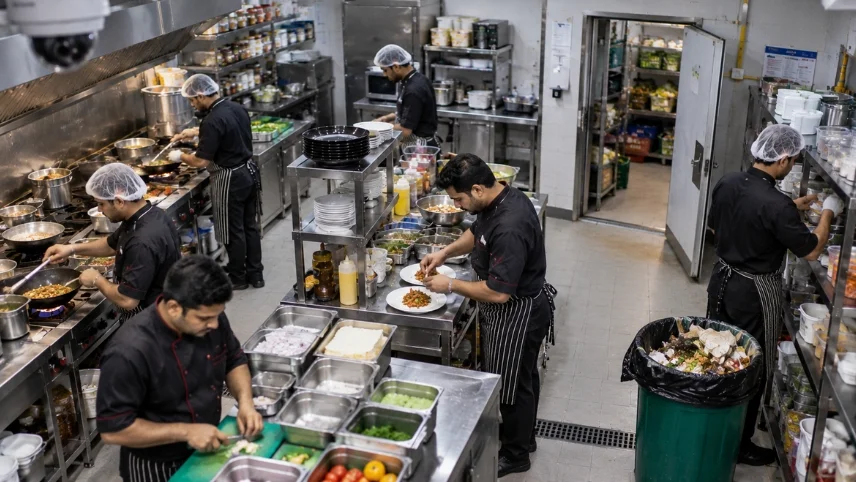
Read enough enforcement reports, and a pattern shows up. Many of the findings behind improvement notices have nothing to do with missing equipment. They come down to what people did, or skipped, on an ordinary shift. The hygiene requirements that the FDA reminds restaurant operators about are drawn from Schedule 4 of the FSS (Licensing and Registration of Food Businesses) Regulations, 2011, sit at the core of restaurant food safety compliance. They include food handler hygiene, separation of raw and cooked food, proper storage, safe water, pest control, waste disposal, and cleaning of utensils and equipment. These are some typical problems that a restaurant faces :
- A hair net that is on at 9 AM and gone by 11, because nobody checks at 11.
- The storage room door was left open through the afternoon. That is how pests get in, and it is also how people who should not be in the storage room get in.
- Waste bins sitting full next to a prep counter until the closing crew finally deals with them.
- Same kitchen, different shift, different standard. The morning crew can be spotless while the late shift quietly cuts corners.
Under Section 56 of the Food Safety and Standards Act, processing food under unhygienic or unsanitary conditions attracts a penalty of up to ₹1 lakh. That is the small number. A suspended licence means zero revenue from that outlet until the department is satisfied.
Ask any inspector. A visit is a snapshot of one moment, while compliance is the sum of every hour in between, and those are precisely the hours nobody is watching.
Do you know what your kitchen looked like at 3 PM yesterday, when nobody senior was in it?
Book a demo with Mikshi AIAnd get the answer.
Your Kitchen Camera Is About to Become Public
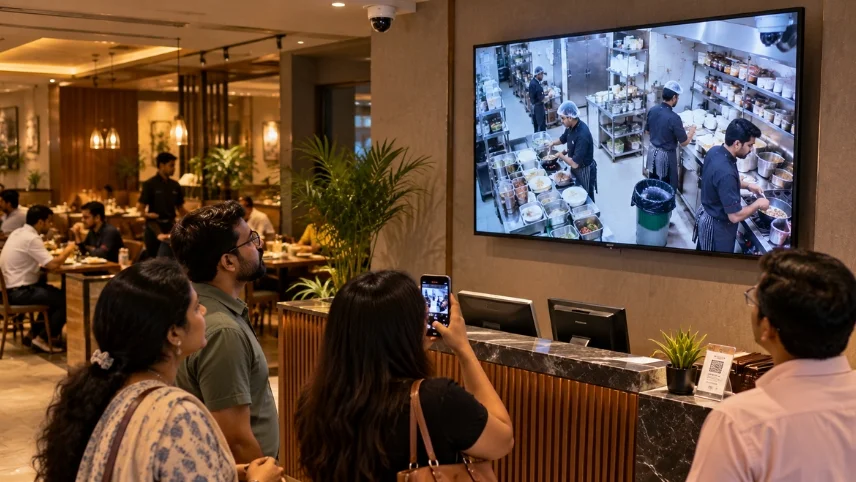
in August 2026, the Ahmedabad municipal corporation asked restaurant owners to display the live CCTV footage of their kitchens to their customers. Once a live kitchen feed plays at reception, the camera stops being a private record and becomes a public window. Every diner waiting for a table is now an informal inspector holding a phone.
- A diner who films a lapse on your reception screen and posts it can reach more people in one evening than an improvement notice ever will.
- A live feed that nobody on your team watches means the customer spots the problem before the manager does. That is the worst possible order of events.
- The idea has already drawn public calls to take it nationwide, so operators outside Ahmedabad should read it as a preview, not a local quirk.
Footage cuts both ways. Under Section 63 of the Bharatiya Sakshya Adhiniyam, 2023, electronic records such as CCTV footage are treated as documents and can be admitted as evidence once the certification conditions are met. The same camera that can expose a lapse can also show that your kitchen was clean when a complaint claims otherwise.
The restaurant operators who come out ahead will be the ones running AI video analytics systems for restaurants on those CCTV cameras, so the manager gets the alert first.
Where AI Video Analytics Genuinely Helps a Kitchen
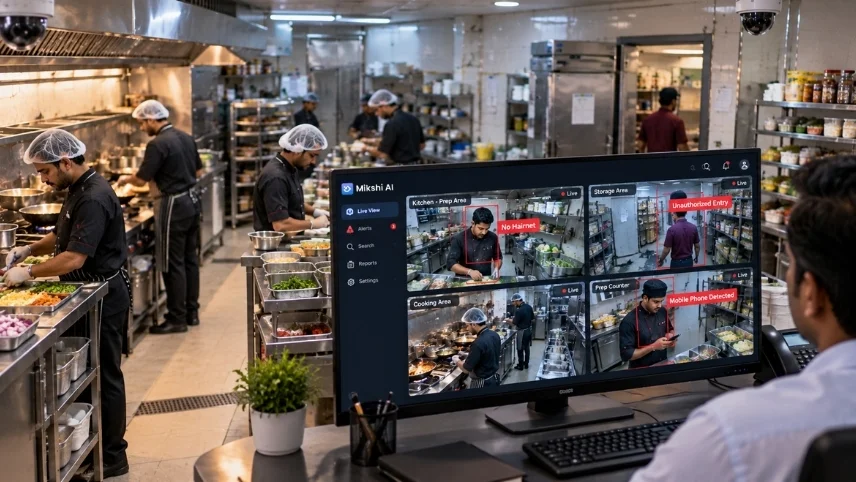
A camera on its own only records, which is the core difference covered in CCTV vs AI video analytics. An AI video analytics system for restaurants adds a layer that watches for defined events and raises an alert when one happens, so a supervisor can act during the shift instead of finding the problem in footage a week later. The use cases below map directly to what a Food Safety Officer looks for when he walks into your kitchen unannounced.
Hygiene Compliance on the Prep Line
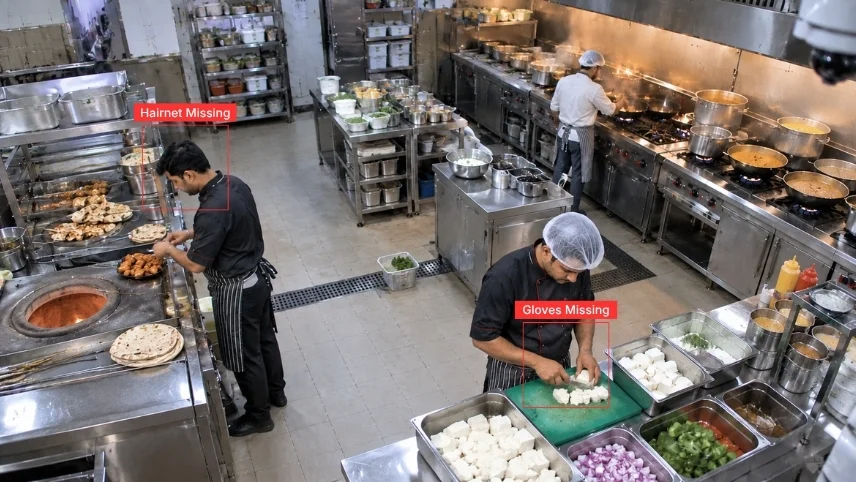
It is 11:30 AM and the tandoor section is running hot. One helper pulls off his head covering because it itches in the heat, another starts portioning paneer without gloves because the box ran out, and nobody notices for two hours because the chef is busy on the curry line. That is exactly the kind of food handler hygiene lapse an inspector writes up first. Hygiene compliance monitoring works on the same principle as PPE compliance monitoring on a factory floor: the prep zone is marked, the required gear for that zone is defined, and a violation inside it raises an alert while the shift is still running.
How Mikshi AI helps:
- Marks prep zones on your existing kitchen cameras and defines the gear required in each one.
- Alerts the supervisor when a violation is detected inside a marked zone, during the shift.
- Builds a daily and shift-wise record of repeat lapses, so training goes to the right people.
Unauthorized Entry into Cold Rooms and Dry Stores
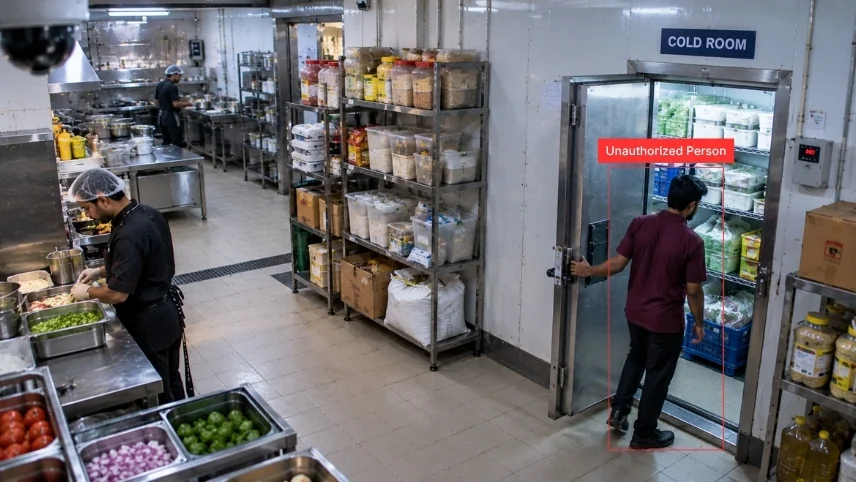
At 4:30 PM, the dead hour between lunch and dinner, the vegetable supplier's delivery boy finds nobody at the back door. He carries the crates into the cold room himself, sets them on the floor next to the paneer, and leaves the door open behind him for twenty minutes. Uncontrolled access to storage is how raw and ready-to-use stock end up mixed, and how pests find their way in. If the cold room and dry store are set to alert on any entry outside scheduled restocking windows, the kitchen manager knows within seconds, not at the next stock count. It is the same restricted area monitoring logic factories use for hazardous zones.
How Mikshi AI helps:
- Sets cold rooms, dry stores, and back-of-house corridors as staff-only zones.
- Sends zone and schedule-based alerts for entry outside permitted hours.
- Monitors for open-doors
- Logs every entry event with camera, time, and location for later review.
Rodent Activity in Storage and Kitchen Areas
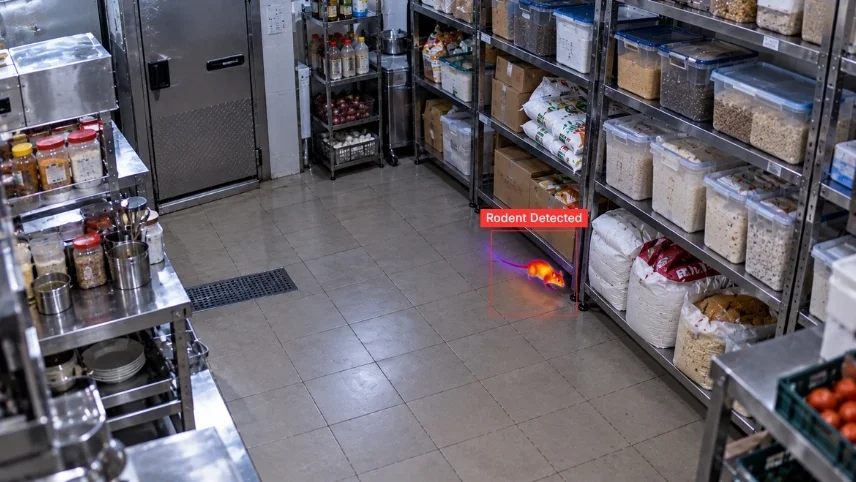
Pest control is one of the fastest ways to lose a licence, and it is usually discovered by the inspector, not the owner. Rats move at night, when the kitchen is dark and the store room is locked, so the first sign is often droppings near a flour sack the next morning. Rodent detection on storage and kitchen cameras flags movement along walls, shelves and floor edges during closed hours, the same approach covered in how AI video analytics in pharma prevents rodents. You call the pest control contractor with a camera, a time and a location, instead of a vague complaint.
How Mikshi AI helps:
- Monitors storage and kitchen cameras during closed hours, when pests are most active.
- Flags rodent movement with the exact camera, time, and location.
- Shows repeat hotspots over time, so pest control targets the right corner.
Unstaffed Wash and Hand-wash Stations
The wash area is always the first station to empty during a rush. The dishwasher gets pulled onto the line to help with plating, and within twenty minutes cooks are reusing ladles that were only rinsed under the tap. Staff presence monitoring shows supervisors when a wash or prep station has been left unstaffed, so someone can be sent back before the corner-cutting becomes the evening's routine.
How Mikshi AI helps:
- Tracks whether wash stations and prep counters are staffed across every shift.
- Alerts supervisors when a key station stays empty during service hours.
- Gives shift-wise coverage reports that show which stations run short most often.
Mobile Phone Use on the Prep Line
A cook takes a call while shaping kebabs, then goes straight back to the mince without washing his hands. A phone that travels from pocket to prep counter to toilet and back is a contamination risk most kitchens never think about. Mobile phone usage detection flags phone use inside marked food handling zones, so supervisors can enforce a no-phone rule that otherwise lives only on a laminated sign.
How Mikshi AI helps:
- Detects mobile phone use inside marked food handling zones.
- Alerts supervisors in real time, so the rule is enforced during the shift.
- Records repeat incidents by zone and time for coaching and SOP reviews.
Audit-Ready Records for the Follow-Up Visit
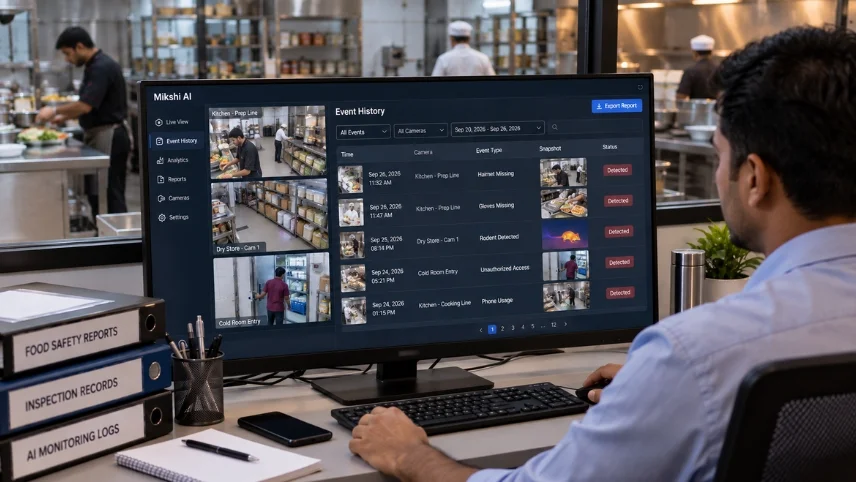
Every one of these alerts is logged with the camera, location, and time. When the Food Safety Officer returns for a follow-up FDA inspection to check whether your improvement notice has been acted on, the manager can open a dated record of what was flagged and what was done instead of promising that the team is more careful now. For a chain, the same record shows a regional manager which outlet keeps generating the same alert, without a site visit.
How Mikshi AI helps:
- Stores every alert with camera, location, and timestamp in one dashboard.
- Generates daily, weekly, or monthly reports you can show during a follow-up visit.
- Brings events from multiple outlets into one central view for chains and hotel groups.
Every hygiene check depends on camera angle, lighting, steam, and kitchen layout, so each use case should be validated on your own feeds during deployment. None of this replaces a kitchen supervisor. It tells the supervisor where to look, and when.
Beyond the Kitchen: How Mikshi AI Covers Your Entire Property
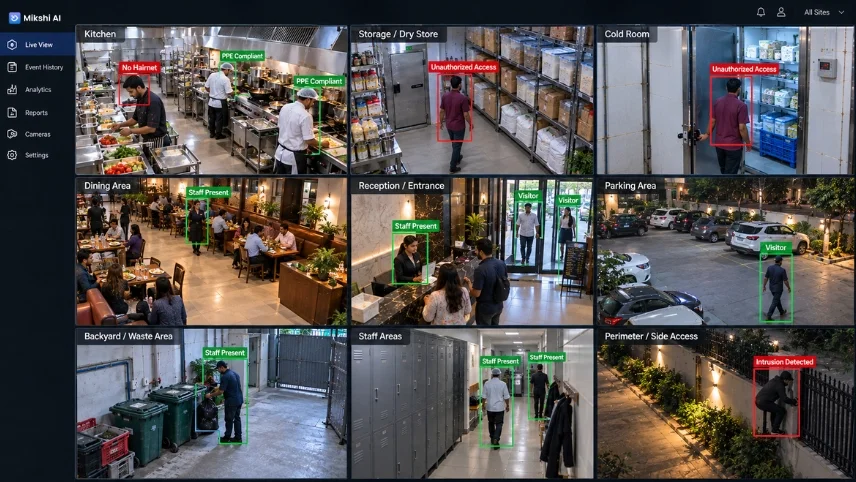
The scene at the start of this post had one real problem: the officer saw things the owner never did. Mikshi AI closes that gap on the cameras most restaurants already have. We connect to compatible IP cameras through RTSP streams and run analytics on premises, in the cloud, or in a hybrid setup.
The kitchen use cases above are only the ones an FDA inspector checks first. The same platform covers the rest of your property too, so one deployment does several jobs:
- Queue and crowd monitoring at ordering counters, reception desks, and dining entrances, so you open another counter before the line turns into complaints.
- Blocked emergency exit detection, so crates and cylinders stacked against a fire exit get moved before a fire officer or a real emergency finds them.
- Fire and smoke detection across kitchens, storage areas, and service corridors is flagged the moment it is visible on camera.
- After-hours intrusion and restricted area alerts for store rooms, parking areas, and back-of-house entrances.
- Fight detection in lobbies, bars, and dining areas, so security reaches the spot quickly.
You can see the full list on our AI video analytics for hotels and restaurants page, with centralised hotel and restaurant video analytics for groups running several properties. The fastest way to judge any of this is on your own kitchen feed.
Every shift your kitchen runs unwatched is a shift where you are taking avoidable risk.
Book a demo with Mikshi AIAnd cut the risk.
In this article
- What the 2026 FDA Crackdown Actually Looks Like on the Ground
- Most Violations Are Shift Behaviour, Not Infrastructure
- Your Kitchen Camera Is About to Become Public
- Where AI Video Analytics Genuinely Helps a Kitchen
- Hygiene Compliance on the Prep Line
- Unauthorized Entry into Cold Rooms and Dry Stores
- Rodent Activity in Storage and Kitchen Areas
- Unstaffed Wash and Hand-wash Stations
- Mobile Phone Use on the Prep Line
- Audit-Ready Records for the Follow-Up Visit
- Beyond the Kitchen: How Mikshi AI Covers Your Entire Property


