Beyond Security: How Hotels & Restaurants Turn CCTV Into a Revenue Engine
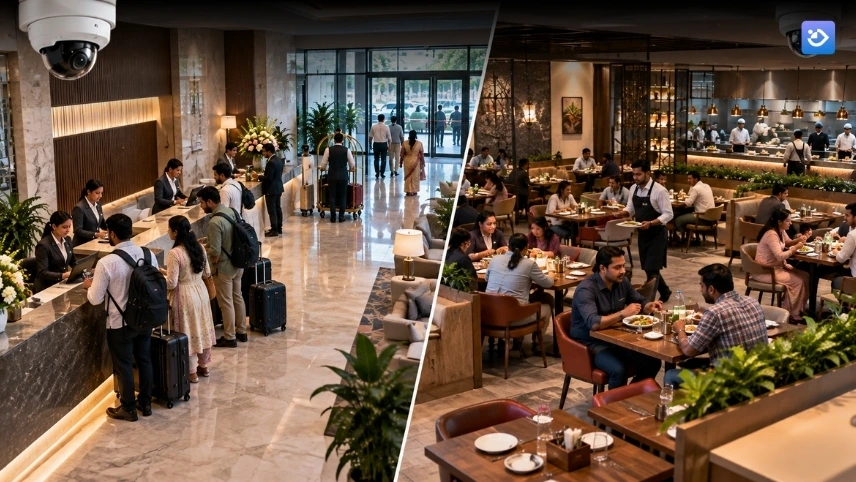
It is 8:40 on a Saturday night at your city hotel. A wedding party has just arrived, the reception queue stretches back to the lobby doors, and one of the three front-desk stations is empty. Downstairs, the all-day dining restaurant has a line at the entrance and an unattended billing counter. A couple who booked for the weekend waits twenty minutes to check in. A walk-in family at the restaurant gives up and leaves. Your duty manager is upstairs, handling a complaint about a noisy corridor.
Your cameras saw all of it. The queue at reception, the empty station, the family walking out. That footage will sit on a hard drive for a few weeks and then get overwritten because in most hotels and restaurants, CCTV is opened only after something goes wrong: a guest complaint, a missing bag, a police request.
Here is the question few hospitality operators ask. If your cameras already see every queue, every unattended desk, and every quiet hour, why is that information used only after the damage is done?
That gap is what AI CCTV analytics for hotels and restaurants closes. Once you understand the difference between recorded CCTV and AI video analytics, the camera on your ceiling starts to look less like an insurance policy and more like an underused member of your operations team.
Why Security-Only CCTV Is Your Most Underused Asset
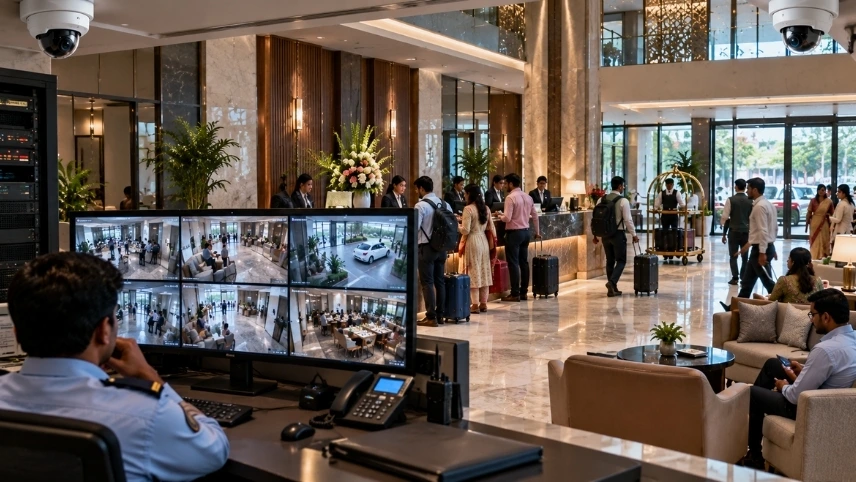
Most properties already pay for the cameras, the NVR, the cabling, and the maintenance contract. What they get back is a recording someone scrubs through to settle a dispute. The investment is sunk, and the return is almost entirely defensive.
- Coverage already sits where revenue happens. Reception desks, lobbies, ordering counters, dining entrances, and parking are the first places any property installs a camera.
- Nobody watches live. A front-office team handling check-ins cannot also monitor thirty feeds, and an outlet manager in the middle of a rush will not look at a screen until the rush is over.
- Review is reactive by design, so the camera contributes only after a loss has already happened.
- The sector's scale magnifies small leaks. India's food services industry alone is valued at roughly ₹5.69 lakh crore and directly employs over 8.5 million people, so minor inefficiencies repeated across outlets and shifts add up fast.
Nothing about the hardware needs to change. Your CCTV is not obsolete; it simply has nothing reading the feed while the shift is still running.
Queues Are a Revenue Leak You Can Actually See
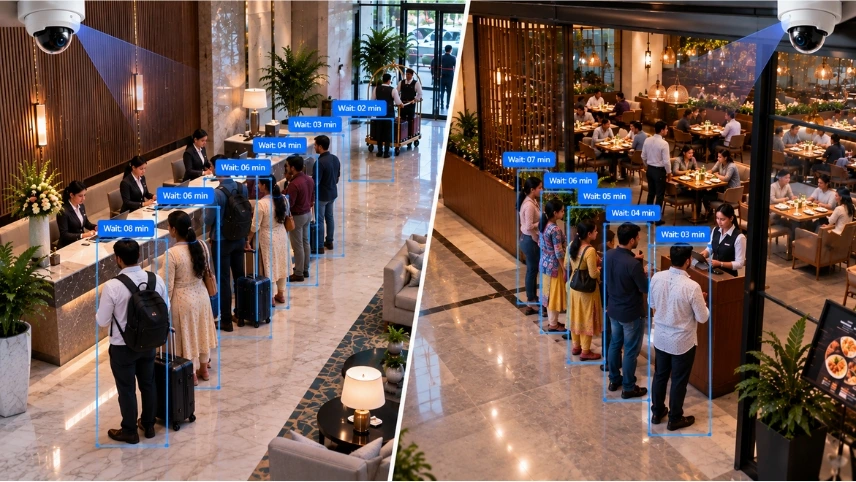
In a restaurant, a queue is demand, and a queue that grows faster than the counter can clear it is demand walking out the door. Hotels feel it differently. A guest who waits too long at check-in after a long journey carries that irritation into the stay, into the review, and into the decision about where to book next time.
The queue monitoring feature of an AI CCTV video analytics system used for hotels and restaurants flags build-up at reception desks, ordering counters, and dining entrances as it happens, so a manager can open another desk or redirect guests before anyone leaves.
- A walkaway never appears in your POS or property management data. You see the orders and check-ins you completed, never the ones you lost.
- Peak patterns become staffable. Logged by hour and day, the Friday check-in rush and the Sunday brunch crowd turn into two separate, predictable demands instead of one vague "weekends are busy."
- Check-in and check-out are the first and last impressions of a stay. Shortening them costs nothing in rooms or rates.
Every minute cut from the wait at peak is capacity you already paid for. That is why AI video analytics for hotels and restaurants treats crowd and queue monitoring as a core module rather than an add-on.
How many guests waited too long at your reception or counter last weekend, and could anyone on your team tell you the number?
Book a demo with Mikshi AIand gain such insights.
Staff Presence: Your Biggest Cost Is Your Least Measured One
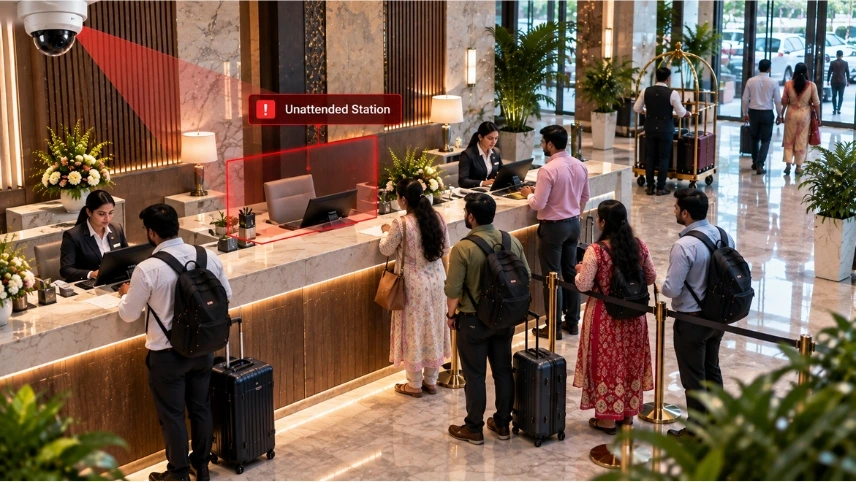
Labour is the line every hospitality P&L watches closely. Yet the measurement behind it is usually a roster and a biometric punch, and neither tells you whether the front desk was staffed during the afternoon check-in wave or whether a billing counter sat empty for forty minutes at lunch.
The staff presence monitoring feature checks whether reception desks, concierge points, service counters, and other key stations are occupied, and shows supervisors which positions go uncovered across shifts.
- Rostered and present are two different numbers. A shift can be fully staffed on paper and still leave the front desk empty when two people step away together.
- Coverage data shows where to add a person at peak and, just as usefully, where you carry one too many during slow hours.
- Supervisors stop managing by walking around. The dashboard points them to the station that needs attention instead of the one they happened to pass.
The aim is the right person at the right desk at the right hour, not tracking individuals for their own sake. That distinction matters when you explain the system to your team.
Hotel Use Cases: Lobby, Parking and Pool
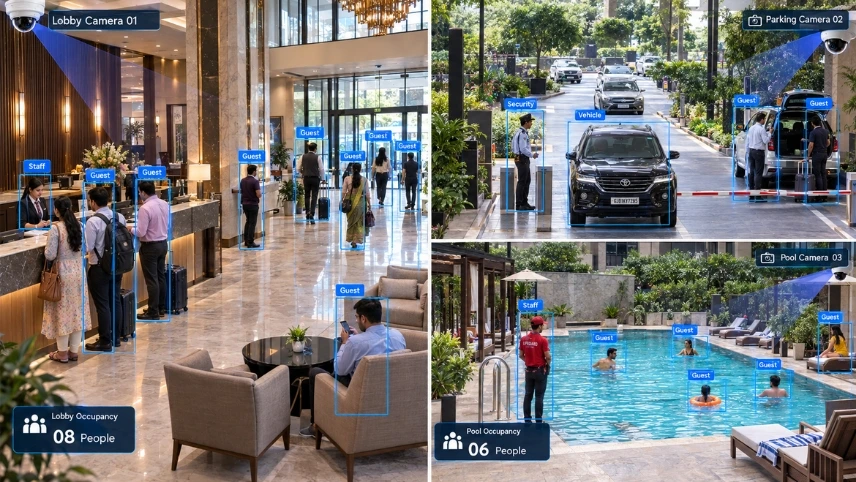
A hotel has far more ground to cover than a restaurant, and much of it sits outside anyone's line of sight, especially after midnight. Hotel video analytics spreads attention across spaces that a lean night shift cannot physically patrol.
- Lobby occupancy and guest flow. Footfall patterns across entrances and the lobby help front-office leaders plan desk staffing, bell desk coverage, and guest routing around real arrival peaks rather than assumed ones.
- Parking and entry monitoring feature in an AI CCTV video analytics system watches entrances, parking areas, and vehicle access points with intrusion and line-crossing alerts, so security reviews boundary activity as it happens instead of discovering it the next morning.
- Loitering near entrances, parking, or restricted access points gets flagged for review. Sometimes it is a guest who needs help. Sometimes, it is something security should check.
- Pools, spas, and other designated areas get occupancy and crowd-density monitoring, so staff can manage capacity before a space becomes uncomfortable or unsafe.
- Service corridors, stockrooms, and storage zones trigger restricted area monitoring alerts when entry happens outside expected zones or schedules.
- Fight detection covers lobbies, bars, entrances, and common spaces, helping security locate an altercation and respond before it becomes a story other guests tell.
Each of these protects revenue in a way specific to hotels. A guest who feels safe in the parking area at midnight and never fights for space at a crowded pool is a guest far more likely to book again.
Restaurant Use Cases: Dining Room, Kitchen, and Storage
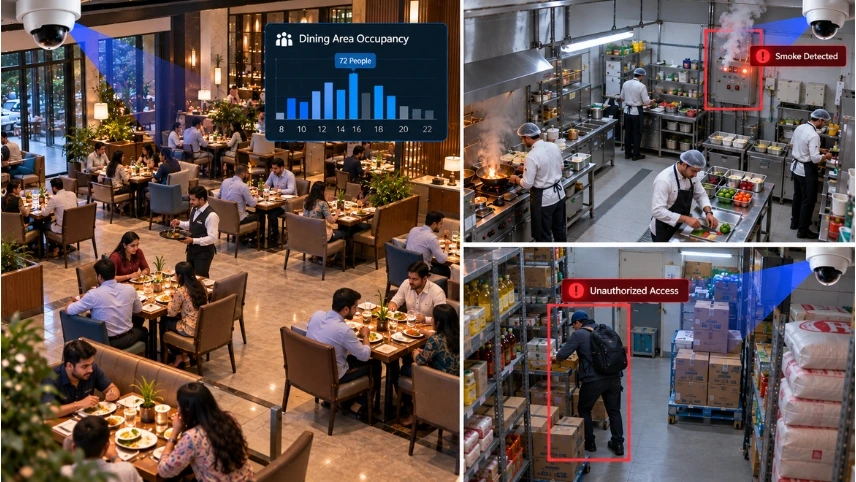
Restaurants run on tighter margins and faster cycles, so the value of restaurant video analytics shows up in weeks, not quarters. The dining room and the kitchen need very different kinds of attention.
- Dining-area occupancy by hour shows when the room truly fills, which is often different from when the team believes it fills.
- If guests consistently bunch at one entrance or one buffet station, that is a routing problem. Signage or a moved counter fixes it once you can see it.
- Kitchens get visible fire and smoke detection within camera coverage, alerting teams so the established emergency response starts sooner. India recorded 7,054 fire accidents in 2023, according to NCRB, and a commercial kitchen with open flames and hot oil is exactly where minutes matter.
- Entry into restricted kitchen and storage zones is flagged, so unexpected access gets checked the same night instead of at the next stock count.
A kitchen fire closes an outlet for days, and the lost business usually costs more than the damage. The compliance side, including inspection readiness, is covered in our blog about restaurant food safety compliance with AI video analytics.
One View Across Every Property and Outlet
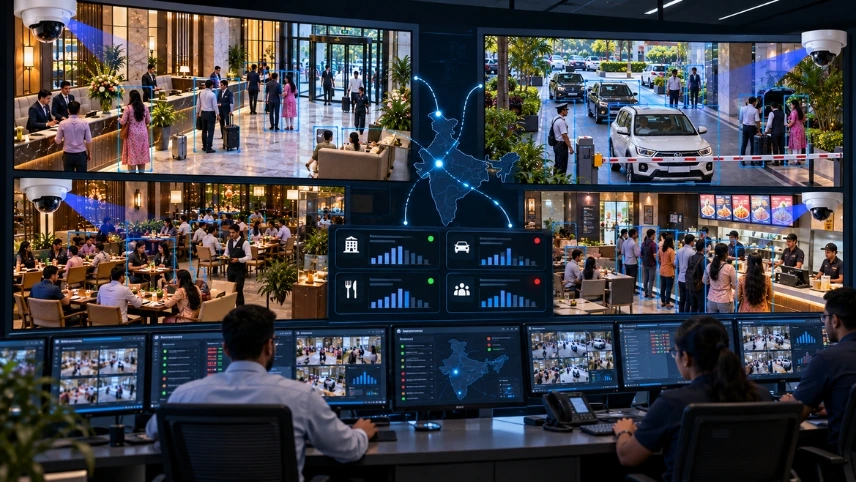
For a single property, the owner can still walk the floor. For a hotel group with four properties or a chain of twelve QSRs, that stops working, and regional managers end up relying on incident reports that arrive late and describe only what someone chose to write down.
- Events from every hotel and outlet flow into one centralised dashboard, so central operations can see which locations need attention this week.
- Recurring issues stand out. If one property's reception queues every evening and the others do not, the cause is specific to that site.
- Brand standards around desk coverage and guest wait times can be compared across properties instead of assumed.
- Rollout can start with one property and two or three priority use cases, then expand once the value is visible.
For multi-location operators, this is usually where the business case closes. One insight repeated across ten sites is worth ten times as much.
The Objections Worth Raising Before You Sign Anything
Any sensible operator should push back on a video analytics pitch. These are the questions that decide whether a deployment actually pays off.
- Will it work with my cameras? Most modern platforms connect to compatible IP cameras through RTSP streams, and a compatibility review of stream quality and camera angles should come before any commitment.
- Guest privacy is non-negotiable. Analytics should cover operational and common areas only. Guest rooms, bathrooms, and changing spaces must be excluded, and a vendor who does not say so upfront is a red flag.
- Ask where the video is processed. On-premises processing keeps footage inside your own infrastructure, with cloud and hybrid as options rather than requirements.
- False alerts kill adoption because a system that raises false noise gets muted within a week. Ask how the platform filters irrelevant motion and why AI cameras see "ghosts" in the first place.
- Detection has physical limits. Lighting, obstructions, and crowding all affect performance, and an honest vendor tests representative feeds before rollout.
If a pitch skips these questions, the system they are selling will not be worth your time and money.
How Mikshi AI Helps Drive Revenue for Hotels and Restaurants
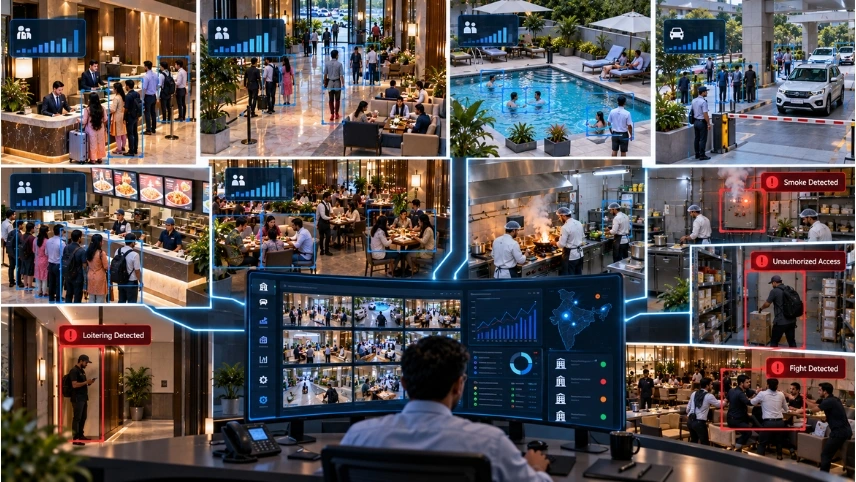
Go back to that Saturday night. The crowded reception, the empty front-desk station, the family leaving the restaurant. Every piece of it was on camera, and none of it reached anyone in time to matter.
Mikshi AI is built to close exactly that gap. It adds AI video analytics to the compatible IP cameras you already have and turns their feeds into alerts, dashboards, and reports that front-office teams, outlet managers, security, and central operations can act on during the shift.
- Crowd and queue monitoring at reception desks, ordering counters, and dining entrances.
- Staff presence monitoring across front desks, service counters, and key stations, shift by shift.
- Guest flow and occupancy insights for lobbies, dining areas, pools, and spas.
- Parking and entry monitoring, loitering detection, restricted area alerts for back-of-house and kitchens, fight detection, and fire and smoke detection that support your existing security and emergency response.
- On-premises, cloud, or hybrid deployment, with guest rooms and private spaces excluded, and centralised dashboards across every hotel and outlet in your group.
We usually start with one property and the use cases closest to revenue, then expand once your team has seen the data from its own floor. The full module list is on the Mikshi AI hospitality video analytics page.
Every busy shift without live video data is a shift where your revenue depends on what one duty manager happened to notice.
Book a demo with Mikshi AIand mitigate this risk.
In this article
- Why Security-Only CCTV Is Your Most Underused Asset
- Queues Are a Revenue Leak You Can Actually See
- Staff Presence: Your Biggest Cost Is Your Least Measured One
- Hotel Use Cases: Lobby, Parking and Pool
- Restaurant Use Cases: Dining Room, Kitchen, and Storage
- One View Across Every Property and Outlet
- The Objections Worth Raising Before You Sign Anything
- How Mikshi AI Helps Drive Revenue for Hotels and Restaurants


