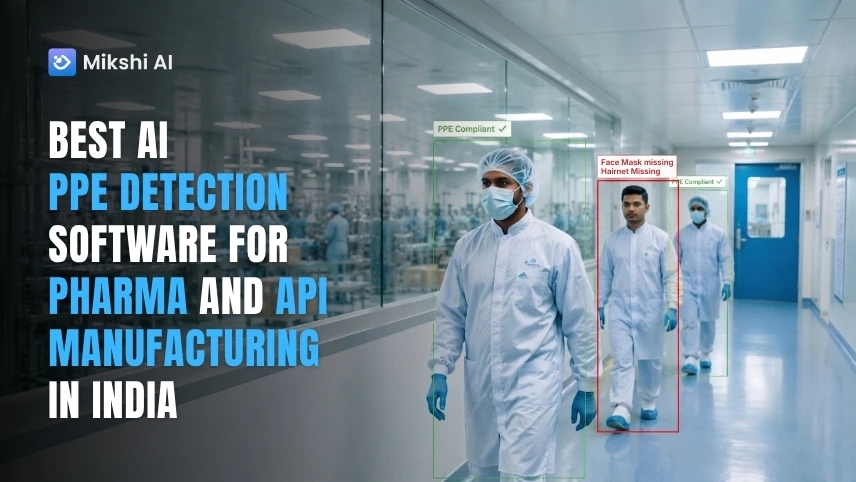
Best AI PPE Detection Software for Pharma and API Manufacturing in India
You have shortlisted three or four platforms. They all claim real-time detection, compatibility with existing cameras, and fast deployment. They all have a demo video that looks impressive. The sales decks are polished. The case studies are from German and US pharmaceutical facilities. And somewhere in the procurement process, it occurs to you: none of these platforms were built with Indian pharma conditions in mind.
The comparison most EHS managers and QA heads run is features vs. features. Helmet detection, vest detection, real-time alerts, dashboard reporting. That comparison leads to parity. Almost every platform on a shortlist can detect a missing hard hat in a well-lit factory. The question that actually separates these platforms is not what they detect. It is whether they were built to work in environments like yours, with your workforce density, your regulatory context, and your data residency requirements.
This post cuts through the comparison fatigue and answers the one question that matters: which platform was actually built for your pharmaceutical facility.
Why Global AI PPE Detection Platforms Often Underperform in Indian Facilities
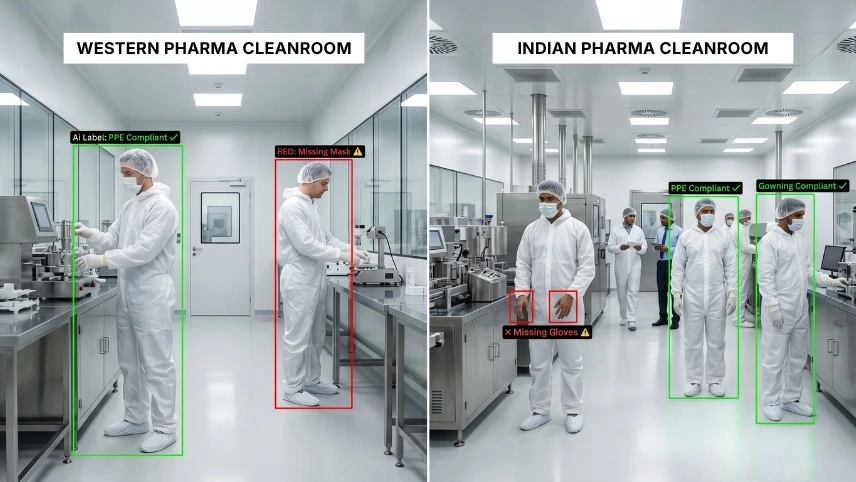
AI models for PPE detection are trained on data. The data reflects the environments in which the model was developed. A model trained primarily on Western factory footage carries assumptions about lighting conditions, worker density, PPE configurations, facility layouts, and camera placement that do not map cleanly onto an Indian pharma context.
Indian plants operate at significantly higher worker densities. PPE types vary across industries in ways that differ from EU or US norms. For instance, clean-room gowning in an Indian pharma GMP facility follows Schedule M and CDSCO requirements, not just FDA or EMA frameworks.
The ILO estimates 2.3 million workers die annually from occupational accidents and work-related diseases globally. Against that backdrop, improving PPE compliance and workplace safety remains a major priority for manufacturers worldwide. In India, the scale of pharmaceutical operations, workforce density, and local regulatory requirements create conditions that differ significantly from many Western facilities, making locally relevant deployment and model training especially important.
The result: a platform with 95% accuracy in a Michigan auto plant can run with lower accuracy in a Hyderabad pharmaceutical facility simply because it has never seen that environment in training data. That gap matters when your auditor is walking the floor and your system is generating false negatives.
- Model training environment determines real-world accuracy more than algorithm sophistication.
- Regulatory context determines whether the platform's compliance outputs are actually useful for Indian audit documentation.
- Data residency and deployment model determines whether the platform can operate in classified pharma zones with strict on-premise requirements.
- Local support determines whether a critical alert failure at 2 AM on a Saturday gets resolved before your Monday inspection.
Keep these four dimensions in mind. Feature lists are easy to match. These four factors are where the real differences live.
Mikshi AI: The India-First AI Platform Built for Pharma GMP
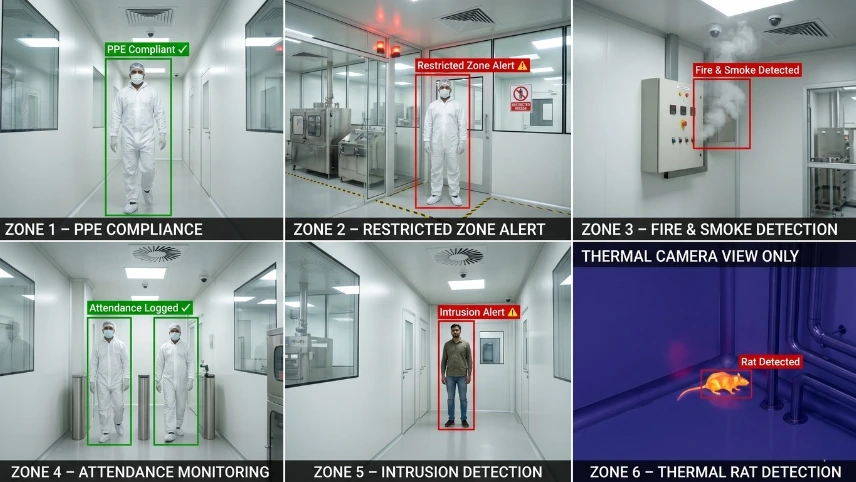
Mikshi AI was built as an AI video intelligence platform for India, trained on Indian facility data, configured for Indian operational environments, and supported by teams working in Indian time zones. While PPE compliance is often the starting point for pharmaceutical manufacturers, the platform extends far beyond a single use case. By transforming existing CCTV infrastructure into a source of real-time operational intelligence, Mikshi AI helps organizations improve safety, strengthen security, and gain greater visibility across day-to-day operations. The following are the ways in which Mikshi AI can help a pharma and API manufacturing plant:
- PPE Compliance Monitoring
- Restricted Zone Detection
- Fire and Smoke Detection
- Workforce and Person Detection
- Attendance Monitoring
- Intrusion Detection and Alerts
- Rodent (Rat) Detection
- Slip and Fall Detection
- Unauthorized Access Monitoring
- Theft Prevention and Incident Investigation
What Mikshi AI does well:
- India-specific model training. AI models trained on Indian pharma facility data, accounting for the workforce densities, PPE configurations, and environmental conditions specific to Indian plants. This directly addresses the accuracy gap that global platforms carry in Indian deployments.
- Pharma GMP gowning sequence detection, configured against your facility's SOPs for each classified zone. Not just PPE presence detection, but procedural compliance verification.
- On-premise, cloud, or hybrid deployment, allowing pharmaceutical and API manufacturers to choose an architecture that aligns with their IT, security, and operational requirements.
- Full platform coverage in one deployment: PPE detection, rodent detection, restricted zone access, attendance monitoring, theft prevention, fire and smoke detection, and slip/fall alerts all run on the same existing camera infrastructure.
- India-based support in local time zones, with implementation teams who have deployed in Indian pharma environments.
- Deployment in days, not months, without hardware replacement or production line disruption.
Global PPE detection video analytics vendors benchmark their accuracy on Western facility data. An Indian plant running at twice the worker density, in a different lighting environment, with different PPE types, will generate different results. Mikshi AI's models have been trained to perform in the Indian pharma manufacturing facility environment.
What would your next audit look like with 18 days of continuous gowning compliance data behind you?
That is not hypothetical for Mikshi AI customers.
Book a Free DemoThree Questions to Ask Any AI PPE Detection Vendor Before You Sign
Ask every PPE detection video analytics vendor on your shortlist these three questions. The answers will tell you more than any feature comparison table.
Question 1: Where was your AI model trained, and what percentage of your training data comes from Indian pharma environments?
If the vendor pivots to accuracy percentages without answering directly, that is the answer. A model trained on Western factory data will under-perform in your facility.
Question 2: Can you deploy fully on-premise in a classified pharma zone, and what does that look like specifically?
A few cloud-first platforms will say yes, then walk you into a hybrid architecture that still routes data through their servers. Get the deployment architecture in writing.
Question 3: Who handles support calls, in which timezone, and what is the SLA for a critical alert failure on a night shift?
A platform that misses a gowning violation or generates a false negative during a inspection has failed. Who fixes it and how fast is not secondary. It is the whole point. These three questions eliminate vendors that cannot support Indian facilities in practice.
The Right Platform Is the One Built for Where You Actually Operate
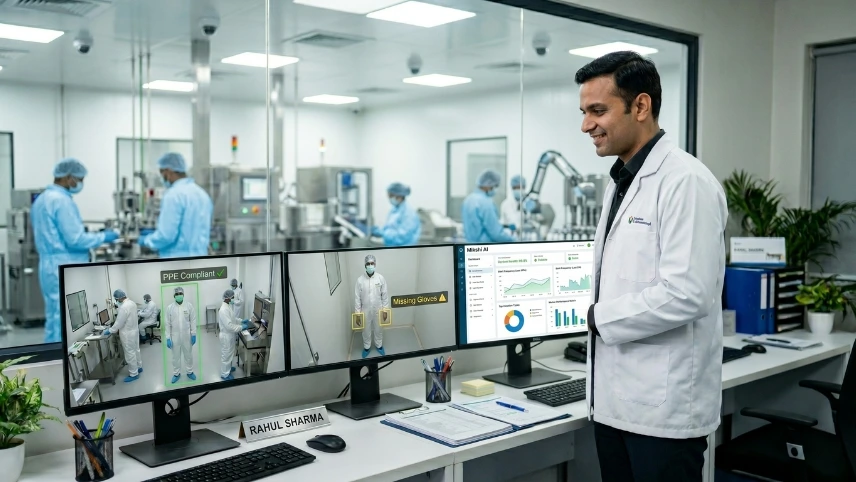
Feature parity is easy to claim in a sales deck. Deployment context is hard to fake once you are on the floor.
The AI PPE detection platform India shortlist gets short very quickly when you apply the filters that matter: training data origin, India-specific regulatory context, on-premise deployment, and local support. You need a platform that was made with Indian pharma manufacturing conditions in mind.
Built and supported in India, Mikshi AI is an enterprise AI Video Analytics platform that transforms existing CCTV infrastructure into real-time operational intelligence for Indian pharmaceutical and API manufacturers.
The next inspection is being shaped right now by what your floor looks like on every shift. The AI PPE detection platform that closes that gap is the one built understanding what your floor actually looks like.


