A Guest Reported an Incident. Now Find the Right Footage.
The hotel, the staff, and the guest in this story are fictional. The scenario is illustrative, not a customer case.
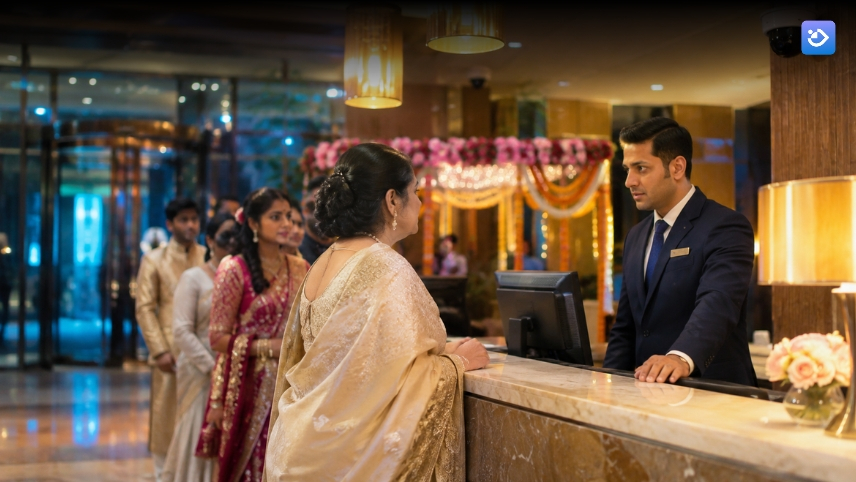
At 9:40 on a Saturday night, Rohan, the night manager at a 150-room hotel, heard the sound every hotelier dreads. It was not an alarm. It was a calm, controlled voice at the front desk saying, "I would like to see the footage."
Mrs. Mehra had checked in that afternoon for her nephew's wedding weekend. She had left her black leather handbag on the lobby sofa at 6:30 while greeting relatives, and walked away without it. She noticed only at 9:30, when she returned from the pre-wedding dinner and reached for her laptop to rehearse. She checked the bell desk first, but the attendant who handled lost property that evening had gone off shift at eight, and nothing was in the register. So she walked to the front desk. Inside the bag were her laptop, her mother's bangles, and the only copy of her speech for the next morning. She did not raise her voice. She did not need to. She just stood at the desk and waited, and the line behind her grew.
Rohan knew what came next. Every property he had worked at handled this moment the same way: somebody sits in the CCTV room, drags a timeline backward from the moment the loss was noticed, and watches the evening at four times speed, the fastest anyone can go without missing things. The camera had recorded everything. What it had never done was help anyone find anything. What happened over the next hour is a lesson in hotel CCTV footage search and in what hospitality video analytics can do for a hotel security team.
9:48 PM: The Race Against a Review
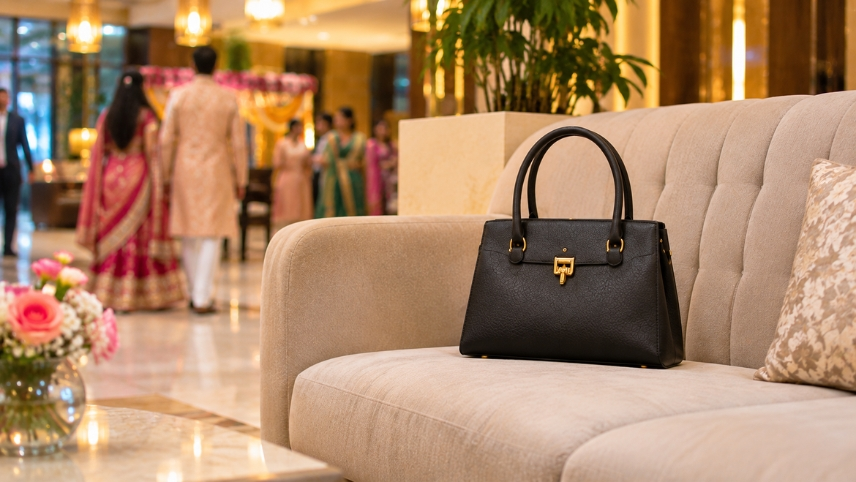
Rohan sent his security supervisor to the CCTV room, seated Mrs. Mehra in the lounge with a cup of tea and told her he would have an answer before she went to bed. That promise was a bet, and he knew the odds. The lobby had hosted wedding guests all evening, and a crowd that size turns a camera feed into a river of kurtas and sherwanis.
Twenty minutes in, the supervisor called the desk. Working backward from 9:30 at four times speed, he had covered barely an hour and twenty minutes of the evening and was only back to about 8:10. He had found a man in a beige kurta lingering near the sofa at 8:15. Was that him? Nobody could say. The clip was grainy at that speed; the man was one of forty people in the frame, and the guest was already typing on her phone.
This is how an incident quietly becomes a guest incident investigation gone wrong. The footage exists. The pressure is real. The only tool in the room is a human eye, and the human eye gets tired.
- The window was three hours wide, from the last moment she saw the bag to the moment she noticed it was gone.
- Watching fast meant missing the moment, and watching slow meant watching too much footage.
- The supervisor was also covering the gate. Attention was split from the start.
- A wrong guess here would not just waste time. It could point at an innocent guest or a staff member.
Could your night team find one specific guest in a full evening of lobby footage before Mrs Mehra finishes writing the bad review?
Book a demo with Mikshi AI10:22 PM: Rohan Asks the Footage a Question
By 10:20, Rohan had spent half an hour steadying the desk and the wedding crowd, and then he remembered something. A few weeks earlier, his property had started using Mikshi AI on its existing cameras, and one capability had barely been used yet: the ability to ask a video what it contained.
He walked to the CCTV room, opened the lobby footage for the evening, and typed the way he would describe the bag to a colleague: a black leather handbag on the sofa. No filters. No timeline scrubbing. Mikshi AI took the question, searched that footage and came back with moments, not a three-hour recording. Rohan did not watch the whole evening. He jumped from match to match. Nothing about the camera had changed, and nothing about the building had changed. It was the same footage that had sat unsearched an hour earlier, and now it could be questioned.
That is the difference AI video search makes. Traditional CCTV answers what the camera saw at a given time. Mikshi AI answers when a specific person or object appeared in the footage, which is the only question a guest at the front desk has ever cared about.
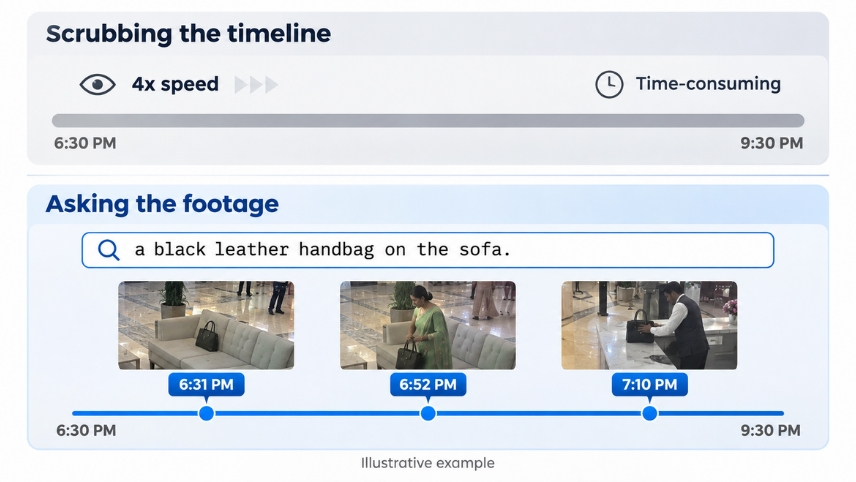
- The first match showed the bag on the sofa at 6:31, exactly where Mrs. Mehra said she left it.
- The next showed a person approaching the sofa at 6:52 and picking the bag up.
Rohan paused there. Mikshi AI had surfaced the moment, but he did not accept it as a verdict. He confirmed it with his own eyes before doing anything else.
The Twist Nobody Expected
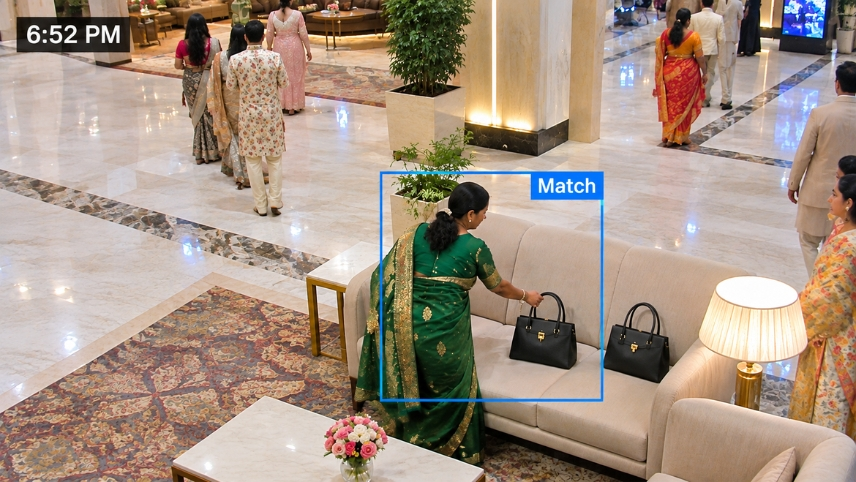
The person in the clip was not who anyone had imagined. It was a woman in a green saree with a black leather handbag on her shoulder. She lifted Mrs. Mehra's bag, glanced at it for a second, then walked toward the lifts carrying it with the same confidence she had carried her own.
Rohan felt the room change. This was not a thief in the usual sense. The woman had been sitting on the next sofa. Her own handbag, a near-identical black leather one, sat beside Mrs. Mehra's. At 6:52, in a lobby full of wedding noise, she had picked up the wrong one. Searching the same footage for the second bag showed what happened to it: at 7:10, a lobby attendant spotted it unattended on the sofa, assumed a guest had forgotten it and carried it to the bell desk's lost-property locker. Because the attendant went off shift at eight, it never made it into the register.
Rohan opened the lift lobby footage next, the camera covering the floor she had stepped into, and ran the same kind of search: a woman in a green saree carrying a black handbag. One footage at a time, he followed her trail. She had stepped out on the fourth floor and walked toward a room at the end of the corridor. Rohan checked the room number against the registration records, a step that stayed fully in human hands, and had a name within minutes.
It was 10:31. Nine minutes after Rohan had typed his first question, he knew where the bag was, who had it and, just as importantly, that nobody had stolen anything.
10:51 PM: The Handbag Comes Home
Rohan called the fourth-floor room himself. The guest, Mrs. Kapoor, had returned from the wedding dinner barely twenty minutes earlier. She had changed in a hurry at seven, dropped the bag by the door and left again, and she had just opened it looking for her phone charger when the phone rang. She was mortified. Within fifteen minutes, a housekeeping supervisor stood at the lobby desk with the right handbag and a very relieved apology, while the bell desk pulled Mrs. Kapoor's own bag from the locker for its trip back upstairs.
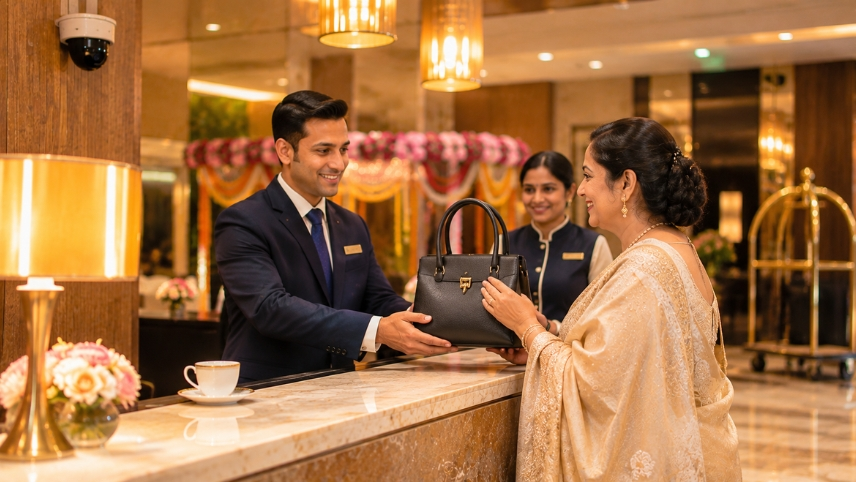
Mrs. Mehra opened it. The laptop was there. So were the bangles. So was the speech. She looked at Rohan for a long moment and then said something no night manager hears often enough: "Thank you for finding it so fast."
The guest who had spent over an hour waiting, prepared to tell the whole wedding party how her weekend began, left with a bag and a story about the hotel that actually solved her problem. Rohan sent the short clip to the duty manager, closed the incident and went back to the desk. The line at the desk had long since cleared.
The Morning After: What Changed
The next morning, Rohan did not remember the footage as a hotel security win. He remembered it as the night a complaint did not become a review. The guest stayed. The wedding party spoke well of the property. A scene that could have cost goodwill, a refunded night, or a public rating dip cost nothing but nine minutes of a calm manager's attention.
That is where hotel CCTV footage search earns its place. It protects revenue and reputation in the same motion, which is the same logic behind how hotels and restaurants turn CCTV into a revenue engine, and it does so for incidents far smaller than a stolen bag.
- A disputed restaurant bill gets checked against what the camera saw instead of two competing memories.
- Porch and parking incidents get settled at the portico instead of by email a week later.
- Staff allegations get handled with evidence, which protects honest employees as much as it exposes the other kind.
- Repeat patterns, like items going missing near one entrance, become visible when every search takes minutes.
Beyond the Handbag: What Else Mikshi AI Does for a Hotel
The handbag was the capability of Mikshi AI, that Mrs. Mehra felt. The rest of what Mikshi AI does is what a hotel's operations team feels every day because detection runs continuously instead of only when someone goes looking. All of it works on existing CCTV, and the breakdown of 22 AI video analytics use cases for hotels goes deeper on each one.
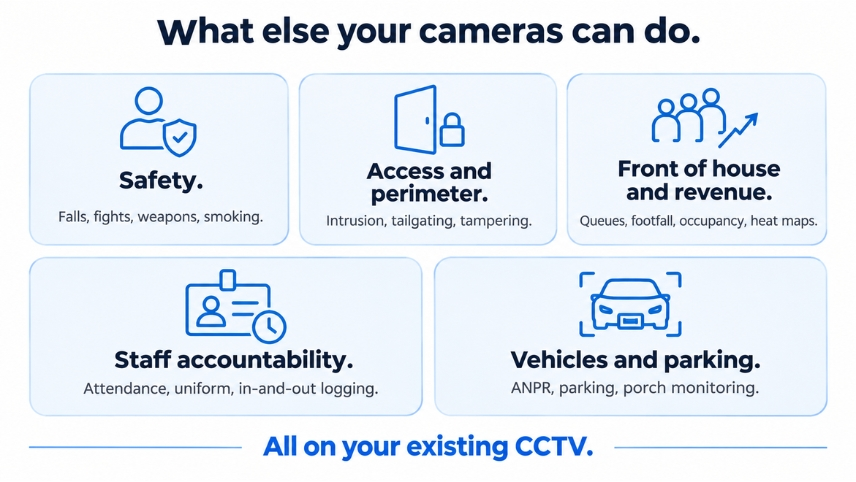
- Guest and staff safety: Fall detection in corridors and lobbies, human fighting detection, weapon detection, smoking detection in no-smoking areas and vandalism alerts.
- Access and perimeter control: unauthorized access and intrusion alerts for back-of-house areas and staff-only floors, tailgating, loitering, covered-face detection, and camera tampering alerts.
- Alerts when a blacklisted or unknown person is detected, for properties that maintain a watch list.
- Front of house and revenue: Queue count and dwell time at reception and restaurant entrances, footfall, crowd counting for banquets, occupancy management and location-based heat maps.
- Staff accountability handled by role: attendance, in-and-out time logging, uniform compliance, and mobile usage.
- Vehicles and parking: ANPR-based entry and exit logs, authorized and unauthorized vehicle checks, parking management, stationary vehicle detection at the porch, and wrong-direction or speed alerts on driveways.
Few properties switch everything on at once. Most start with the use case that costs them the most, whether that is a safety gap, a revenue leak, or a slow response to guests, and expand from there.
How Mikshi AI Closes the Footage Gap Named Above
Every hotel has a version of that Saturday night. The cameras record without fail, and nothing helps a person find the right moment inside the recording. Mikshi AI was built for that gap. It connects to the CCTV a hotel already has, with no new camera hardware, and gives your team AI video search over it, so they can find a person or object inside a long footage by describing it. We built it for the moment your night manager is standing next to an unhappy guest and needs the clip, not the evening.
- Works on existing CCTV, with no rip-and-replace project before the first search.
- Finds a person or object within a single long footage using plain-language queries.
- Keeps a human in the loop. Matches are moments to confirm, never verdicts.
- Extends to safety, access, queue, occupancy, attendance, and vehicle use cases on the same cameras.
Every night your team scrubs footage by hand is a night a guest waits for an answer the cameras already hold.
Book a demo with Mikshi AI


