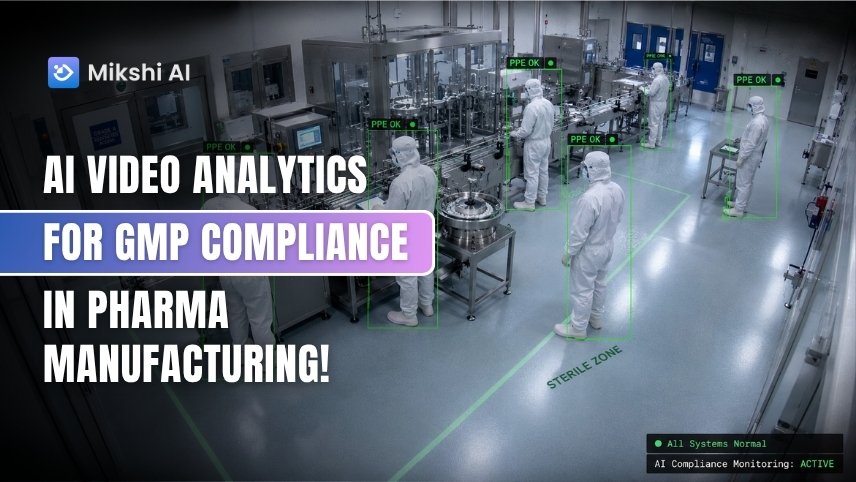
AI Video Analytics for GMP Compliance in Pharmaceutical Manufacturing: A Complete Guide
The FDA inspector has just left your facility. You are reviewing the Form 483. Line three reads: "Aseptic operators observed performing gowning procedures inconsistently with written SOPs." You know which shift. You can guess which bay. But could you have stopped it in real-time?
Most QA teams are working with the right procedures, the right training records, and the right intent. What they do not have is a system that watches the floor continuously, across every shift, without depending on a supervisor being in the right place at the right time.
An AI video analytics system used for GMP compliance in pharma can prove to be a useful solution. This is not about replacing your quality team. It is about giving them something they have never had:
Real-time digital eyes across the entire facility.
GMP Compliance in Pharma Is Not Getting Easier
The regulatory pressure on pharmaceutical manufacturers has increased consistently, and it shows no sign of slowing.
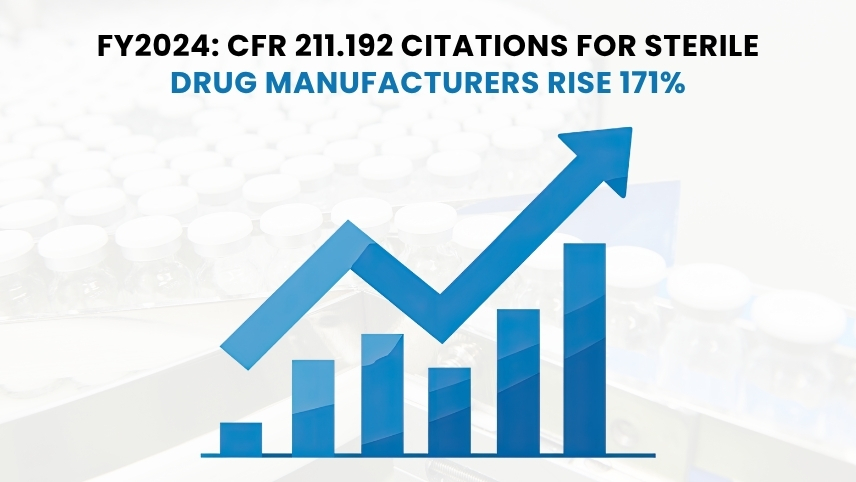
In FY2024, FDA observations for sterile drug manufacturers showed a 171% increase in citations under CFR section 211.192, which governs cross-contamination investigations.
Gowning inadequacy and poor aseptic practices were specifically called out as recurring findings. In India, the Ministry of Health revised Schedule M GMP rules in January 2024 to align with WHO manufacturing standards, introducing requirements for pharmaceutical quality systems, quality risk management, and computerized monitoring systems across all drug product facilities.
The message from regulators is consistent: just documenting the procedures is not enough. You need evidence that they are being followed, in real time, on every shift.
That evidence gap is exactly where AI surveillance for pharmaceutical clean rooms systems creates value that no audit trail, SOP update, or periodic supervisor round can replicate.
PPE and Gowning Compliance: The Gap That Keeps Appearing on 483s
Priya is a QA manager at a sterile injectable plant in Hyderabad. Her facility has detailed gowning SOPs, trained operators, and a supervisor on every shift. What she does not have is a way to confirm that every operator in every clean-room antechamber is following the full gowning sequence, every time, across the night shift, especially when senior QA personnel are not on the floor.
The FDA knows this gap exists. In the past, the FDA inspectors have specifically flagged facilities where aseptic operators did not adequately follow gowning procedures.
Gowning is not a peripheral concern. It is a primary vector for microbial contamination in sterile environments, and it is almost entirely dependent on human discipline, which is fragile in the absence of monitoring.
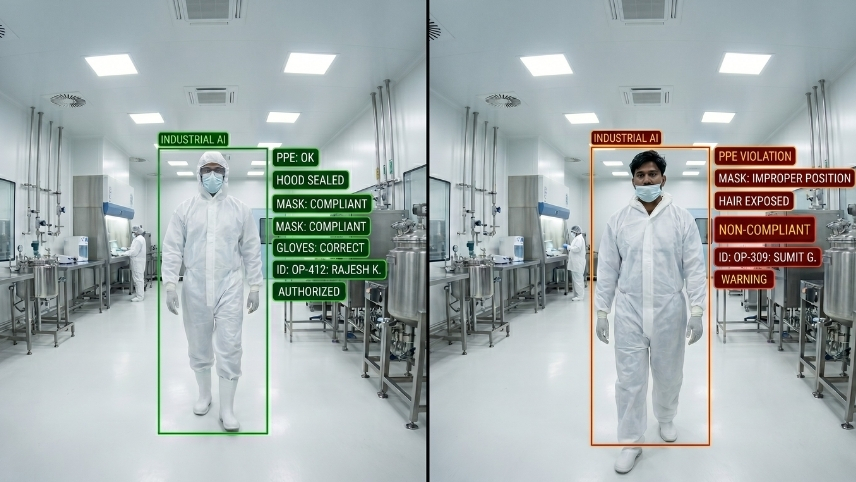
PPE detection in pharma GMP environments works differently from general manufacturing. Organizations evaluating vendors should also understand how to choose the best AI PPE detection platform for pharma and API manufacturing in India before deployment. The AI system is configured to verify specific gowning sequences, not just the presence of PPE items. It monitors:
- Full gowning sequence compliance: Whether operators are following the correct order of donning, not just wearing the required items at the point of entry.
- Glove and mask integrity checks: Whether double-gloving protocols, mask positioning, and hood coverage meet the visual standards defined in the facility's SOPs.
- Antechamber and airlock behavior: Whether operators are spending the required time in airlocks, avoiding re-entry violations, and not bypassing intermediate zones.
- Shift-level compliance patterns: Whether gowning adherence drops on specific shifts, in specific zones, or correlates with particular operators, giving QA a data-backed basis for targeted intervention.
When the system detects a deviation, the alert goes to the QA supervisor immediately, not when the shift ends. The event is logged with a timestamp, camera reference, and zone. When the FDA inspector asks for evidence of ongoing gowning monitoring, you have an automatic, continuous record rather than a folder of periodic walkthrough checklists.
Your SOPs say compliant.
But Your 483 said gowning.
Mikshi AI plugs this GAP.
Book a Free DemoClean-room Access Control: Every Unauthorized Entry Is a Contamination Risk
At a formulation plant in Pune, a batch investigation traced an OOS result back to a two-hour window on a Wednesday night shift. The restricted clean-room had been accessed by a maintenance technician who needed to check an equipment calibration. The access was not logged. The technician was not in gowning compliant with that zone's requirements. Nobody stopped him because nobody saw him.
The batch was quarantined. The investigation took three weeks. The CAPA required six months of additional environmental monitoring data before the FDA accepted it as closed.
Unauthorized or non-compliant access to classified zones is one of the most consequential GMP violations in pharmaceutical manufacturing. The contamination risk is real. The documentation liability is immediate. And with standard CCTV and manual access logs, the evidence trail is almost always incomplete.
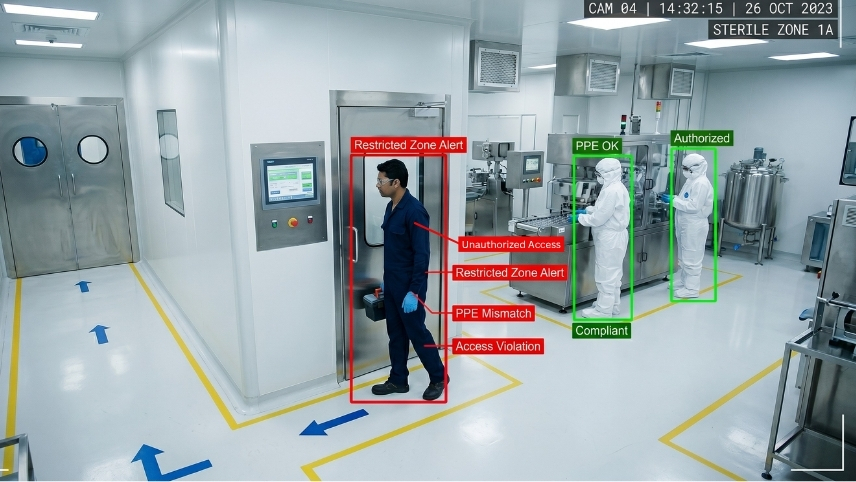
AI surveillance for pharmaceutical clean-rooms monitors every classified zone continuously. It is configured to recognize:
- Zone-specific gowning requirements: An operator correctly gowned for a Grade C area entering a Grade A area without upgrading triggers an immediate alert.
- Non-personnel entry: Maintenance staff, contractors, and visitors entering clean-rooms outside approved windows or without the correct escort protocols.
- Duration and frequency anomalies: If a zone is accessed more frequently than expected, or if an operator remains in a restricted area longer than the task warrants, the system flags it.
- After-hours and weekend access: When supervision is thinnest, access logging is most likely to fail. AI monitors these windows automatically.
Every entry and exit is timestamped and stored against the camera reference and zone classification. When your next CDSCO or FDA inspection requires classified zone access record for the previous quarter, you produce a complete, unbroken log, not a notebook that depends on someone having remembered to write in it.
Environmental Monitoring Gaps: What Happens Between Scheduled Sampling
A sterile manufacturing facility in Ahmedabad ran a flawless environmental monitoring program on paper. Sampling was done at the right locations, at the right frequencies, with results consistently within limits. What the program did not capture was the behavior pattern of operators between sampling events.
Doors were left open slightly longer than they should. Equipment carts moved through zones without the correct decontamination step. A cleaning crew working faster than the validated procedure allowed.
None of these showed up in the EM data. Until they did, in a contamination event that triggered a batch recall and an unannounced FDA inspection.
Scheduled environmental monitoring captures the floor at defined moments. AI video analytics for GMP compliance in pharma captures the floor continuously, filling the gaps between sampling events with behavioral data that EM alone cannot produce. Many of these compliance failures originate in specific production and access-control areas. Understanding the pharma deviation zones where risks typically begin can help teams focus monitoring efforts more effectively.
What continuous visual monitoring adds to your EM program:
- Procedure adherence tracking: Whether cleaning and disinfection steps are being completed in the correct sequence and with the correct dwell times, not just whether they were performed at all.
- Door and airlock discipline: Whether classified zone doors are being opened and closed correctly, and whether positive pressure integrity is being maintained through correct entry behavior.
- Material and equipment movement: Whether items moving between zones are following the correct transfer routes, decontamination steps, and documentation triggers.
- Operator density and zone traffic: Whether classified zones are being accessed at higher-than-validated frequencies during certain periods, creating a contamination risk that EM trending alone would not catch until after the fact.
The combination of AI-driven behavioral monitoring and your existing EM program gives regulators something they rarely see: a facility where the gap between written procedure and actual practice is continuously measured, not periodically inferred.
The FDA Inspectors are not checking your SOPs.
They are checking whether your operators follow them.
Mikshi AI gives you the evidence before they ask for it.
Book a Free DemoOperator Training and Behavior: The Compliance Gap You Cannot See in Training Records
Rohan joined the aseptic filling line six months ago. He completed his gowning training, passed the written assessment, and has a clean training record. On paper, he is qualified. On the floor, during the 11 PM to 7 AM shift, his technique drifts. Not dramatically. Not in a way that would catch a supervisor's eye during a spot check. But consistently, in small ways, that accumulate risk.
Training records tell you what someone was taught. They do not tell you what they do at 3 AM when the QA manager is not on shift.
This is one of the most honest statements in pharmaceutical manufacturing, and regulators understand it. The experienced hands in the pharma industry know that the facilities fail not because operators are untrained, but because training has not translated into consistent daily practice.
AI employee monitoring for pharma manufacturing bridges this gap by creating behavioral data alongside training records:
- Individual operator compliance profiles: Over time, the system builds a picture of compliance patterns by operator, by shift, and by zone. Training intervention can be targeted at actual behavior gaps, not assumed ones.
- Deviation analysis: If deviations cluster around a specific time window, a specific zone, or a specific team, that is a root cause signal that generic retraining will not address.
- Real-time coaching triggers: When a deviation is detected, the alert goes to the shift supervisor immediately, enabling real-time correction rather than a post-event CAPA.
- Audit trail for personnel monitoring: Every detected deviation, every alert issued, and every corrective action taken is logged automatically. This is precisely the kind of documented, ongoing monitoring that regulators expect to see as part of a robust quality culture.
The goal is not to penalize operators. It is to build a facility where compliance is reinforced continuously rather than assessed periodically. That shift in approach is what regulators are increasingly looking for.
Rodent and Pest Intrusion: The Risk You Rarely See Until It’s Too Late
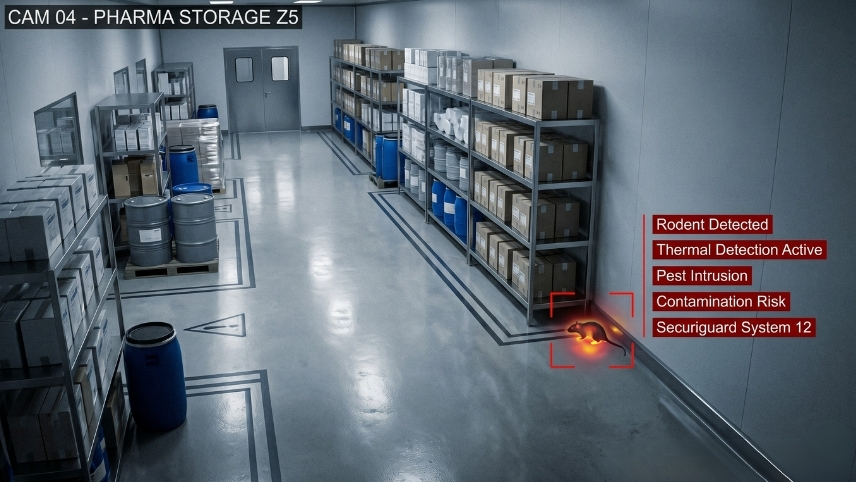
At a tablet manufacturing unit in western India, a routine deviation traced back to a rodent sighting in a secondary storage area. The entry window was brief, but it led to batch rejection, deep cleaning, and extended documentation.
Rodents and insects don’t follow SOPs, and most facilities detect them only after risk has escalated. Traditional pest control relies on periodic inspections and traps. It shows where pests were found, not when they entered or how long they remained.
Many pharmaceutical manufacturers are adopting AI specifically for rodent contamination prevention in pharmaceutical facilities, where a single intrusion event can trigger significant compliance and product-quality consequences.
AI video analytics adds continuous visibility. It can detect:
- Rodent movement along walls, storage racks, and transfer corridors
- Insect activity near equipment, lighting, and exposed materials
- Repeated activity near entry points like doors, drains, or gaps
- Night-shift or low-supervision intrusion patterns
Real-time alerts enable immediate action before the issue becomes a batch-level impact.
Periodic logs show intent.
Continuous monitoring shows control.
The Hidden Math: What One GMP Deviation Actually Costs
Here is a calculation that most pharmaceutical QA heads know intuitively but rarely put down on paper.
A single undetected gowning violation in a sterile filling line leads to a contamination event. One batch is flagged. The OOS investigation takes three weeks. The batch is quarantined and destroyed. An unannounced inspection follows. CAPA documentation consumes two QA analysts for many days. A warning letter is issued. Export shipments to regulated markets are held pending resolution.
According to FDA annual reporting data, the agency issued 105 warning letters for human drug quality issues in FY2024, an 11% increase year on year. Each of those letters represents a facility that is now navigating exactly that chain of events, measured in months of operational disruption and costs that run well into crores of rupees.
The direct technology cost of deploying AI video analytics for GMP compliance in pharma is a fraction of what a single warning letter scenario triggers. The question is not whether you can afford to implement it. It is what it is costing your facility every quarter that you are relying on periodic supervisor rounds to close a gap that only continuous monitoring can address.
How Mikshi AI Fits Into Your Existing GMP Framework
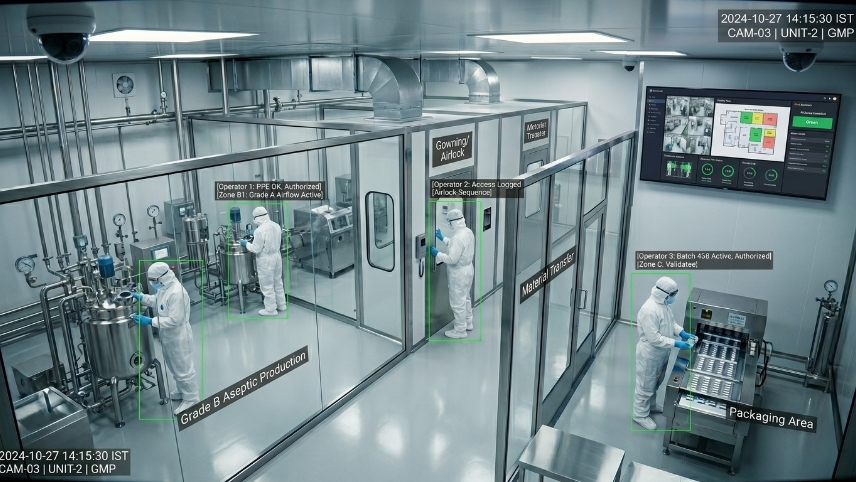
The assumption most QA and EHS heads make is that deploying a new monitoring system means a parallel compliance project. It does not.
Mikshi AI is designed to integrate with existing pharmaceutical facility infrastructure rather than replace it. It works with your installed IP cameras and CCTV systems, your existing zone classifications, and your existing SOP documentation to configure AI models specific to your facility's requirements. Many manufacturers are surprised to discover that existing CCTV infrastructure can be upgraded with AI video analytics without replacing cameras or disrupting operations.
Deployment is available on-premise, cloud, or hybrid depending on your data residency and IT policy. For multi-site pharmaceutical operations, cloud deployment gives you consolidated compliance visibility across all facilities from a single dashboard.
What deployment looks like in a pharmaceutical environment:
- Camera compatibility assessment against your existing CCTV infrastructure
- Zone classification mapping: Grade A, B, C, D areas, restricted access points, antechambers, and transfer bays are all configured separately
- AI model configuration based on your facility-specific SOPs for gowning, access, material movement, and cleaning procedures
- Integration with existing QMS or ERP systems for automatic deviation logging where required
- Deployment without production line disruption or clean-room downtime
- Qualification documentation support for regulatory submission if required
Time from decision to live deployment: days, not months.
Your Next Inspection Is Already Happening on Your Floor
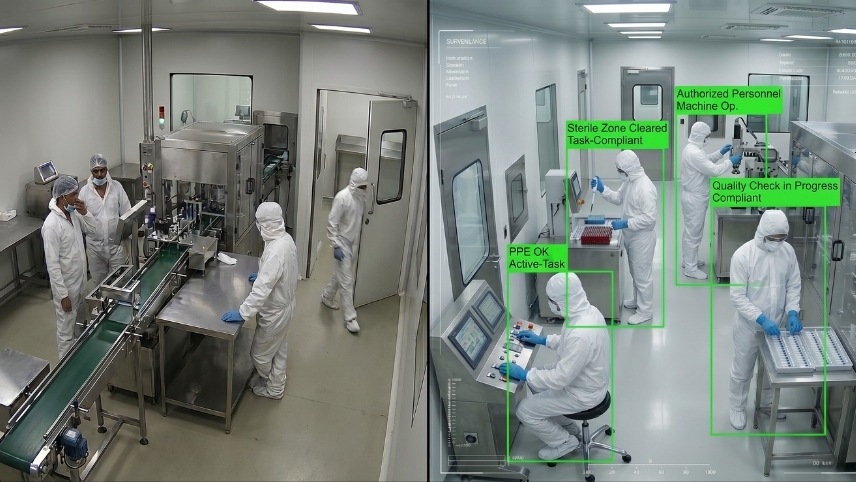
The FDA inspector who walks through your facility next quarter will not ask to see your training records first. They will walk the floor. They will watch how operators behave in the antechamber. They will look at how doors are opened, how materials move between zones, and how the night shift looks when no QA manager is present.
The AI video analytics for system for GMP compliance in pharma lets you walk that same floor, continuously, before they do.
The facilities that close the gap between written procedures and actual practice are not just better prepared for inspections. They are building a compliance infrastructure that holds up across shifts, across sites, and across the regulatory intensification that India's revised Schedule M and global FDA enforcement trends have made the new baseline for the industry.
What your next inspection finds on your floor is being determined right now, on your current shifts, in your current clean-rooms. AI surveillance for pharmaceutical clean-rooms makes that visible while you can still act on it.
The next 483 observation is forming on your floor right now.
Mikshi AI shows you where, before the inspector does.
Book a Free DemoIn this article
- GMP Compliance in Pharma Is Not Getting Easier
- PPE and Gowning Compliance: The Gap That Keeps Appearing on 483s
- Clean-room Access Control: Every Unauthorized Entry Is a Contamination Risk
- Environmental Monitoring Gaps: What Happens Between Scheduled Sampling
- Operator Training and Behavior: The Compliance Gap You Cannot See in Training Records
- Rodent and Pest Intrusion: The Risk You Rarely See Until It’s Too Late
- The Hidden Math: What One GMP Deviation Actually Costs
- How Mikshi AI Fits Into Your Existing GMP Framework
- Your Next Inspection Is Already Happening on Your Floor


