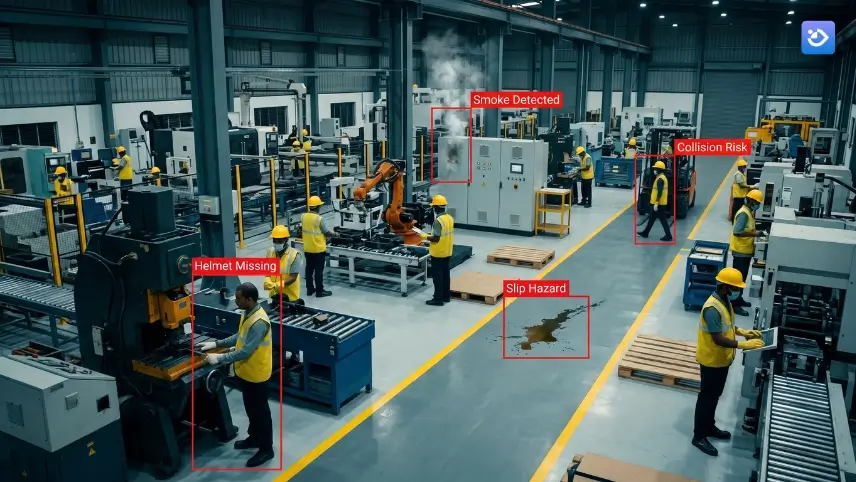
10 Manufacturing Safety Challenges That AI Video Analytics Can Solve
A shift supervisor walks the floor twice a day. In between those walks, anything can happen: a helmet comes off, a guard rail gets propped open, a worker steps into a zone they were never cleared for. The cameras were rolling. Nobody was watching.
That gap is where most safety failures happen. Factory and machine accidents claimed 660 lives in India in 2024 alone, close to two deaths a day, according to NCRB data. A manufacturing AI analytics solution closes that gap. It turns the CCTV system that a plant already owns into something that watches every frame and catches what a walk-through misses, which is really the whole idea behind an AI safety system in manufacturing: no new hardware, just CCTV cameras that finally do something with what they see.
Ten specific challenges it solves, and how it solves them.
1. PPE Violations That Go Unnoticed Until It's Too Late
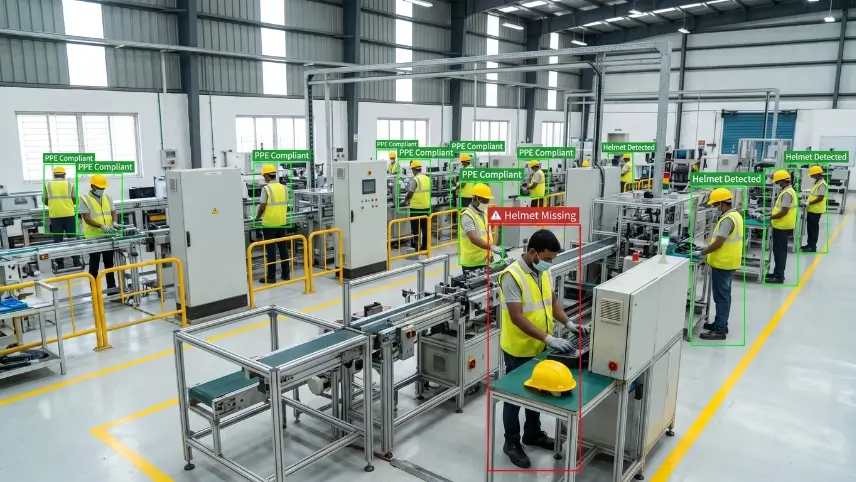
A missing helmet or a pair of gloves left at the workstation rarely gets caught the moment it happens. It shows up in the incident report, after the fact, when it's too late to matter. PPE detection AI watches every camera zone continuously and flags a violation the second it occurs. If the idea of a camera actively watching a live feed is new to you, our blog on what AI video analytics actually is can be a good starting point.
What it catches:
- Missing helmets, gloves, vests, or other required gear, per zone
- Alerts sent to the relevant supervisor within seconds, not at shift end
- Every violation logged with zone, timestamp, and camera reference
No plant needs a person stationed at every entry point to enforce this. The camera that's already there does it, all day, every day.
2. Workers Entering Restricted or Hazardous Zones
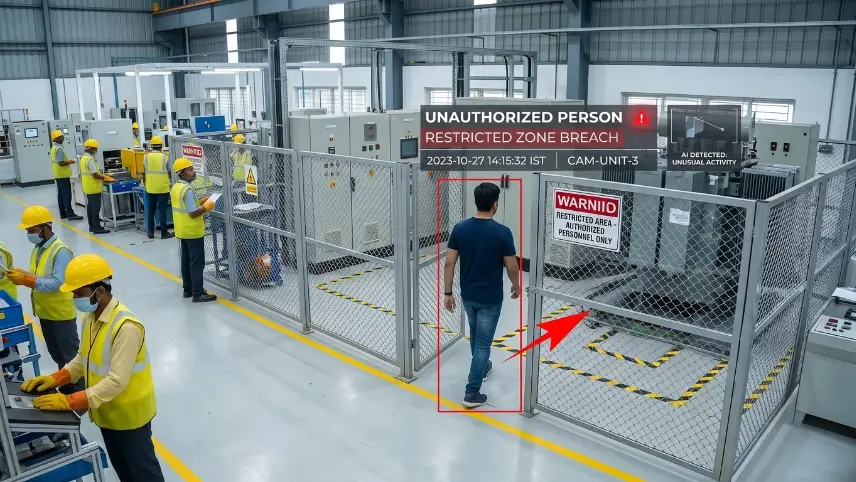
Some areas of a plant carry risk that has nothing to do with PPE: high-voltage rooms, confined spaces, zones near moving cranes. A badge system can log who swiped in. It can't tell you who walked in behind them or who propped a door open for a shortcut.
Restricted zone monitoring watches the physical space itself rather than just the access point. It flags an entry the moment it happens instead of a line item nobody checks in a badge log. It also works in zones that were never wired for access control in the first place, which describes a surprising number of high-risk areas on most floors.
3. Fire and Smoke That Spreads Before Anyone Notices
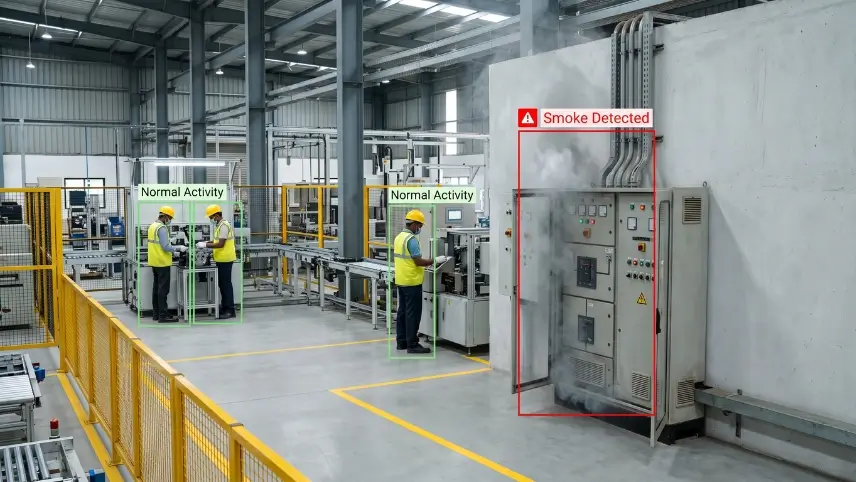
Ceiling-mounted smoke sensors need the smoke to reach them actually, and in a big warehouse corner, that can take minutes. A camera pointed at that same corner doesn't wait for smoke to travel. It catches the first visible wisp and fires an alert right then, while there's still time to do something about it.
- Detects visible smoke and flame directly from the video feed, not heat or particulates
- Covers open floor areas that fixed sensors struggle with
- Names the exact camera zone in the alert, not a building-wide siren that tells nobody where to go
A fire alarm tells you what already happened.
What tells you it's starting?
Book a demo4. Slip, Trip, and Fall Hazards That Build Up Between Rounds
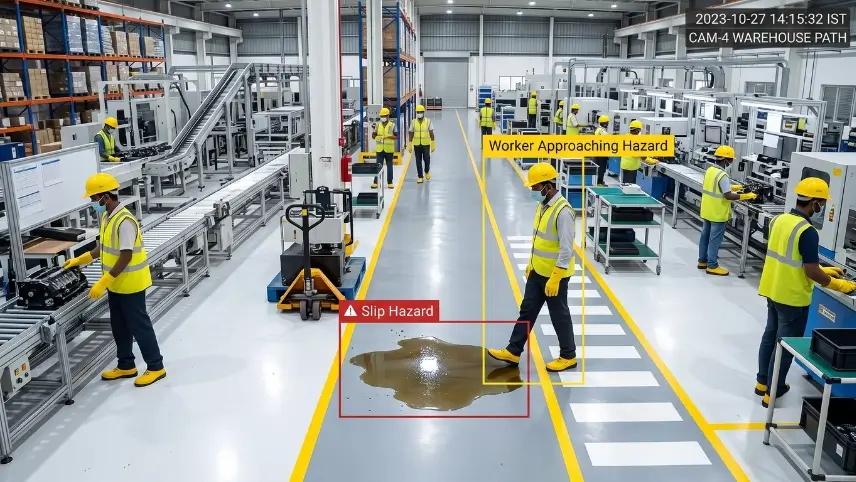
A spill near a loading bay. A pallet somebody left in the walkway. A wet patch by the wash station nobody's gotten around to mopping. None of it looks dramatic, right up until someone goes down over it. And these things sit there longer than people assume; sometimes, a whole shift passes before anyone even notices.
A camera doesn't wait to walk past. It catches the hazard the second it shows up, and it keeps score too. Same corner, same alert, week after week? That's not rotten luck. That's a layout problem somebody needs to actually fix instead of mopping around it every time.
5. Workers Getting Too Close to Moving Machinery
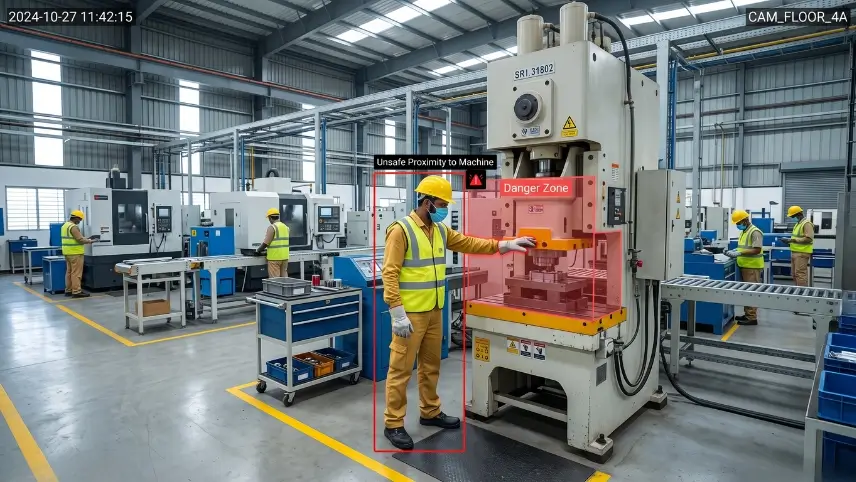
Getting too close to a running machine is about as serious as shop-floor risk gets, and it's brutal to police by hand. You can't post a supervisor at every machine on every shift. A painted line on the floor? It won't stop anyone from stepping past it to grab a tool that rolled just out of reach.
- Tracks the safety perimeter around high-risk machines in real time
- Flags unsafe proximity before contact happens, not after the incident report gets filed
- Shows which machines trigger the most alerts, often the clearest signal of where a guard rail actually belongs
An AI video analytics system built for manufacturing treats this as ongoing monitoring, not a one-time floor-marking exercise that gets forgotten after the first inspection.
6. Safety Audits That Depend on Memory and Manual Checklists
Most plant safety audits are still a clipboard exercise. Someone walks the route, checks the boxes, and moves to the next section. That's a snapshot, not a record. It tells you what the auditor happened to catch in that one pass and nothing about the eight hours on either side of it.
Log every detection automatically, and you get something different, an actual record instead of a spot check. Timestamps, camera zones, all of it. Pull a report for any week you want, not just the day the auditor showed up, and it stops mattering whether anyone happened to be looking at the right screen at the right second.
7. Incidents That Get Detected Long After They Happen
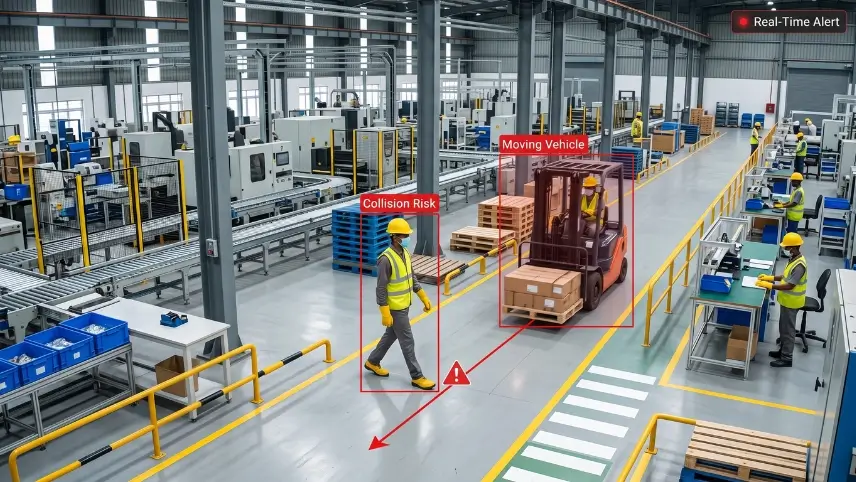
Traditional CCTV really only does one job: let you review what already happened. Something goes wrong, somebody pulls the footage a few days later, and by then, the plant is finding out about a problem that stopped being useful information days ago. That's record-keeping, not safety monitoring.
- Alerts within seconds of a detected violation, not after someone scrubs through footage
- Response measured in minutes, not the days it takes to notice something buried in stored video
- Every camera acting as an active monitor instead of a passive recorder
Real-time detection changes the whole sequence, from reviewing what happened to acting on what's happening right now.
acting on what's happening right now.
Somewhere on your floor, a rule just broke.
Did anyone see it happen?
Book a demo8. Blind Spots From Camera Fatigue, Not Camera Coverage
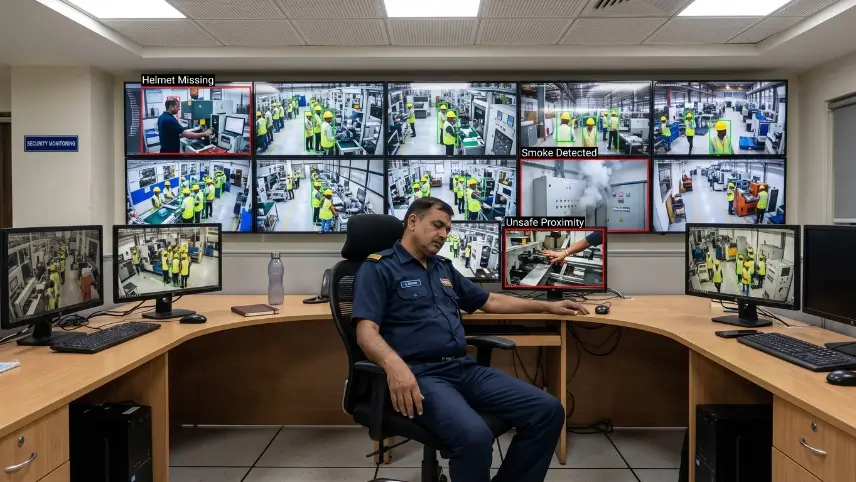
Most plants already have enough cameras. What they don't have is a person who can watch forty feeds at once without losing focus by hour three. Anyone who's sat in front of a bank of monitors knows how fast that attention fades, and it happens long before the shift is even half over.
This isn't a coverage problem. It's an attention problem, and it's exactly the kind of task a detection model doesn't get tired of. AI safety monitoring applies the same standard at 3 AM as it does at 3 PM, doesn't skip a violation because it was mid-way through logging the last one, and doesn't blink.
9. No Audit-Ready Evidence When an Inspector Asks for Proof
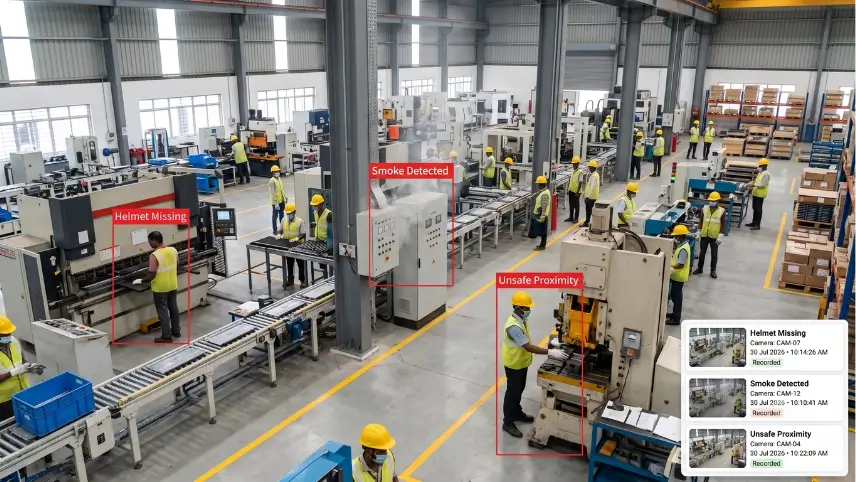
When a regulator or an internal auditor asks for proof of a safety violation, "we're pretty sure it doesn't often happen" isn't an answer. A continuous, time-stamped detection log is.
- Doubles as a defensible record during Factories Act inspections
- Filterable by zone, date range, or violation type in minutes, not a records search that eats an afternoon
- Doesn't rely on a supervisor's memory of a single walk-through weeks earlier
This matters most after an incident, when a plant has to show what controls were actually in place rather than what the policy binder says should have been in place.
10. Every Risk Type Running on a Separate System
PPE compliance, restricted zones, fire detection, and unsafe behavior often get bought as separate point solutions from separate vendors, each with its own dashboard, its own login, its own camera feed to configure.
That fragmentation is a safety risk in its own right. Nobody has one place to look, and an alert in one system doesn't talk to an alert in another. Manufacturing safety compliance improves fastest when every risk type runs on the same cameras and reports into the same system: one dashboard instead of five logins, one set of cameras instead of five separate installs, and one alert stream a supervisor can realistically watch.
Why Mikshi AI Is the Right Fit for These Ten Problems
None of these ten challenges are new. What's new is that a plant no longer needs ten different fixes for them. Mikshi AI's manufacturing safety solution was built to solve all ten infrastructures a plant already has, not as ten separate products stitched together after the fact.
What that actually looks like on the floor:
- Runs on the CCTV and IP cameras already mounted; no hardware replacement in most cases
- Covers PPE detection, restricted zone monitoring, fire and smoke, proximity alerts, and slip or fall hazards on one platform
- Uses a hybrid edge and cloud setup, so alerts stay fast without pushing every frame to the cloud
- Produces a continuous, time-stamped log that doubles as audit-ready evidence, not just a live alert
Suppose a mid-sized plant avoids even one serious incident a year through earlier detection. A single serious workplace incident in India routinely runs into several lakhs rupees once medical costs, downtime, and Employees' Compensation Act liabilities are counted, though the exact figure varies by severity and this is an illustrative estimate, not a published statistic. That's the kind of cost this is built to prevent.
The result is one supervisor, one dashboard, and a system watching every camera the moment a rule breaks, not the next time someone reviews the footage. More on how this plays out across a full plant is covered in how AI video analytics supports manufacturing plants on safety and productivity.
A supervisor can't watch every camera at once.
Your CCTV already can.
Book a demoIn this article
- 1. PPE Violations That Go Unnoticed Until It's Too Late
- 2. Workers Entering Restricted or Hazardous Zones
- 3. Fire and Smoke That Spreads Before Anyone Notices
- 4. Slip, Trip, and Fall Hazards That Build Up Between Rounds
- 5. Workers Getting Too Close to Moving Machinery
- 6. Safety Audits That Depend on Memory and Manual Checklists
- 7. Incidents That Get Detected Long After They Happen
- 8. Blind Spots From Camera Fatigue, Not Camera Coverage
- 9. No Audit-Ready Evidence When an Inspector Asks for Proof
- 10. Every Risk Type Running on a Separate System
- Why Mikshi AI Is the Right Fit for These Ten Problems


