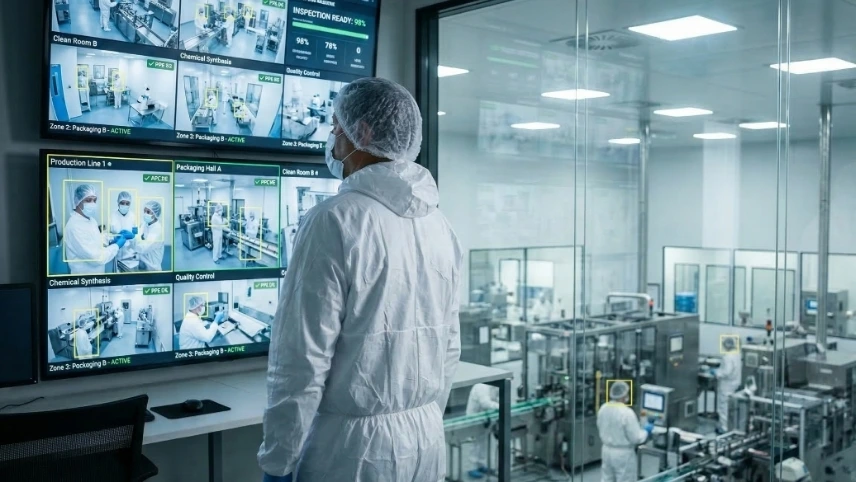
A Pharma Plant Head’s Guide to Staying Inspection-Ready Using AI Video Analytics
Executive Brief: Modernizing Inspection Readiness
India’s pharmaceutical exports crossed $30 billion in FY2025, with nearly 35% dependent on the US market. A single adverse FDA classification can directly impact market access and revenue continuity.(Pharmexcil / Investment Guru India, April 2025)
Pharmaceutical leadership faces a shift toward continuous regulatory scrutiny. With the FDA increasing unannounced inspections and utilizing AI-driven "Elsa" analytics, compliance must move from periodic audit preparation to constant operational discipline. (FDA / McGuireWoods, May 2025)
AI Video Analytics bridges this visibility gap by transforming existing CCTV infrastructure into a proactive monitoring system. This technology addresses the "human element" which is the source of most GMP observations by detecting behavioral deviations in real time.
Key Strategic Benefits of an AI Video Analytics System
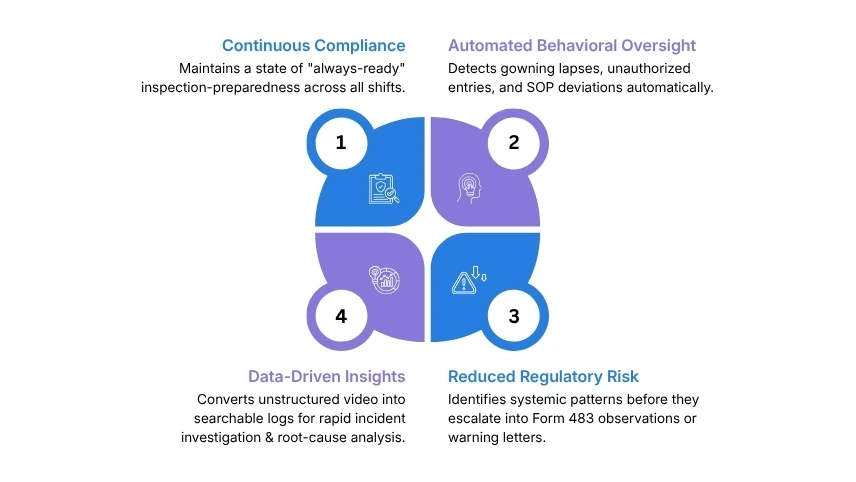
- Continuous Compliance: Maintains a state of "always-ready" inspection-preparedness across all shifts.
- Automated Behavioral Oversight: Detects gowning lapses, unauthorized entries, and SOP deviations automatically.
- Reduced Regulatory Risk: Identifies systemic patterns before they escalate into Form 483 observations or warning letters.
- Data-Driven Insights: Converts unstructured video into searchable logs for rapid incident investigation and root-cause analysis.
Regulatory Inspection Trends in Pharmaceutical Manufacturing
A Recent Reminder From the Industry
In September 2025, the U.S. FDA classified Sun Pharmaceutical Industries’ Halol facility in Gujarat as Official Action Indicated (OAI) after an inspection earlier that year. Inspectors issued Form 483 observations related to manufacturing and quality practices, indicating potential non-compliance with current Good Manufacturing Practice (cGMP) requirements.( Reuters, September 2025)
An OAI classification signals significant compliance concerns. As a result, the facility faced restrictions on exports to the United States until corrective actions were implemented.
Increasing Regulatory Scrutiny
Regulatory oversight of pharmaceutical manufacturing is intensifying globally. In May 2025, the U.S. FDA expanded unannounced inspections for overseas facilities, particularly in India and China, to eliminate the “preparedness bias” created by scheduled inspections.
Enforcement activity has also accelerated. Between July and December 2025, the FDA issued 327 warning letters(Reed Smith, December 2025) reflecting a sharp 73% rise in regulatory actions. The agency is also using advanced analytics tools, including its internal AI system “Elsa,”(Reed Smith, December 2025) to identify facilities with potential compliance risks based on data anomalies, adverse event reports, and historical inspection findings.
Increasing Regulatory Scrutiny
- 327 FDA warning letters issued in just 6 months (2025) (Reed Smith, December 2025)
- 73% increase in enforcement activity (Reed Smith, December 2025)
- Over 30% of violations linked to quality system failures (Leucine.io, 2025)
- 25% of quality deviations driven by human error (PwC Belgium, May 2025).
- 80%+ process deviations linked to human behavior (PwC Belgium, May 2025).
- 21% of violations tied to hygiene lapses (CareEdge / USFDA Inspections Rise Report, 2025).
Human Behavior as a Major Risk Factor
According to PwC's pharmaceutical quality research, over 80% of process deviations and 25% of all quality faults ranging from lab errors and complaints to inspection concerns are attributed to human error (PwC Belgium, May 2025)
Despite automation in pharmaceutical manufacturing, many GMP observations still arise from routine human actions on the shop floor, such as:
- Improper gowning or hygiene practices
- Failure to follow standard operating procedures (SOPs)
- Incomplete documentation
- Unauthorized entry into restricted areas
- Improper material handling
Repeated deviations often indicate deeper weaknesses in operational discipline and quality systems.
Key Takeaways
- Regulatory inspections increasingly evaluate real shop-floor practices, not just documentation.
- Human behavior and systemic quality gaps remain major drivers of GMP observations.
The Most Common GMP Observations Linked to Human Behavior
Many regulatory observations in pharmaceutical manufacturing arise not from equipment failures but from human actions on the shop floor. Even in highly automated plants, daily operational discipline plays a critical role in maintaining compliance with Good Manufacturing Practice (GMP).
Incomplete Gowning and Hygiene Procedures
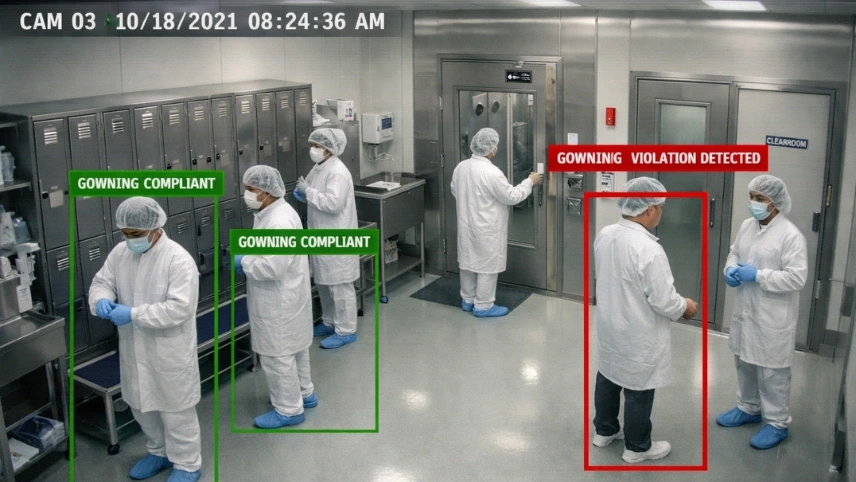
Cleanroom environments rely on strict hygiene and gowning protocols to prevent contamination. However, inspections often reveal lapses such as:
- Skipping hand sanitation before entering controlled areas
- Incorrect gowning sequence during cleanroom entry
- Improperly worn PPE such as masks or gloves
- Touching non-sterile surfaces after gowning
Such deviations can compromise sterile environments and raise contamination concerns.
Unauthorized Entry Into Controlled Areas
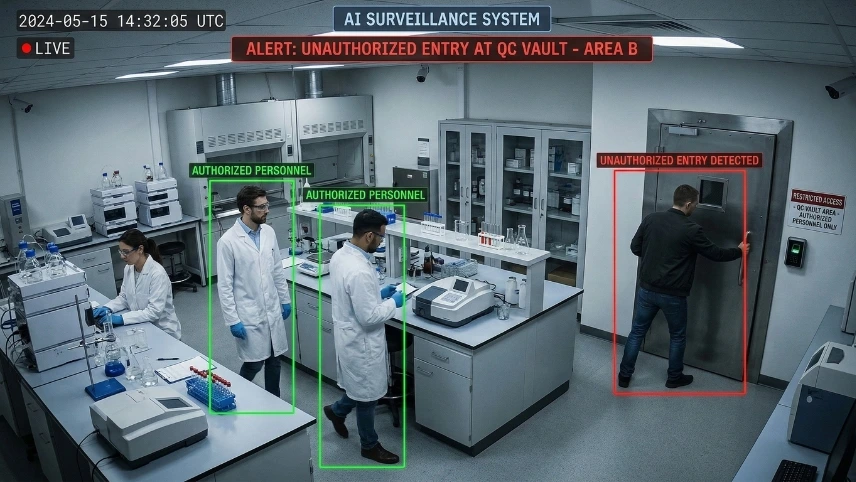
Pharmaceutical facilities maintain strict zoning to protect production areas. Inspectors frequently observe issues such as:
- Personnel entering restricted zones without authorization
- Movement between areas without proper decontamination
- Tailgating through controlled access points
These lapses weaken environmental controls and process integrity.
Improper Material Handling Practices
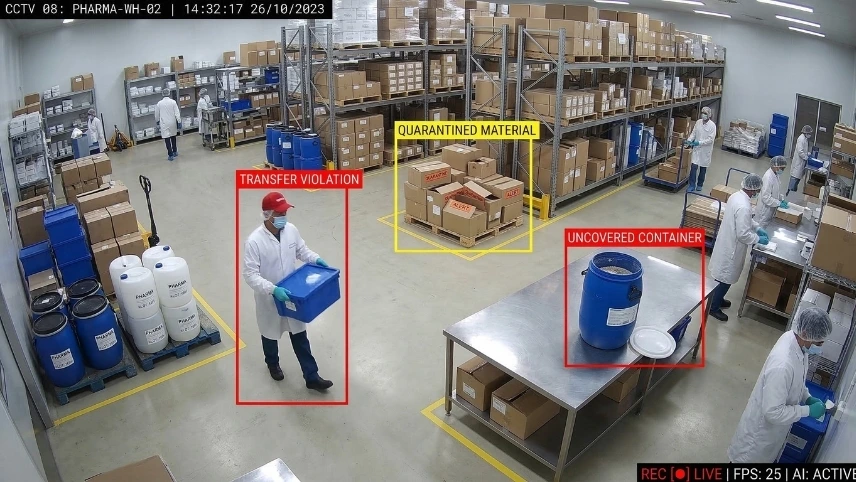
Material handling errors can affect traceability and product quality. Common examples include:
- Materials moved outside defined transfer procedures
- Mishandling of rejected or quarantined materials
- Containers left uncovered or improperly labeled
Key Takeaways
- Many GMP observations originate from routine human behavior on the shop floor.
- Small procedural lapses can indicate broader weaknesses in operational compliance.
Inside an Inspection-Ready Pharma Plant
Daily Operations and Key Operational Metrics
In a pharmaceutical manufacturing plant, daily operations must consistently align with Good Manufacturing Practice (GMP) standards. From shift entry to end-of-day reviews, multiple activities across production floors, warehouses, and cleanrooms must follow strict procedures. However, in large facilities with multiple teams and shifts, it is difficult for supervisors to monitor every activity manually.
AI Video Analytics helps address this challenge by turning existing CCTV infrastructure into a system that continuously monitors operational discipline, safety practices, and compliance behavior across the plant.
Start of the Day: Shift Change and Gowning Compliance
Shift changes are one of the busiest periods in pharmaceutical facilities. Large numbers of operators enter controlled areas through gowning rooms and hygiene stations before accessing cleanrooms.
Supervisors often rely on manual checks to verify that operators follow proper hygiene procedures. During peak entry times, however, certain steps may be skipped.
Common risks include:
- Skipped hand sanitation
- Incorrect gowning sequence
- Improperly worn protective equipment
- Entering cleanrooms before completing hygiene protocols
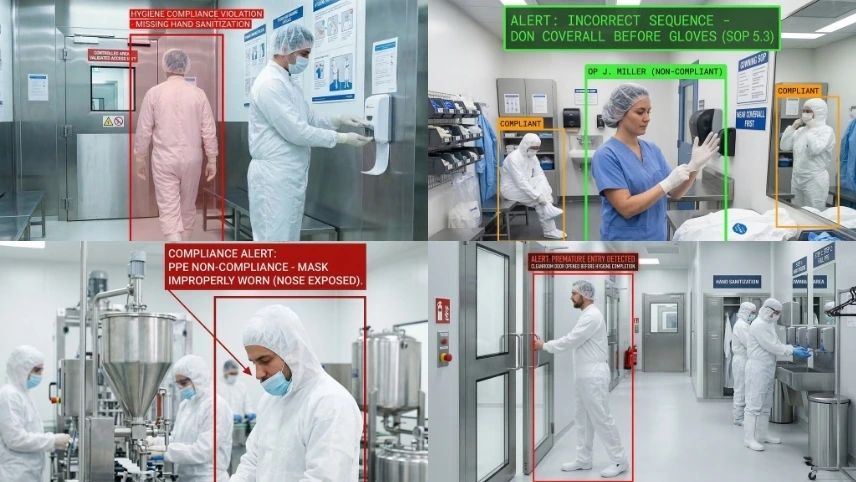
AI Video Analytics can monitor gowning areas and detect hygiene or PPE violations. When deviations occur, alerts are sent to supervisors so corrective action can be taken immediately.
Key Operational Metrics
- Gowning compliance rate
- Hygiene violation frequency
- Entry protocol adherence
Morning Operations: Production Floor Oversight
Once production begins, operators work across multiple rooms and equipment lines. Supervisors must ensure that SOPs are followed and safety practices are maintained.
However, maintaining continuous visibility across all production zones is challenging.
Common risks include:
- Unauthorized entry into restricted areas
- Unsafe proximity to machinery
- Deviations from defined workflows
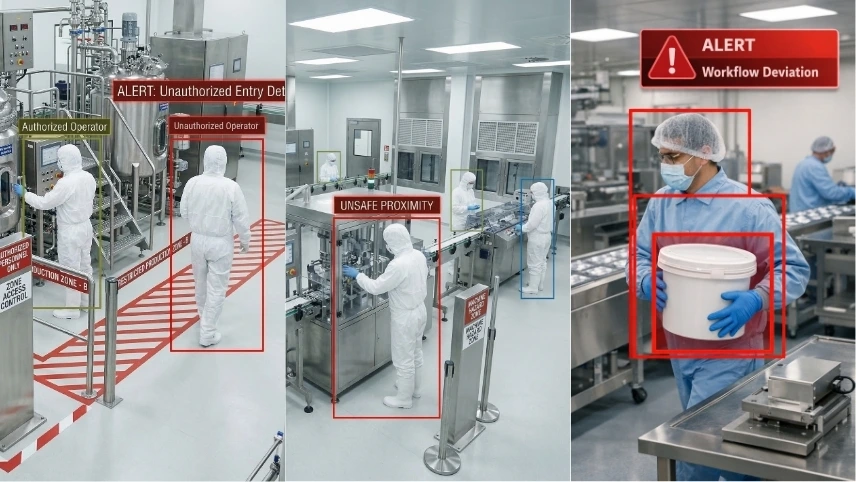
AI Video Analytics continuously monitors activity across production zones and generates alerts when unusual behavior or safety risks are detected.
Key Operational Metrics
- Restricted zone violations
- SOP deviation alerts
- Safety incident indicators
Mid-Day Operations: Warehouse and Material Monitoring
Material movement between warehouses, staging areas, and production lines is critical for traceability and contamination control.
Operational risks may include:
- Unauthorized warehouse access
- Materials moved outside defined transfer routes
- Improper handling of containers
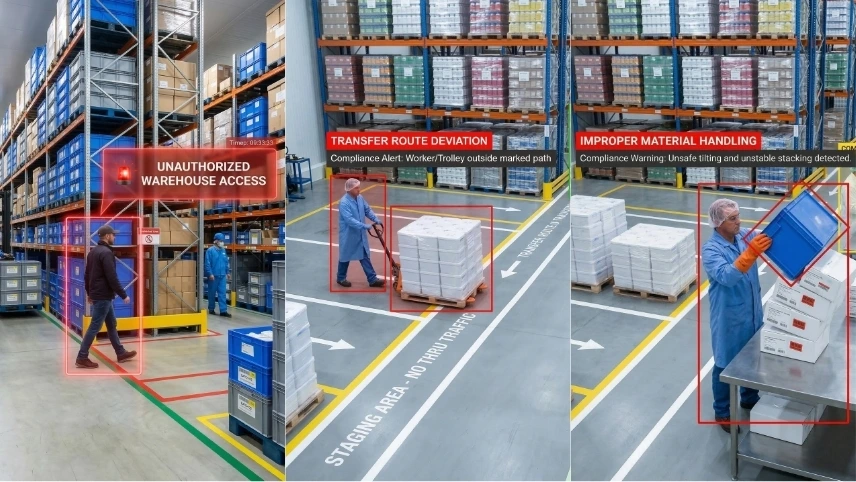
AI Video Analytics monitors warehouse areas and identifies abnormal movement patterns or access violations, enabling faster response and improved traceability.
Key Operational Metrics
- Material handling violations
- Unauthorized warehouse access
- Traceability deviation alerts
Afternoon Operations: Safety and Workforce Compliance
During peak production hours, safety risks increase as more operators work around complex machinery.
Examples include:
- Missing PPE in safety zones
- Unsafe proximity to equipment
- Unauthorized access to hazardous areas
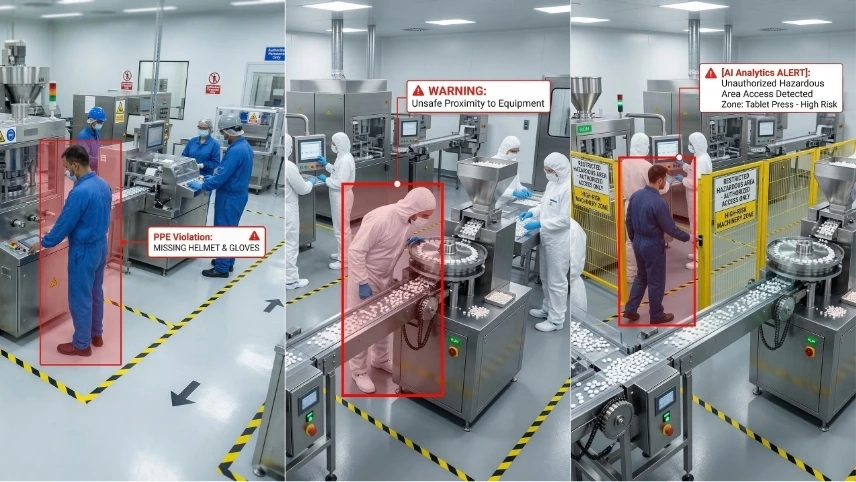
AI Video Analytics detects these behaviors and alerts supervisors before incidents escalate.
Key Operational Metrics
- PPE compliance rate
- Safety violation frequency
- Near-miss indicators
End of Day and Night Monitoring
At the end of each day, the QA teams review incidents and deviations. Traditional investigations often require hours of manual CCTV review.
AI Video Analytics converts video footage into structured events with timestamps and visual evidence, enabling faster investigation and compliance reporting.
During night shifts, the system continues monitoring for intrusion, safety violations, or unusual activity.
Key Operational Metrics
- Incident response time
- SOP violation trends
- After-hours intrusion alerts
Key Takeaways
Inspection readiness requires continuous visibility into daily plant operations.
AI Video Analytics enables monitoring of safety, compliance, and SOP discipline across all shifts and zones.
Technical Architecture of an AI Video Analytics System in Pharma
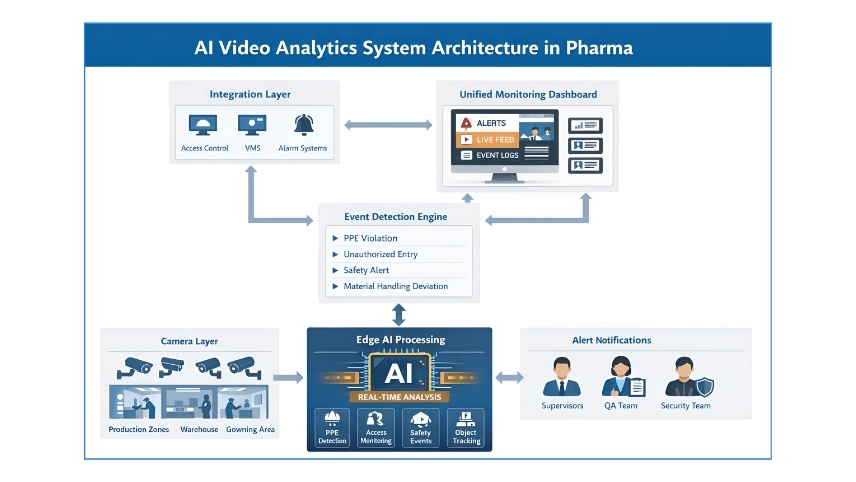
AI Video Analytics systems use a layered architecture that captures video, analyzes it in real time, and converts it into actionable insights for plant teams.
Camera Layer: Capturing Operational Activity
The first layer consists of the existing CCTV cameras installed across the pharmaceutical facility. Cameras are typically placed in key operational zones such as:
- Production floors and cleanrooms
- Warehouses and storage areas
- Entry and exit points
- Gowning rooms and hygiene stations
- Corridors and material transfer areas
These cameras continuously capture video streams of plant activity. A major advantage of Mikshi AI is that it integrates with existing camera infrastructure, allowing facilities to activate intelligent monitoring without replacing current systems.
Edge AI Processing Layer
Video feeds are then analyzed using edge AI computing devices installed within the facility. These devices run computer vision models that process video streams in real time.
The system can detect events such as:
- Personnel movement and activity patterns
- PPE compliance in controlled areas
- Entry into restricted zones
- Unsafe proximity to equipment
- Material handling activities
Processing video locally enables low-latency detection, allowing alerts to be generated within seconds. Because analysis occurs within the facility network, sensitive video data does not need to be transmitted to external cloud servers.
Event Detection Engine
When the system identifies predefined conditions, it generates structured operational events. Examples include PPE violations, unauthorized access, or unsafe worker behavior.
Each event contains information such as:
- Timestamp
- Camera location
- Type of violation detected
- Visual snapshot for verification
This structured data allows teams to investigate incidents quickly and identify recurring risks.
Monitoring Dashboard and Integration
All alerts and events appear in a centralized monitoring dashboard used by supervisors, QA teams, and security personnel. The system can also integrate with existing tools such as Video Management Systems (VMS), access control systems, and alarm platforms, creating a unified operational monitoring environment.
Distributed Edge AI Architecture for Multi-Facility Video Analytics
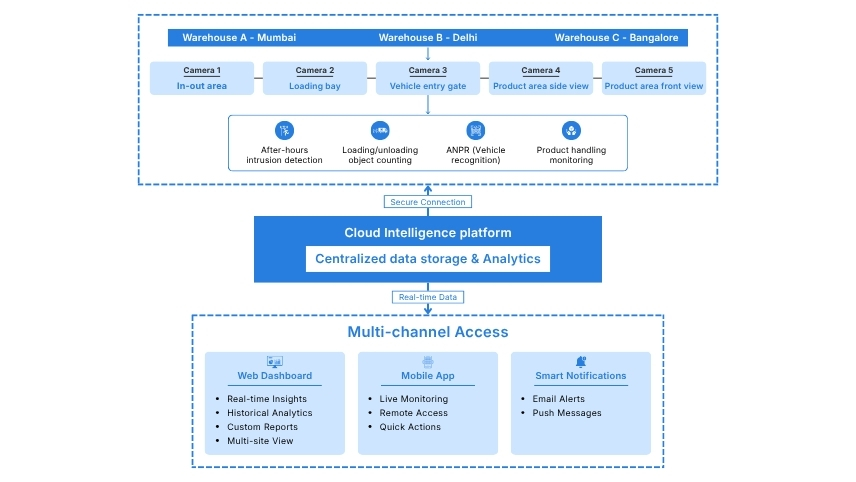
The architecture shown above illustrates how Mikshi AI converts distributed CCTV infrastructure into a unified video intelligence platform.
At each facility, cameras installed across operational zones such as entry gates, loading bays, warehouses, and product handling areas continuously stream video to an Edge AI device. These edge systems run computer vision models that analyze video locally and detect operational events such as intrusion, object movement, vehicle identification, or product handling activity.
Processing at the edge ensures low-latency detection and secure on-premise video analysis, eliminating the need to send raw video streams to external servers.
Detected events and summarized data are transmitted through a secure connection to the central cloud intelligence platform, where information from multiple facilities is aggregated.
The centralized system enables real-time dashboards, multi-site monitoring, analytics, and smart alerts through web and mobile interfaces. This architecture allows organizations to monitor distributed operations while maintaining secure processing at each site.
Key Takeaways
- AI Video Analytics converts existing cameras into real-time operational intelligence systems.
- Edge-based processing enables secure, low-latency monitoring within the facility network.
Deploying Video Intelligence in Pharmaceutical Plants
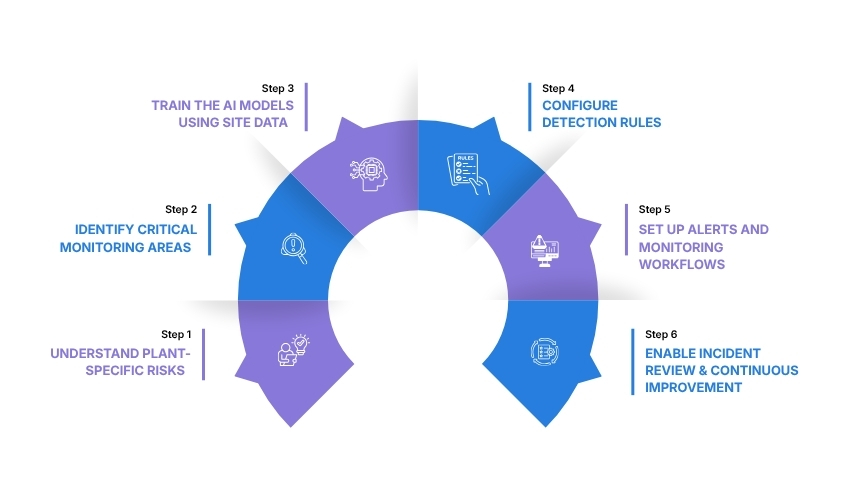
Deploying AI Video Analytics in a pharmaceutical facility requires a structured approach to ensure the system aligns with plant operations, GMP requirements, and security policies. The Mikshi AI team follows a step-by-step deployment process to configure the platform on your existing CCTV infrastructure and adapt it to the specific conditions of your facility.
The goal is not just to install software, but to set up a system that reliably monitors safety, compliance, and operational activities across the plant.
Step 1: Identify Critical Monitoring Areas
The deployment process begins with mapping key areas in the facility where monitoring is most important.
These typically include:
- Cleanrooms and production areas
- Gowning rooms and hygiene stations
- Warehouses and material storage areas
- Entry and exit points
- Restricted production zones
By identifying these areas, the Mikshi AI team ensures the system focuses on locations where compliance, safety, or security risks are highest.
Step 2: Understand Plant-Specific Risks
Every pharmaceutical plant has its own operational workflows and risk factors. The next step involves understanding what types of incidents or violations need to be monitored.
Examples may include:
- Hygiene or gowning violations
- Unauthorized entry into controlled areas
- Unsafe worker proximity to equipment
- Improper material handling practices
This helps define the monitoring objectives so the system can detect events that matter most for your operations.
Step 3: Train the AI Models Using Site Data
To improve accuracy, the Mikshi AI team can train and fine-tune models using video data from your facility.
Real-world environments often contain patterns that generic models may misinterpret. For example, movement captured during night shifts may include tree branches moving in the wind or shadows shifting under lighting conditions.
By analyzing footage from your cameras, the system can be trained to distinguish between normal environmental movement and actual security events, such as an intruder entering the premises.
This process helps reduce false alerts and ensures the system performs reliably in your specific plant environment.
Step 4: Configure Detection Rules
Once the monitoring requirements are defined, the system is configured to detect specific events across camera feeds.
Detection rules are aligned with the plant’s operational procedures and safety requirements. For example:
- Entry zones can monitor PPE compliance
- Restricted areas can detect unauthorized access
- Production areas can detect unsafe worker behavior
These configurations ensure the system reflects real operational policies within the facility.
Step 5: Set Up Alerts and Monitoring Workflows
Alerts generated by the system are routed to the appropriate personnel within the organization.
This may include:
- Production supervisors
- Quality assurance teams
- EHS or safety officers
- Security teams
Clear alert workflows ensure that potential violations or incidents are addressed quickly.
Step 6: Enable Incident Review and Continuous Improvement
Once deployed, the system automatically records detected events with timestamps and visual evidence. This allows teams to review incidents quickly and identify patterns of repeated violations.
Over time, the system can also be refined further to improve detection accuracy and adapt to changes in plant operations.
Key Takeaways
- The Mikshi AI team follows a structured deployment process tailored to your facility and workflows.
- Custom model training using your camera footage improves accuracy and reduces false alerts.
Closing Perspective
Pharmaceutical manufacturers today operate under simultaneous regulatory pressure from global authorities and domestic reforms such as revised Schedule M (PharmaState Academy, 2025)). At the same time, regulators are increasingly using data and analytics to identify high-risk facilities before inspections occur.
AI Video Analytics introduces a proactive monitoring approach. By analyzing live video feeds in real time, the system can detect safety violations, unauthorized access, and behavioral deviations as they occur. This allows plant teams to respond faster and maintain stronger operational discipline.
Key Takeaways
- Continuous visibility is essential for maintaining GMP discipline.
- Manual CCTV monitoring cannot cover all plant activities.
- AI Video Analytics detects safety and compliance deviations in real time.
- Faster alerts enable quicker corrective action.
- Existing CCTV infrastructure can be used without major upgrades.
FDA is using AI to find violations in your plant. Will you use AI to avoid FDA observations?
Request a FREE POC for your Pharma facility
References
-
Pharmexcil / Investment Guru India — India's Pharma Exports Surpass $30 Billion in FY25 (April 2025):
https://investmentguruindia.com/newsdetail/india-s-pharma-exports-surpass-30-billion-in-fy25-us-top-market881161 -
McGuireWoods — FDA to Expand Unannounced Inspections of Foreign Facilities (May 2025):
https://www.mcguirewoods.com/client-resources/alerts/2025/5/fda-to-expand-unannounced-inspections-of-foreign-facilities-manufact -
Reed Smith — FDA Inspections in 2025: Heightened Rigor, Data-Driven Targeting and Increased Surveillance (December 2025):
https://www.reedsmith.com/articles/fda-inspections-in-2025-heightened-rigor-data-driven-targeting-and-increased-surveillance/ -
Leucine.io — 2025 FDA Warning Letter Trends: What Pharma Can Learn (November 2025):
https://www.leucine.io/qms-blogs/2025-fda-warning-letter-trends-pharma-lessons -
PwC Belgium — Reducing Human Error in the Pharma Quality Environment (May 2025):
https://www.pwc.be/en/news-publications/2025/reducing-human-error-in-the-pharma-quality-environment.html -
CareEdge / USFDA Inspections Rise — Indian Pharma at the Crossroads of Compliance (2025):
https://www.careratings.com/uploads/newsfiles/1750843740_Indian%20Pharma%20-%20CareEdge%20Report.pdf -
PharmaState Academy — Revised Schedule M: A Complete Guide to Pharma Compliance (February 2025):
https://pharmastate.academy/revised-schedule-m-complete-guide-to-pharma-compliance/ -
Reuters — US FDA Deems Sun Pharma Halol Plant OAI (September 2025):
https://www.reuters.com/business/healthcare-pharmaceuticals/us-fda-deems-sun-pharmas-halol-plant-not-compliant-with-its-manufacturing-rules-2025-09-09


