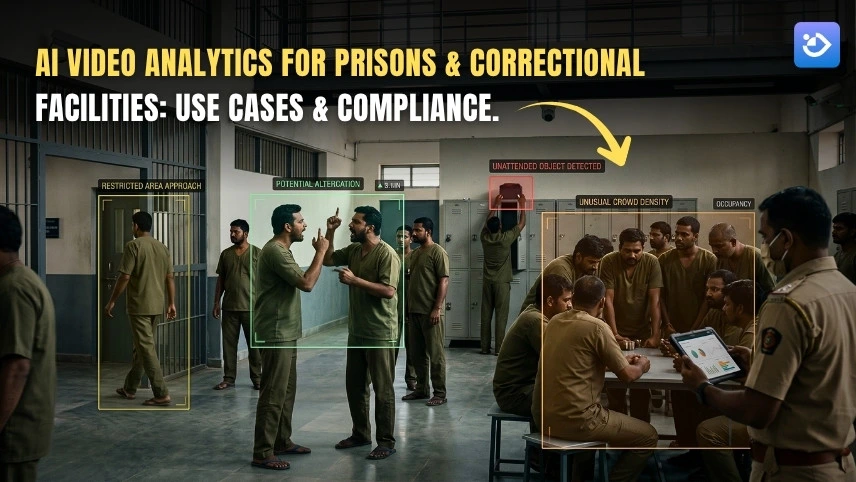
AI Video Analytics for Prisons and Correctional Facilities in India: Use Cases and Compliance
Moving Beyond Passive CCTV: Why Indian Correctional Facilities are Adopting AI Monitoring
India has 1,332 prisons housing over 5.3 lakh inmates as of December 2023. The national occupancy rate is 120.8%. Delhi's prisons run at nearly 200% of sanctioned capacity. Against a staff strength where vacancies are described by the Parliamentary Standing Committee on Home Affairs as "the most neglected part of prison administration," a prison superintendent is expected to maintain security, prevent violence, stop contraband, monitor self-harm risk, and document every incident, simultaneously, across facilities that were never built for the population they now hold.
This is not a technology problem. It is a monitoring gap created by structural conditions that no hiring cycle will close quickly enough. AI video analytics systems for prisons in India does not solve overcrowding or the under trial crisis. It gives the staff that is present the ability to monitor what they cannot physically be everywhere for at once.
This post covers what AI-powered prison monitoring actually enables in an Indian correctional facility context, what responsible deployment looks like on the ground, and why states like Karnataka, Punjab, Uttar Pradesh, and West Bengal are already moving on this.
Many of the same capabilities are already being deployed across AI video analytics for smart city and public sector infrastructure to improve public safety, incident response, and operational visibility.
The Monitoring Gap That NCRB Data Makes Undeniable
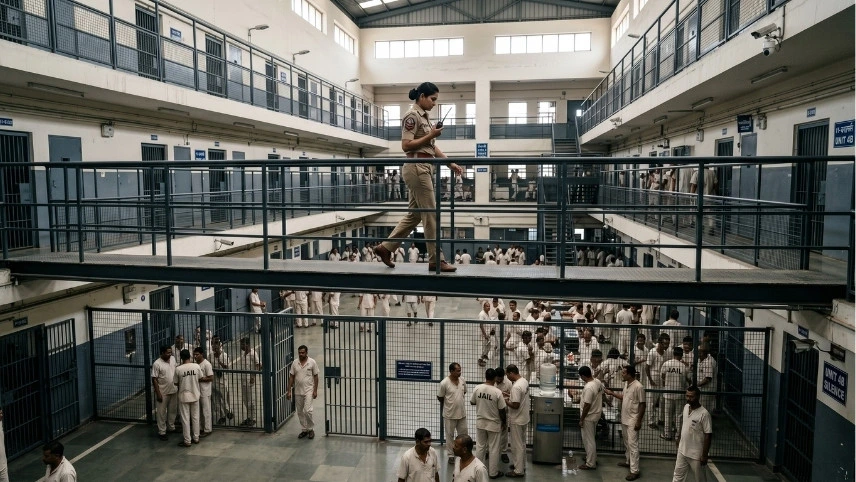
The scale of India's prison monitoring challenge is not an assertion. It is documented in the National Crime Records Bureau's Prison Statistics India 2023 report, and the numbers are worth sitting with before any technology conversation begins.
According to the Prison Statistics India 2023 report cited by The Print and PRS India, the picture across India's correctional system looks like this:
- 120.8% national occupancy rate across 1,332 prisons as of December 31, 2023. Delhi operates at nearly 200% occupancy. The national rate had been as high as 131.4% the previous year, and the Parliamentary Standing Committee on Home Affairs noted that six states alone account for more than half the total prison population.
- 73.5% of all prisoners are undertrials - People who have not been convicted of any offence but remain in custody due to trial delays. Managing this population, which has a fundamentally different security and welfare profile from convicts, requires differentiated monitoring that passive CCTV cannot provide.
- Staff shortage is "the most neglected part of prison administration" according to the Parliamentary Standing Committee on Home Affairs, with high vacancy rates across all categories of jail staff. The Committee specifically recommended that no post remain vacant for more than three months, a recommendation that reflects how acute the staffing gap has become.
- Prison administrations spend more money keeping undertrials inside jails than the bail money required for their release, according to the same Committee. Over 70% of the prison population has not been convicted, creating a welfare and monitoring obligation that most facilities are structurally unable to meet through headcount alone.
When staff shortages are structurally acute and facilities are running at 120% to 200% capacity, AI surveillance for correctional facilities is not a modernization aspiration. It is the arithmetic of what continuous monitoring requires when human deployment alone cannot deliver it. And it is precisely what AI video analytics for prisons in India is now being configured to address.
What AI Prison Monitoring Actually Detects
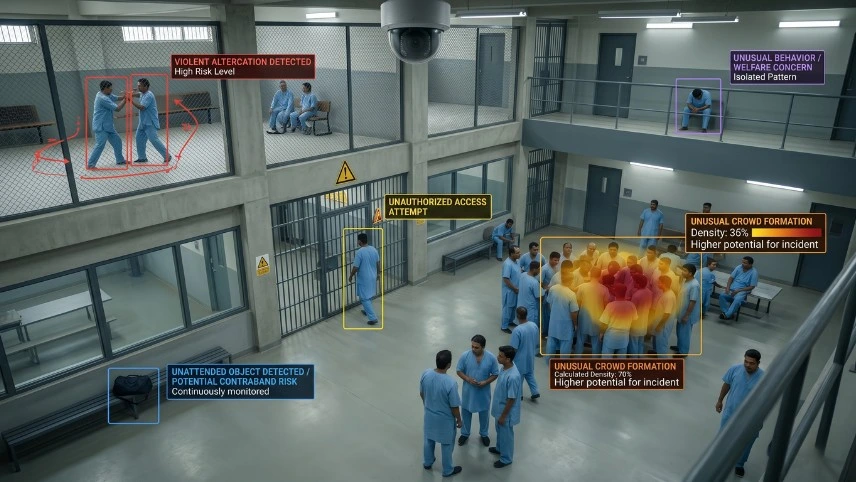
Several Indian states have already moved from evaluation to deployment. Karnataka's Prison and Correctional Services Department floated a tender in 2024 for an AI-powered audio-video analytics system at Bengaluru's Central Prison, specifically citing violence detection, contraband monitoring, crowd analysis, suicide attempt detection, and unauthorized mobile phone use as target use cases. The same Security Today report notes that prisons in Punjab, Uttar Pradesh, and Delhi have also deployed AI to monitor their facilities. Punjab's Jail Minister formally announced AI adoption across state prisons with an emphasis on unauthorized mobile phone detection and 24/7 surveillance. West Bengal has begun connecting AI technology to existing cameras across its approximately 60 correctional homes, with an official stating the process is being implemented step by step.
What AI video analytics for prisons in India is configured to detect in these environments:
- Violence and physical altercations- Real-time detection of fighting, assault behavior, and crowd escalation in cell blocks, exercise yards, and common areas. The alert reaches the control room before staff intervention is required rather than after an incident has already escalated. Response time is the variable that determines outcome severity.
- Self-harm and suicide attempt detection- This is among the most clinically significant use cases given the NCRB suicide data. AI detects specific postures and behavioral patterns associated with self-harm attempts in monitored cells and common areas, generating immediate alerts to duty staff. Night hours and shift transition windows, when staffing is thinnest and risk is highest, are specifically covered.
- Contraband and unauthorized object detection- Mobile phones, weapons, and prohibited items are detected through AI object recognition in common areas, barracks, and visitor zones. Karnataka's tender specifically cited unauthorized mobile phone detection as a priority, given the documented use of smuggled phones to coordinate criminal activity from inside facilities.
- Unauthorized access and internal zone monitoring- Monitoring movement between classified zones within the facility, like administrative areas, high-security blocks is logged and alerts generated for unauthorized personnel movement. This covers both security and compliance documentation requirements. Perimeter intrusion detection helps to identify unauthorized movement around security boundaries before incidents escalate.
- Crowd density and occupancy monitoring- Real-time headcount and density alerts in cell blocks and common areas. In facilities running at 120% to 200% capacity, crowd management is not a periodic concern. It is a daily operational requirement that passive CCTV cannot address in real time.
Inmate Welfare Monitoring: The Use Case That Is Rarely Discussed
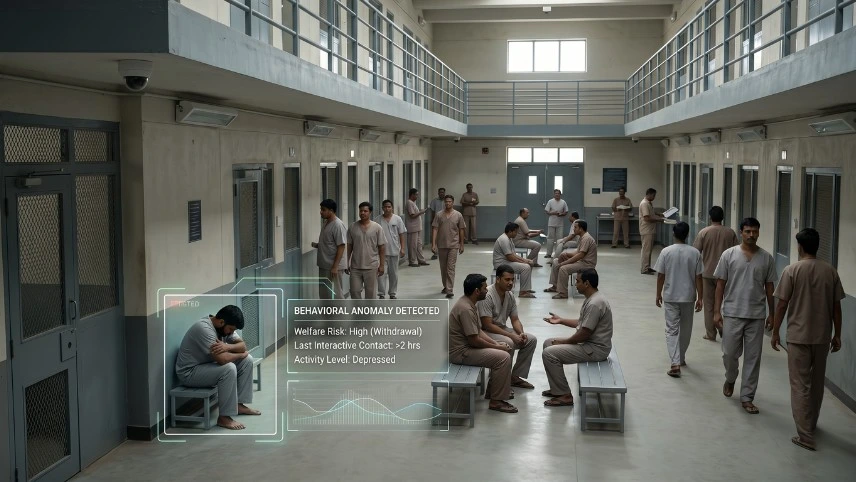
Most conversations about AI surveillance for correctional facilities stay on the security side of the use case list. Violence, contraband, perimeter breach. These are real and important. But in overcrowded, understaffed Indian facilities where mental health vulnerability is documented and under-reported, welfare monitoring is an equally significant application of AI prison monitoring.
The same AI system covering security use cases can be configured for:
- Medical emergency detection- A prisoner who collapses in a cell or common area generates an immediate alert. In a facility with high occupancy and limited medical staff, the time between a medical event and discovery is not a minor variable. It determines whether the outcome is a recovery or a custodial death.
- Isolation and behavioral anomaly monitoring- Prolonged social withdrawal, behavioral changes, and patterns associated with mental health deterioration can be flagged for welfare review. The Parliamentary Standing Committee on Home Affairs has specifically highlighted the neglect of inmates' psychological well-being as a documented systemic failure. AI behavioral monitoring gives welfare staff an additional signal layer for a population whose mental health risk is largely invisible to standard supervision.
- Visitor zone compliance documentation- Ensuring visitation protocols are followed protects inmate rights and security simultaneously. AI documents compliance automatically, creating a record that is useful for both administrative oversight and welfare audit purposes.
- Shift handover coverage- The period between one shift ending and the next beginning is a documented high-risk window for both security incidents and welfare events. AI covers this window continuously regardless of the staffing gap it represents.
Security monitoring and welfare monitoring are not competing applications on the same system. They are complementary uses of the same infrastructure, serving different but equally legitimate institutional obligations.
Staff shortage is the most neglected part of India's prison administration.
The monitoring gap that creates is documented in every incident report.
Book a Free Demo with Mikshi AIWhat Responsible AI Prison Monitoring Deployment Looks Like
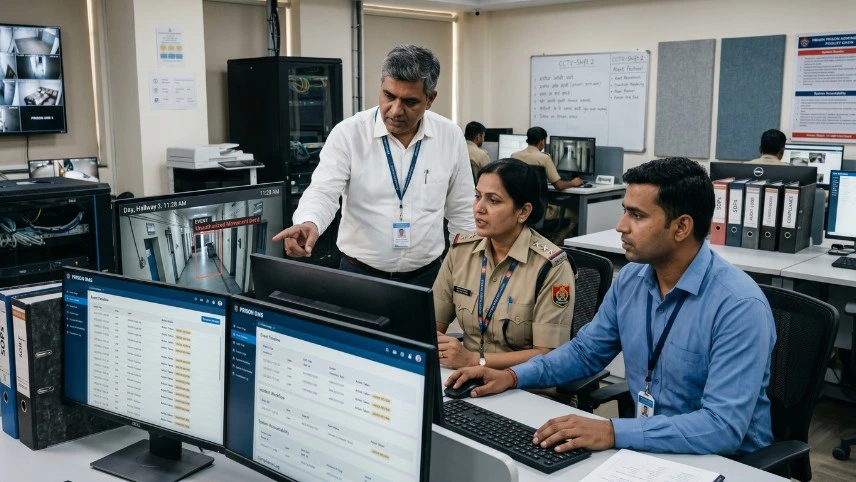
Deploying AI video analytics in prisons in India involves operational considerations specific to correctional environments. For any AI surveillance correctional facility deployment in a government institution, administrators evaluating platforms should verify:
- On-premise deployment as the default- Inmate footage routed through external cloud infrastructure creates data custody questions that on-premise or government-hosted deployment resolves. For state government facilities, this is a procurement standard most departments will require.
- Defined retention limits by footage category- Security incident footage, welfare monitoring footage, and visitor zone footage each carry different retention requirements. A system that treats all footage identically does not serve a correctional facility's differentiated needs.
- Audit trails for every footage access event- Who accessed what, when, and for what purpose must be logged automatically. This is non-negotiable for a government facility subject to RTI requests, oversight committees, and judicial scrutiny.The same principles are widely used in AI video analytics for corporate campuses and high-security facilities, where auditability and access control are operational requirements.
- Staff response protocols before deployment- AI generates alerts. Trained staff must respond. A deployment without a documented response protocol creates a system that generates alerts nobody acts on, which is worse than no system from an accountability standpoint.
- Inmate transparency- Constitutional principles of proportionality and prisoner rights under Articles 14 and 21 of the Indian Constitution support disclosing monitoring practices to the incarcerated population. A deployment that is not disclosed carries legal exposure no technology vendor can absorb.
- Vendor qualifications- Any platform deploying in a correctional environment should demonstrate prior experience in high-security institutional settings and commit to on-premise or India-resident data hosting as a contractual obligation.
The Gap Between a Recorded Incident and a Prevented One
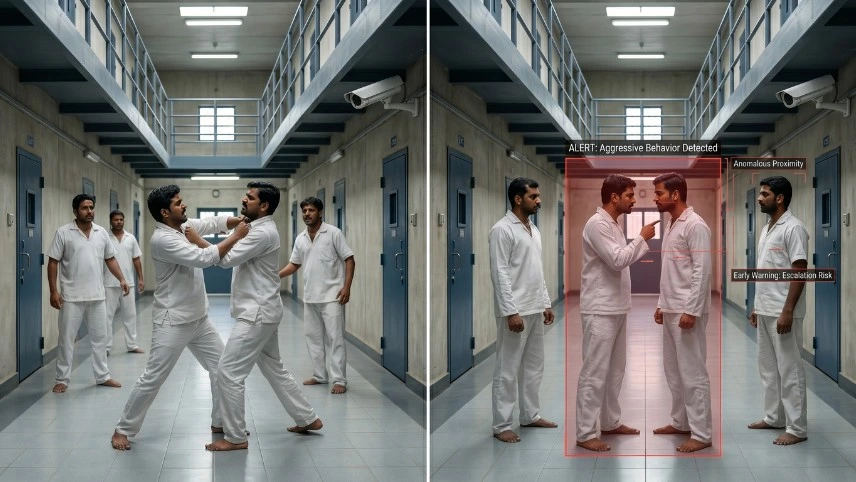
Every prison in India with a CCTV system has footage of incidents that happened. Fights that escalated. Self-harm attempts that went undetected for minutes. Contraband transactions in visitor areas. The footage exists. It was reviewed after the fact. Incident reports were filed. Review committees met. And the same events continued on the next shift.
AI prison monitoring does not add cameras to this pattern. It adds the response window that passive CCTV systematically discards: the 60 to 90 seconds between when a behavior begins and when an incident becomes an entry in a register. That window is where prevention lives. In a facility where staff vacancy rates make it structurally impossible for any guard to watch every feed simultaneously, the AI layer is the mechanism by which continuous monitoring becomes operationally possible rather than aspirationally documented.
Karnataka's 2024 tender recognized this. So did Punjab, UP, Delhi, and West Bengal. The question for every state department that has not moved is not whether the monitoring gap exists. The NCRB data has answered that. The question is what closes it.
The footage exists. The incident report was filed. The committee met.
And the same thing happened the following shift.
Book a Free Demo with Mikshi AIMonitoring Is Not Surveillance. Accountability Is Not Intrusion.
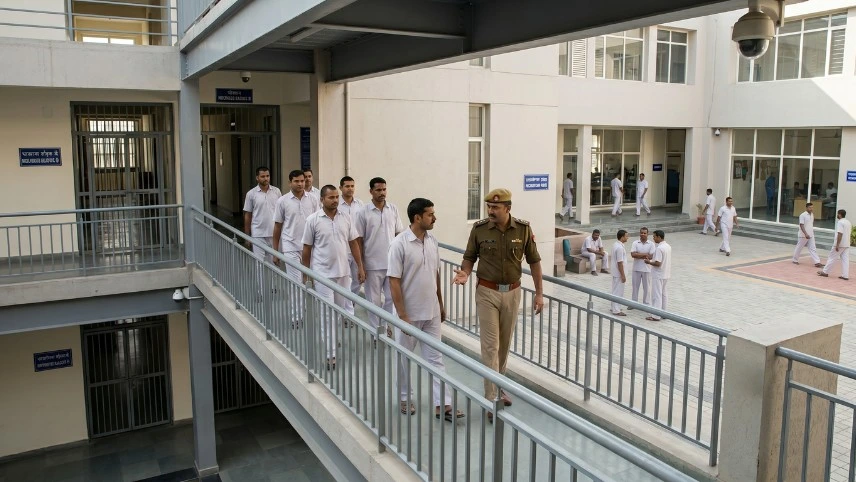
AI video analytics for prisons in India operates at the intersection of two institutional obligations that are not in conflict: security and welfare. The state has a duty to prevent violence and maintain order. It also has a constitutional duty to protect the rights and physical safety of every person in its custody, convicted or under-trial.
AI surveillance for correctional facilities, deployed responsibly, serves both. It gives understaffed facilities a monitoring capacity they cannot achieve through headcount alone. It generates the documentation that judicial oversight and administrative review require. And it creates the response window that passive recording eliminates.
The states that have moved on this are making a governance argument: that the institutions responsible for over 5.3 lakh people deserve infrastructure equal to that obligation.
Mikshi AI is built for exactly this environment. It deploys on existing camera infrastructure without hardware replacement, supports on-premise deployment to keep inmate footage within government systems, and covers the full use case stack like violence detection, self-harm alerts, contraband monitoring, restricted zone access, and welfare anomaly detection in a single deployment.Many government agencies are discovering how existing CCTV infrastructure can be upgraded with AI video analytics rather than replaced entirely.
For correctional facility administrators evaluating AI surveillance, Mikshi AI offers India-based support, India-trained models, and a deployment timeline measured in days rather than months. The monitoring gap that Karnataka, Punjab, West Bengal, and other states are actively closing is one that AI prison monitoring from a purpose-built platform can address without a long implementation runway.
The Model Prisons Act envisions technology-assisted monitoring.
Mikshi AI is built for exactly that environment.
Book a Free Demo with Mikshi AIIn this article
- The Monitoring Gap That NCRB Data Makes Undeniable
- What AI Prison Monitoring Actually Detects
- Inmate Welfare Monitoring: The Use Case That Is Rarely Discussed
- What Responsible AI Prison Monitoring Deployment Looks Like
- The Gap Between a Recorded Incident and a Prevented One
- Monitoring Is Not Surveillance. Accountability Is Not Intrusion


