AI Security Guard: How AI Video Analytics Strengthens Physical Security
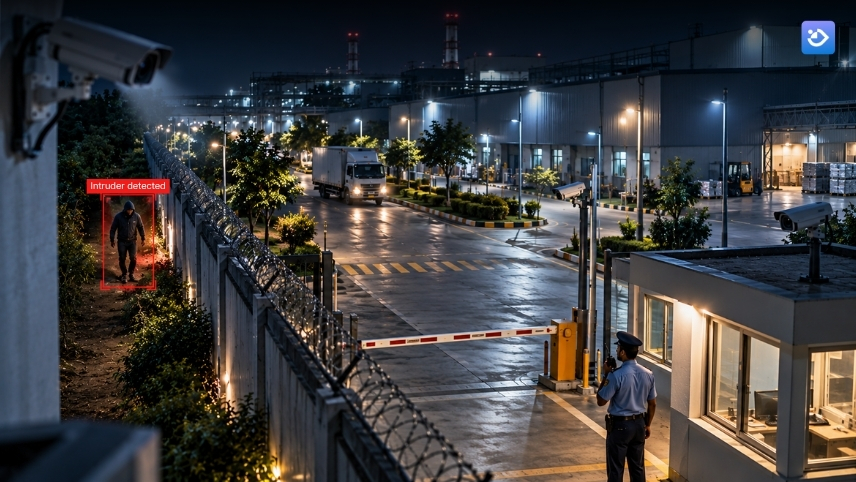
2:40 AM, a factory perimeter outside Sanand, Ahmedabad. One guard is doing rounds on the far side of the compound, torch in hand. Back in the control room, a wall of monitors is running twelve camera feeds, and eleven of them are showing exactly nothing. The twelfth has a figure near the boundary fence who was not there ten minutes ago. Nobody's watching that one right now.
This isn't really a story about a lazy or careless guard, and it never was. It's a staffing math problem nobody ever writes down on paper. How many camera feeds can a trained, paid, reasonably alert human being actually watch continuously, without something eventually getting past them? Fewer than most security budgets assume, is the short answer. Guards rotate. They take rounds. They deal with gate traffic and paperwork and the occasional argument with a delivery driver. They're human. Cameras don't blink. People do, eventually, whether they mean to or not.
That's the gap an AI security guard is built to close, and it's why the phrase has gone from vendor buzzword to something plant heads across India are actually typing into a Google search. Not a robot on patrol. Software sitting on top of cameras that are already bolted to the wall, watching every single feed at once, and pinging a human the moment something on one of those screens actually needs attention.
Why the Guard-Plus-Camera Setup is Not Enough
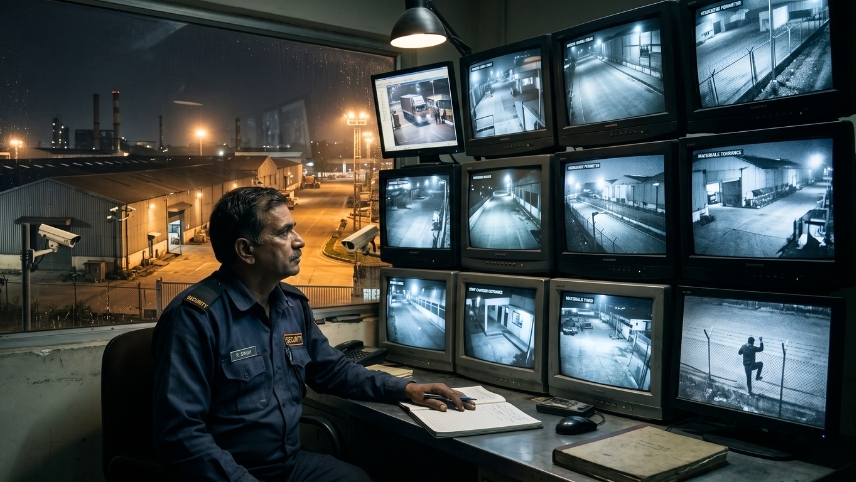
A few things tend to happen on a site like this quietly, over months: Footage gets reviewed the next morning, after whatever happened has already happened, which is a strange way to run security when you think about it. Attention narrows the longer a shift runs; that's not a character flaw; that's just what sustained attention does to anyone, guard or not. Predictable gaps open around shift handovers and tea breaks, and if someone's actually watching the site for a week before trying anything, they figure that rhythm out fast.
Throwing more guards at the problem doesn't really fix it either, and not just because of the obvious cost. India's private security workforce grew by close to 84 percent, which tells you demand for manned guarding has been climbing for years, faster than the pool of people willing to take a night shift for what most sites pay. You can hire three more guards. Each one can still only really watch a handful of screens at a time before their eyes start sliding off the wall.
A few things tend to happen on a site like this quietly, over months:
Footage gets reviewed the next morning, after whatever happened has already happened, which is a strange way to run security when you think about it. Attention narrows the longer a shift runs; that's not a character flaw; that's just what sustained attention does to anyone, guard or not. Predictable gaps open around shift handovers and tea breaks, and if someone's actually watching the site for a week before trying anything, they figure that rhythm out fast.
What an AI Security Guard Is Actually Looking For
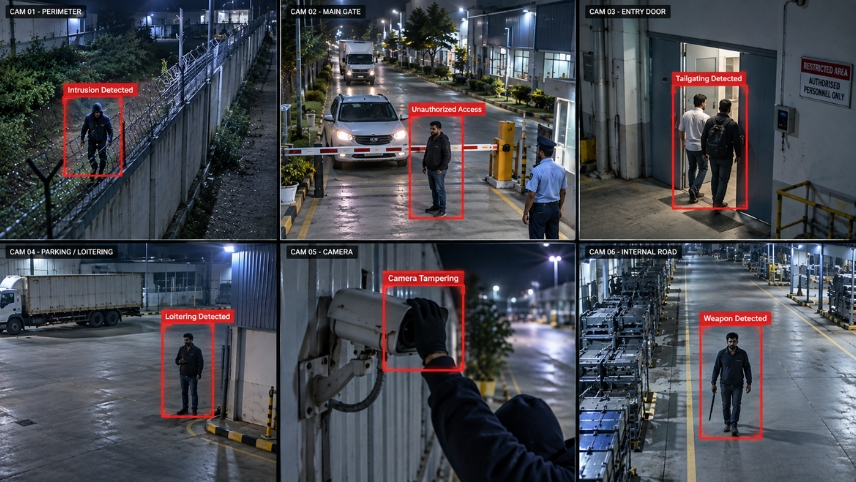
AI video surveillance doesn't swap out the camera. It rides on top of the feed that's already running and applies models trained to spot specific things that matter for physical security, then fires an alert the second one of those things shows up. That's really the whole shift here: CCTV stops being something you record and review and starts being something that's actually watching, live, all the time.
A few of the patterns this typically covers on an industrial or campus site:
Intrusion detection catches someone stepping into a restricted or no-entry zone, whether that's an after-hours factory perimeter or a fence line that's supposed to sit empty all day. At a controlled gate, unauthorized access alerts trigger when a face doesn't match the approved list, and nothing gets physically blocked; someone just gets told fast.
Tailgating is the thing access cards were never built to catch, a second person slipping in right behind an authorized entry, close enough that the door hasn't even shut. Camera tampering detection flags a feed that's suddenly covered, blurred, or nudged out of position because a blinded camera is a gap the control room might not even know exists yet.
Weapon detection works purely off what's visible in frame, a firearm or blade, and gives a security team a head start rather than a discovery after something's already happened.
Loitering and covered-face detection round out entrances and perimeters, where staying too long without explanation or hiding your face entirely is itself the thing worth a second look.
Ask a security head running a multi-gate campus what they actually want out of their cameras. It's rarely "more footage to review later." It's something that taps a person on the shoulder the second something's wrong, not the next morning while scrubbing through last night's clips over coffee.
Would your cameras actually catch a perimeter breach the second it happens, or only during tomorrow's review?
Try Mikshi AI for FREEExtending the Guard, Not Replacing Them
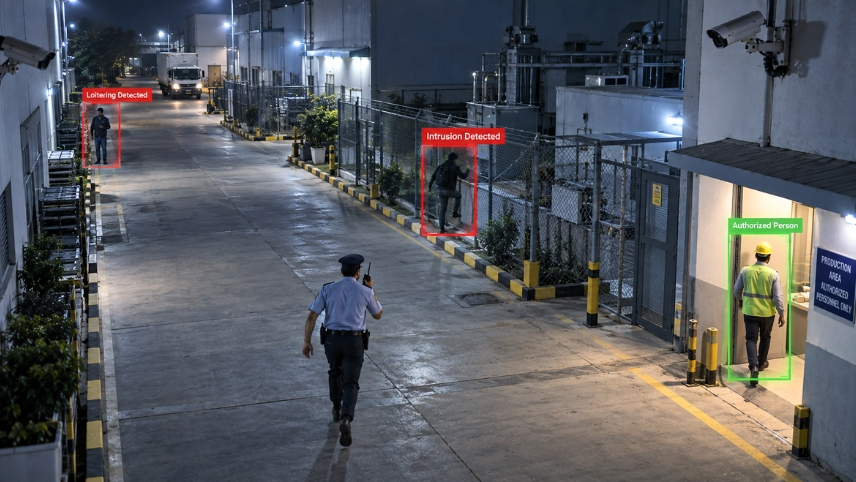
An AI security guard doesn't decide who walks through a gate. It doesn't carry legal authority, and it can't physically stop a single person from doing anything. What it changes is narrower and, honestly, more useful: the part of the job that meant staring at every camera without a lapse for eight straight hours now happens even while a guard is out doing rounds or dealing with a truck at the gate.
The system flags, the human decides. That's the whole model. Every alert from AI-based intrusion detection, or a face that doesn't match the approved list, is built for a person to check before anyone acts on it.
Guards end up spending less time locked to a static monitor wall and more time actually responding to what the system surfaces, which is a far better use of a trained person's judgment than pattern-matching pixels for eight hours straight.
Given how stretched India's private security workforce already is, getting more out of the guards already on payroll matters more than trying to out-hire a shortage that isn't closing anytime soon. Control rooms stop being a place where footage sits waiting to be reviewed and start being a place where someone can actually do something in the moment it's needed.
That distinction isn't small. A guard alerted the second a fence line gets crossed can act on it. A guard reviewing yesterday's footage can only write up what already happened.
What to Actually Check Before Buying One
Not every vendor pitching "AI" in this space is selling the same product, and a plant head who's already sat through three vague pitches this quarter has every reason to be sceptical of a fourth. A handful of questions tend to sort the real thing from the marketing deck fast.
Does it run on the cameras already installed, or does it quietly require ripping everything out and starting over?
Can it deploy on-premise, at the edge, in the cloud, or some mix, depending on what the site's IT policy actually demands?
How does it handle false alerts, because a system that cries wolf over every stray dog and passing shadow gets muted within a week and stops being worth anything.
Does the vendor say plainly that alerts need a human to check them, or do they oversell it as something that decides and acts on its own?
And is there a straight answer on data retention and worker privacy, given that face matching touches sensitive ground that deserves more than a shrug.
Fail enough of those, and what's being sold isn't really an AI security guard. It's a motion sensor with better branding.
Where Mikshi AI Fits Into All This
That guard who is alone at 2:40 AM with twelve monitors and one set of eyes is exactly the situation Mikshi AI exists to fix. Nobody's asked to tear out a working CCTV setup and start from zero. Mikshi AI sits on top of the cameras already mounted at the perimeter, the gates, the restricted zones, and turns that footage into something that's actually watched continuously instead of stored for a morning review nobody has time for anyway.
Intrusion detection, unauthorized access alerts, tailgating detection, and camera tampering detection all run across the camera infrastructure a site already has, on-premise, cloud, or hybrid, whatever the site actually needs.
Alerts land on a single dashboard, so a security team sees what happened, where, and when instead of scrubbing through hours of footage after the fact trying to reconstruct a timeline. And every alert is still built for a human to verify. Mikshi AI extends what a guard on shift is able to see. It was never meant to replace the judgment that guard brings to the job in the first place.
Your cameras were already watching. Mikshi AI just makes them think.
Every shift without real-time detection is a shift where your security depends entirely on what someone happened to notice.
Try Mikshi AI for Free


