Why Video Surveillance Looks Different in 2026?
Most enterprises already have cameras everywhere. And yet, incidents still get missed. Security teams react late. Alerts keep firing, but many of them go unanswered. The problem is not that there isn’t enough video. The problem is that the CCTV videos rarely help people decide what to do next.
According to grand view research, the global video analytics market is expected to reach USD 37.84 billion by 2030, driven by rising demand for automated, intelligent surveillance.
What the AI video surveillance trends in 2026 discussed in this blog make clear is this: surveillance is no longer about watching more screens. It is about building systems that help humans know when something actually needs attention.
What is Video Surveillance and How AI Will Change It in 2026?
Video surveillance has traditionally meant cameras that record footage for humans to watch or review later. The system captures everything, but understanding what matters still depends heavily on manual effort.
In 2026, AI changes this by adding judgment. Video systems no longer just record events. They interpret behavior, filter noise, and highlight situations that actually need human attention.
9 Key AI Video Surveillance Trends Shaping 2026
Across industries, teams are starting to hit the ceiling of traditional monitoring. Motion alerts arrive constantly. Context is missing. Over time, people begin tuning systems out, often without even realizing it.
This pressure is reshaping long-standing CCTV trends. Instead of adding more cameras or expanding control rooms, organizations are investing in intelligence layers that filter noise and surface only what truly matters. The result is quieter systems and sharper responses.
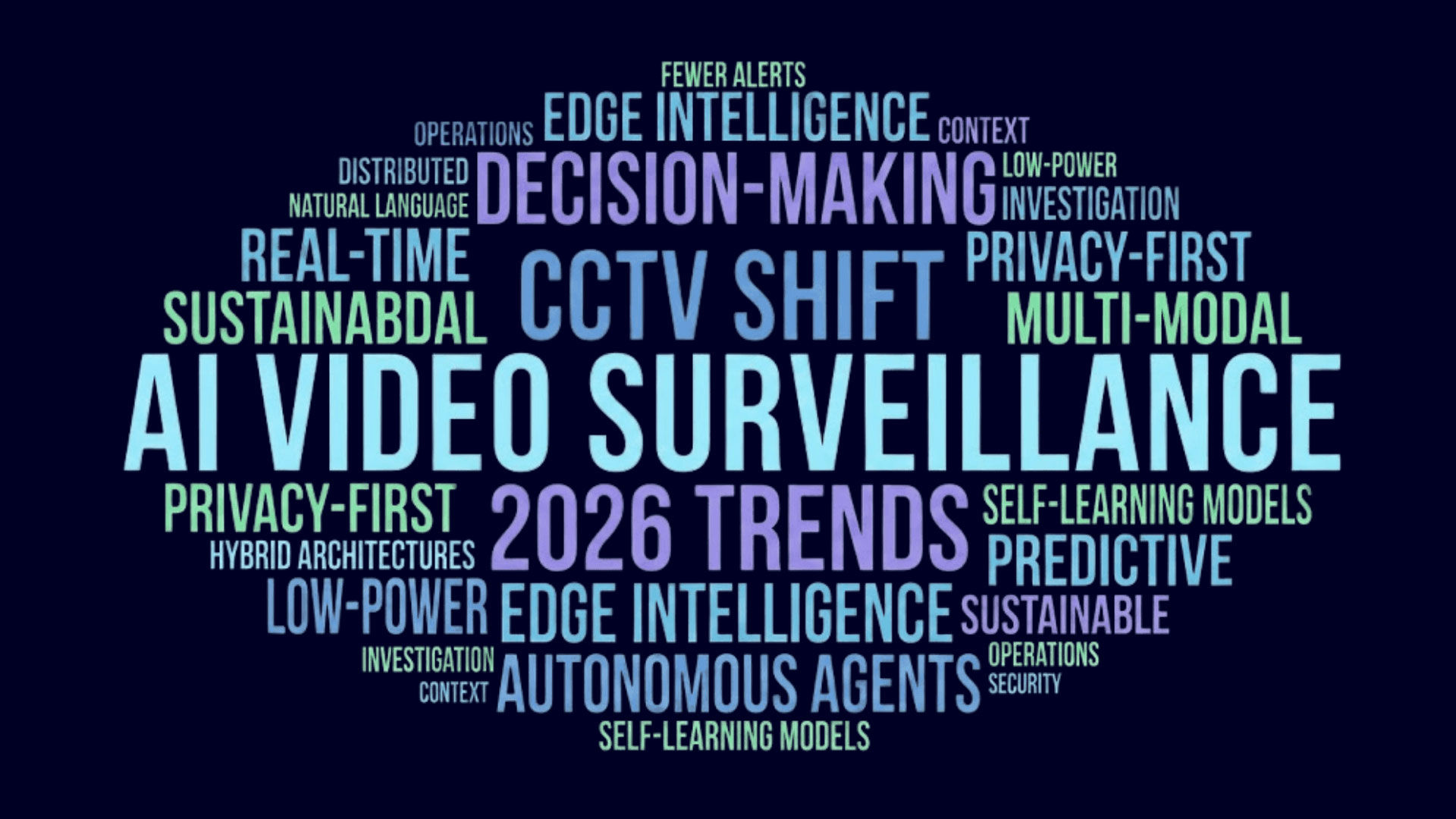
Here are the top video surveillance trends shaping 2026:
1. AI Agents as Autonomous Surveillance Decision Partners
For years, surveillance worked on a basic assumption. Something moves, an alert fires, and a human figures out whether it matters. That sounds reasonable. Until you see it running in a real facility.
Once alerts start coming every few minutes, judgment breaks down.
The issue is not detection. It is judgment. That is why video surveillance trends in 2026 are moving toward AI agents that behave less like alarms and more like decision partners.
What this looks like on the ground:
- A factory perimeter camera that ignores dogs at night but flags a person walking along the fence line
- A warehouse camera that understands forklift routes and highlights unsafe human movement
- A bank branch camera that waits to confirm after-hours presence before escalating
- A university gate camera that notices the same person lingering night after night
This is where AI security camera trends start to feel practical, not theoretical.
2. Event-Driven, Predictive Surveillance
Traditional surveillance reacts after something clearly happens. Predictive systems pay attention earlier, when behavior starts drifting toward risk.
This difference matters because alert overload changes how people behave.
The reason is simple. When alerts never stop, people stop responding. In fact, a recent industry survey published on MSSP market news shows that 62% of security alerts are ignored because teams are overwhelmed by volume. When systems create more noise than insight, real incidents get lost in the background.
What this looks like on the ground:
- A metro station camera noticing crowd buildup near stairways before congestion turns unsafe
- A logistics yard flagging trucks circling high-value docks outside delivery windows
- A hospital corridor system spotting movement patterns linked to fall risk
- A retail store camera noticing repeated pacing near billing counters
Fewer alerts. Better timing. And alerts that actually get taken seriously.
3. Hybrid and Distributed AI Surveillance Architectures
Sending every video stream to a central server sounds neat in diagrams. In practice, it slows everything down. Networks get congested. Alerts arrive late. Costs go up.
Hybrid and distributed architectures split the work. Urgent decisions happen close to the camera. Summaries and trends still flow back centrally. This has become a core part of modern cloud-based AI video surveillance, especially once deployments grow beyond a single site.
What this looks like on the ground:
- A manufacturing plant where safety alerts trigger locally while reports sync centrally
- A multi-city bank detecting ATM tampering on-site and reviewing incidents at HQ
- A retail chain is catching theft in-store while analyzing footfall centrally
- A city detecting traffic violations at intersections with central oversight
The system stays fast without losing the bigger picture.
4. Edge Intelligence for Instant, On-Camera Decisions
When response time matters, sending video elsewhere to think about it becomes a risk. In real facilities, seconds matter.
Edge intelligence brings decision-making closer to the camera itself. That way, actions happen where events unfold. This has become foundational to modern AI CCTV analytics software, especially in safety-critical environments.
What this looks like on the ground:
- A refinery camera alerting the moment a worker crosses into a live zone
- A power plant camera warns when someone gets too close to moving machinery
- A warehouse camera integrated with IoT sensors stops a conveyor as soon as a restricted area is breached
- A construction site camera flagging helmet violations locally
When networks slow down, these systems keep working.
5. Sustainable, Low-Power AI Surveillance Systems
As deployments grow, energy use becomes impossible to ignore. Running intelligence all day should not mean bigger power bills or overloaded server rooms.
This is why sustainability is shaping video surveillance trends 2026. Smarter systems analyze only what matters and avoid unnecessary data movement.
What this looks like on the ground:
- Solar-powered perimeter cameras at remote logistics yards
- Airports using schedule-aware analytics that scale down processing during low-traffic hours
- Hospitals enabling motion-triggered analytics to avoid constant video processing
- Warehouses reducing server load by processing video locally
Efficiency is what makes scale realistic.
6. Privacy-First, Regulation-Native Video Surveillance
Privacy is no longer optional. Systems that ignore it struggle to gain trust.
Surveillance platforms built for 2026 treat regulation as a starting point. They minimize exposure, store less by default, and control access carefully.
What this looks like on the ground:
- Office cameras mask employee identities during normal operations
- Hospitals storing identifiable footage only when incidents occur
- City cameras blurring pedestrians unless enforcement is needed
- Schools limiting footage access based on role
Trust determines whether systems actually get used.
7. Natural Language Driven Video Investigation
Investigations should not feel like forensic work. Most teams just want quick answers.
Natural language interfaces let people search video the way they do on ChatGPT, Gemini, or Google. This is becoming central to AI video surveillance trends because systems adapt to human behavior, not the other way around.
What this looks like on the ground:
Instead of scrolling through a complicated dashboard interface, the security personnel can just type phrases like:
- “People near gate 3 after midnight”
- “Vehicles parked near fire exits for over 15 minutes”
- “Entries into chemical zones after shift end”
- “Covered faces at ATMs last weekend”
When searching feels natural, investigations move faster.
8. Multi-modal Surveillance Intelligence
Video alone rarely explains the full story. Context comes from connecting systems.
Multi-modal surveillance combines video with access logs, sensors, and operational data. This matters most in large remote monitoring security systems, where operators need confirmation before acting.
What this looks like on the ground:
- Card swipes matched with camera footage in data centers
- Traffic signals paired with visual violations in cities
- RFID data linked to video in warehouses
- Baggage alerts confirmed visually at airports
Better context leads to better decisions.
9. Self-Learning Site-Specific AI Models
No site behaves the same way forever. Lighting shifts. Equipment moves. Animals wander through.
Self-learning systems adapt quietly over time. They stop flagging what is normal and focus on what is not.
What this looks like on the ground:
- A plant camera learning robotic arm movement
- A campus system adapting to animal crossings
- A retail store adjusting to glass reflections
- A warehouse adapting to seasonal light changes
This is where intelligence improves through experience.
From CCTV Systems to Decision Infrastructure
The biggest shift in video surveillance trends 2026 is operational, not technical. Surveillance is no longer judged by how much footage it records, but by how reliably it helps teams make the right call at the right time. This reflects broader CCTV trends, where intelligence matters more than adding more cameras or screens.
Mikshi AI, as an AI CCTV analytics software, fits directly into this shift. It sits on top of existing CCTV systems and turns passive video into real-time decisions for safety, security, and operations without forcing infrastructure changes.
What Mikshi AI enables:
- Converts existing cameras into an intelligent decision layer
- Reduces false alerts so teams stay responsive to real incidents
- Works across on-premise, cloud, or hybrid setups based on compliance needs
- Scales reliably across factories, banks, campuses, and city deployments
Same cameras. Same sites. Clearer decisions.
In this article
- Why Video Surveillance Looks Different in 2026?
- What is Video Surveillance and how AI will change it in 2026?
- Key AI Video Surveillance Trends Shaping 2026
- 1. AI Agents as Autonomous Surveillance Decision Partners
- 2. Event-Driven, Predictive Surveillance
- 3. Hybrid and Distributed AI Surveillance Architectures
- 4. Edge Intelligence for Instant, On-Camera Decisions
- 5. Sustainable, Low-Power AI Surveillance Systems
- 6. Privacy-First, Regulation-Native Video Surveillance
- 7. Natural Language Driven Video Investigation
- 8. Multi-modal Surveillance Intelligence
- 9. Self-Learning Site-Specific AI Models
- From CCTV Systems to Decision Infrastructure


